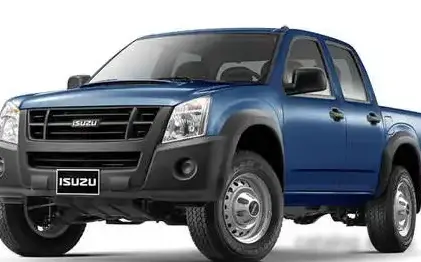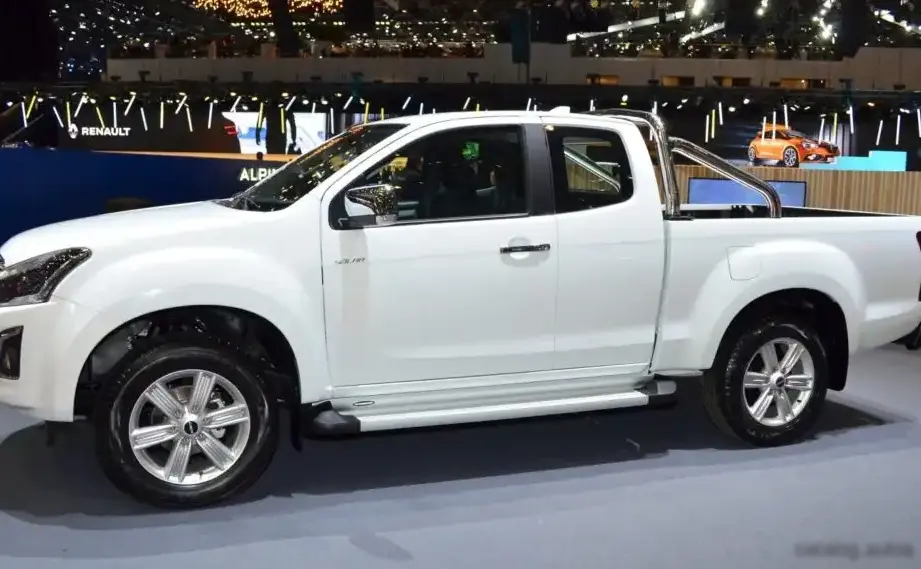
The Isuzu D-Max II, specifically the facelifted version introduced in 2017, represented a significant update to Isuzu’s popular mid-size pickup truck. This iteration of the D-Max, sold from 2017 to 2020, aimed to refine the existing platform with updated styling, improved technology, and enhanced efficiency. The 1.9-liter turbocharged diesel engine paired with a six-speed automatic transmission was a key variant within the D-Max II range, positioned as a balance between capability, fuel economy, and ease of use. It served as a popular choice for both commercial and private buyers seeking a versatile and reliable workhorse, particularly in markets outside of North America where the D-Max was more widely available.
Technical Specifications
| Brand | Isuzu |
| Model | D-Max |
| Generation | D-Max II (facelift 2017) |
| Type (Engine) | 1.9 (164 Hp) Automatic |
| Start of production | 2017 |
| End of production | 2020 |
| Powertrain Architecture | Internal Combustion engine |
| Body type | Pick-up |
| Seats | 5 |
| Doors | 4 |
| Fuel consumption (urban) | 9.3 l/100 km (25.3 US mpg) |
| Fuel consumption (extra urban) | 6.9 l/100 km (34.1 US mpg) |
| Fuel consumption (combined) | 7.8 l/100 km (30.2 US mpg) |
| CO2 emissions | 205 g/km |
| Fuel Type | Diesel |
| Acceleration 0 – 100 km/h | 13 sec |
| Acceleration 0 – 62 mph | 13 sec |
| Acceleration 0 – 60 mph | 12.4 sec |
| Maximum speed | 180 km/h (111.85 mph) |
| Emission standard | Euro 6 |
| Weight-to-power ratio | 11.9 kg/Hp |
| Weight-to-torque ratio | 5.4 kg/Nm |
| Power | 164 Hp @ 3600 rpm |
| Torque | 360 Nm @ 2000-2500 rpm (265.52 lb.-ft.) |
| Engine Model/Code | RZ4E-TC |
| Engine displacement | 1898 cm3 (115.82 cu. in.) |
| Number of cylinders | 4 |
| Engine configuration | Inline |
| Cylinder Bore | 80 mm (3.15 in.) |
| Piston Stroke | 94.4 mm (3.72 in.) |
| Compression ratio | 15.9:1 |
| Number of valves per cylinder | 2 |
| Fuel injection system | Diesel Commonrail |
| Engine aspiration | Turbocharger, Intercooler |
| Engine oil capacity | 6.6 l (6.97 US qt | 5.81 UK qt) |
| Kerb Weight | 1959 kg (4318.86 lbs.) |
| Max. weight | 3050 kg (6724.1 lbs.) |
| Max load | 1091 kg (2405.24 lbs.) |
| Fuel tank capacity | 76 l (20.08 US gal | 16.72 UK gal) |
| Permitted trailer load with brakes (12%) | 3500 kg (7716.18 lbs.) |
| Permitted trailer load without brakes | 750 kg (1653.47 lbs.) |
| Permitted towbar download | 245 kg (540.13 lbs.) |
| Length | 5295 mm (208.46 in.) |
| Width | 1860 mm (73.23 in.) |
| Height | 1795-1870 mm (70.67 – 73.62 in.) |
| Wheelbase | 3095 mm (121.85 in.) |
| Front track | 1570 mm (61.81 in.) |
| Rear track | 1570 mm (61.81 in.) |
| Ride height (ground clearance) | 235 mm (9.25 in.) |
| Approach angle | 30° |
| Departure angle | 23° |
| Ramp-over angle | 22° |
| Drive wheel | All wheel drive (4×4) |
| Number of gears | 6 |
| Gearbox type | Automatic transmission |
| Front brakes | Ventilated discs |
| Rear brakes | Drum |
| Assisting systems | ABS (Anti-lock braking system) |
| Tires size | 255/60 R18 |
| Wheel rims size | 7.0J x 18 |
Powertrain & Engine Architecture
The heart of this D-Max variant is the RZ4E-TC 1.9-liter inline-four cylinder diesel engine. This engine represented a move towards downsizing and improved efficiency compared to the previous 2.5-liter engine offered in earlier D-Max models. The RZ4E-TC utilizes a cast iron block and aluminum cylinder head, a common configuration for durability and weight reduction. It features a single turbocharger with an intercooler to boost power and torque. The fuel injection system is a common rail direct injection system, allowing for precise fuel delivery and optimized combustion. The engine produces 164 horsepower at 3600 rpm and 360 Nm (265.52 lb-ft) of torque between 2000 and 2500 rpm. This torque band is particularly useful for towing and hauling. The six-speed automatic transmission is a conventional torque converter type, providing smooth shifts and ease of operation. While not the sportiest transmission, it was well-suited to the D-Max’s intended purpose.
Driving Characteristics
The 1.9-liter automatic D-Max offers a comfortable and capable driving experience. Acceleration is adequate, with a 0-60 mph time of around 12.4 seconds, but it’s not designed for outright speed. The automatic transmission prioritizes smooth shifts and fuel efficiency over aggressive performance. The torque converter provides a good level of low-end grunt, making it easy to pull away from a standstill or navigate challenging terrain. Compared to the manual transmission versions of the 1.9, the automatic sacrifices some responsiveness, but gains in convenience. Higher output versions of the D-Max, such as those with more powerful engines, offered significantly quicker acceleration and a more engaging driving experience, but at the cost of fuel economy. The automatic transmission’s gear ratios are tuned for practicality, providing sufficient power for highway cruising and off-road driving.
Equipment & Trim Levels
The 1.9-liter automatic D-Max typically came equipped with a reasonable level of standard features. These often included air conditioning, power windows and locks, a basic audio system with Bluetooth connectivity, and alloy wheels. Higher trim levels added features such as a touchscreen infotainment system, navigation, leather upholstery, and a reversing camera. Safety features such as ABS brakes, electronic stability control, and multiple airbags were standard across the range. Optional extras could include a tow bar, bed liner, and various styling accessories.
Chassis & Braking
The D-Max II utilizes a body-on-frame construction, providing a robust and durable platform for demanding applications. The suspension consists of independent double wishbones at the front and leaf springs at the rear. This setup provides a good balance between ride comfort and load-carrying capacity. The braking system features ventilated discs at the front and drum brakes at the rear. While the drum brakes at the rear were a cost-saving measure, they provided adequate stopping power for most driving conditions. The 4×4 system offers selectable four-wheel drive, allowing the driver to switch between two-wheel drive and four-wheel drive modes as needed.
Market Reception & Comparison
The 1.9-liter automatic D-Max was generally well-received by critics as a practical and efficient pickup truck. It was praised for its fuel economy, comfortable ride, and reliable powertrain. However, some reviewers noted that the engine could feel underpowered when fully loaded or driving uphill. Compared to other pickups in its class, such as the Toyota Hilux and Nissan Navara, the D-Max offered a competitive combination of features, performance, and price. The automatic transmission was seen as a convenient option for drivers who preferred not to operate a manual gearbox.
Legacy
The Isuzu D-Max II 1.9-liter automatic has proven to be a reliable and durable vehicle in the used car market. The RZ4E-TC engine is known for its longevity, and the automatic transmission is generally trouble-free. However, as with any diesel engine, regular maintenance is essential to ensure long-term reliability. The D-Max II continues to be a popular choice for buyers seeking a capable and affordable pickup truck, and the 1.9-liter automatic variant remains a viable option for those who prioritize fuel efficiency and ease of use.