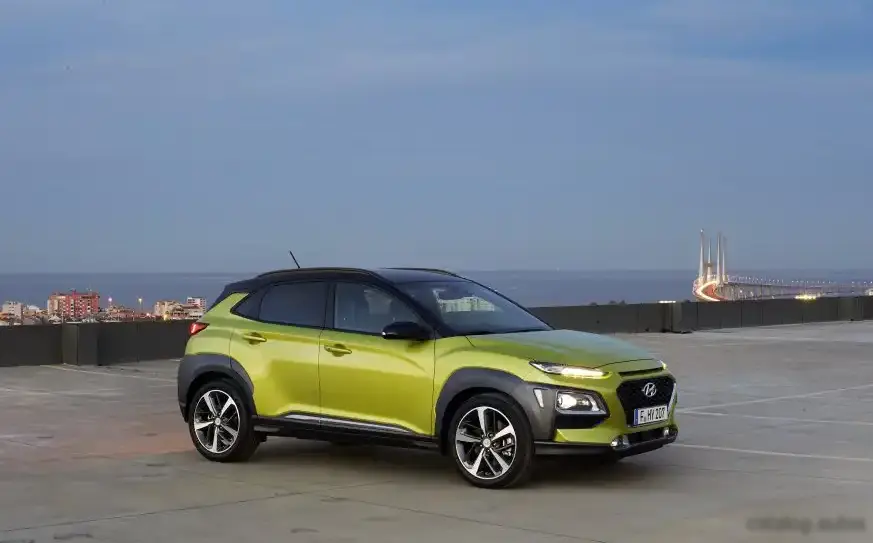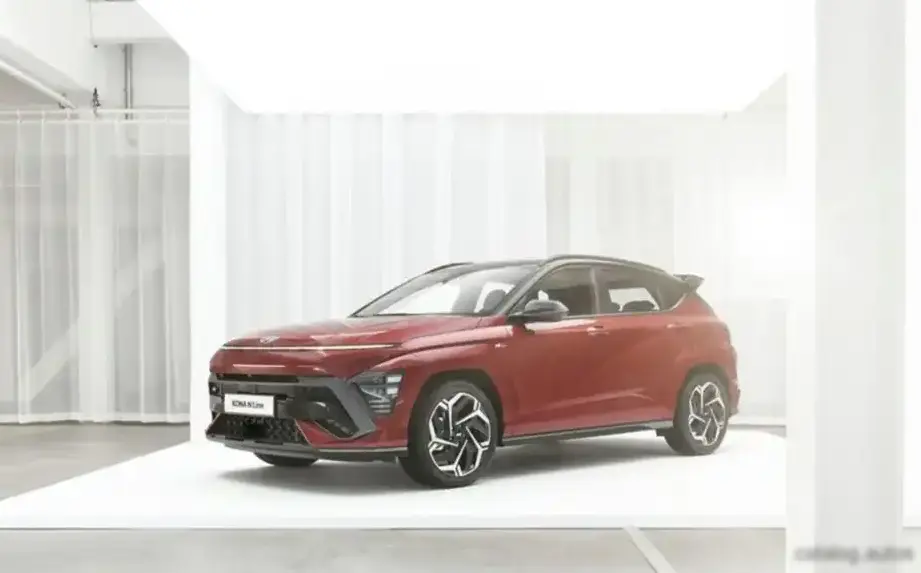
The Hyundai Kona II 1.6 T-GDI (180 hp) AWD DCT represents a significant offering within the second generation of Hyundai’s popular subcompact SUV, launched in August 2025. Positioned as a mid-range to upper-mid-range trim, this variant balances performance with practicality, appealing to buyers seeking all-weather capability and a more engaging driving experience than the base engine options. It builds upon the foundation of the PF3 platform, shared with other Hyundai and Kia models, and aims to compete with established players in the competitive subcompact SUV segment like the Mazda CX-5, Honda HR-V, and Toyota Corolla Cross.
Technical Specifications
| Brand | Hyundai |
| Model | Kona |
| Generation | Kona II |
| Type (Engine) | 1.6 T-GDI (180 Hp) AWD DCT |
| Start of production | August, 2025 |
| Powertrain Architecture | Internal Combustion engine |
| Body type | SUV |
| Seats | 5 |
| Doors | 5 |
| Combined fuel consumption (WLTP) | 7.0 l/100 km (33.6 US mpg, 40.4 UK mpg, 14.3 km/l) |
| CO2 emissions (WLTP) | 163-164 g/km |
| Fuel Type | Petrol (Gasoline) |
| Acceleration 0 – 100 km/h | 8.4 sec |
| Acceleration 0 – 62 mph | 8.4 sec |
| Acceleration 0 – 60 mph | 8 sec |
| Maximum speed | 209 km/h (129.87 mph) |
| Emission standard | Euro 6e-bis |
| Weight-to-power ratio | 8.1 kg/Hp, 122.9 Hp/tonne |
| Weight-to-torque ratio | 5.5 kg/Nm, 180.9 Nm/tonne |
| Power | 180 Hp @ 6000 rpm |
| Power per litre | 112.6 Hp/l |
| Torque | 265 Nm @ 1500-4500 rpm (195.45 lb.-ft. @ 1500-4500 rpm) |
| Engine layout | Front, Transverse |
| Engine Model/Code | G4FP |
| Engine displacement | 1598 cm3 (97.52 cu. in.) |
| Number of cylinders | 4 |
| Engine configuration | Inline |
| Cylinder Bore | 75.6 mm (2.98 in.) |
| Piston Stroke | 89 mm (3.5 in.) |
| Number of valves per cylinder | 4 |
| Fuel injection system | Direct injection |
| Engine aspiration | Turbocharger, Intercooler |
| Engine oil capacity | 4.8 l (5.07 US qt | 4.22 UK qt) |
| Coolant | 8.6 l (9.09 US qt | 7.57 UK qt) |
| Kerb Weight | 1465-1590 kg (3229.77 – 3505.35 lbs.) |
| Max. weight | 2015 kg (4442.31 lbs.) |
| Max load | 425-550 kg (936.96 – 1212.54 lbs.) |
| Trunk (boot) space – minimum | 466 l (16.46 cu. ft.) |
| Trunk (boot) space – maximum | 1300 l (45.91 cu. ft.) |
| Fuel tank capacity | 47 l (12.42 US gal | 10.34 UK gal) |
| Max. roof load | 100 kg (220.46 lbs.) |
| Permitted trailer load with brakes (12%) | 1310 kg (2888.06 lbs.) |
| Permitted trailer load without brakes | 600 kg (1322.77 lbs.) |
| Permitted towbar download | 80 kg (176.37 lbs.) |
| Length | 4350 mm (171.26 in.) |
| Width | 1825 mm (71.85 in.) |
| Height | 1585 mm (62.4 in.) |
| Wheelbase | 2660 mm (104.72 in.) |
| Front track | 1591 mm (62.64 in.) |
| Rear (Back) track | 1600 mm (62.99 in.) |
| Ride height (ground clearance) | 170 mm (6.69 in.) |
| Drivetrain Architecture | The Internal combustion engine (ICE) drives the front wheels permanently, and the rear wheels are driven through an electrically or mechanically operated clutch if necessary. |
| Drive wheel | All wheel drive (4×4) |
| Number of gears and type of gearbox | 7 gears, automatic transmission DCT |
| Front suspension | Independent type McPherson |
| Rear suspension | Torsion |
| Front brakes | Ventilated discs |
| Rear brakes | Disc |
| Assisting systems | ABS (Anti-lock braking system) |
| Steering type | Steering rack and pinion |
| Power steering | Electric Steering |
| Tires size | 215/55 R18 |
| Wheel rims size | 7.0J x 18 |
INTRODUCTION
The Hyundai Kona II 1.6 T-GDI AWD DCT, introduced in August 2025, is a key variant within the second-generation Kona (internal designation: Kona II). This model year represents a significant redesign of the Kona, moving to a more mature and sophisticated design language while expanding interior space and incorporating the latest in Hyundai’s technology. The 1.6 T-GDI AWD DCT trim is positioned as a compelling option for buyers prioritizing all-wheel drive capability, a responsive turbocharged engine, and the convenience of a dual-clutch transmission. It slots above the base 1.0 T-GDI models and below the fully electric Kona Electric, offering a balance between fuel efficiency and performance.
Powertrain & Engine Architecture
At the heart of this Kona variant lies Hyundai’s G4FP 1.6-liter turbocharged gasoline direct injection (T-GDI) engine. This engine is part of Hyundai-Kia’s “Smartstream” engine family, designed for improved efficiency and reduced emissions. The G4FP utilizes a direct injection system, delivering fuel directly into the combustion chamber for precise control and enhanced power output. It also features a single-scroll turbocharger with an intercooler, boosting power and torque. The engine produces 180 horsepower at 6000 rpm and 265 Nm (195.45 lb-ft) of torque between 1500 and 4500 rpm. The engine employs a four-valve-per-cylinder configuration and a timing chain for durability. Paired with this engine is a 7-speed dual-clutch transmission (DCT). This DCT provides quick and smooth gear changes, contributing to a more engaging driving experience compared to a traditional automatic transmission. The all-wheel-drive system operates by primarily driving the front wheels, with the rear wheels engaging automatically when traction is lost, enhancing stability in various driving conditions.
Driving Characteristics
The 1.6 T-GDI AWD DCT Kona delivers a noticeably more spirited driving experience than the base 1.0-liter engine. Acceleration from 0-60 mph takes approximately 8 seconds, and 0-100 km/h in 8.4 seconds, making it competitive within its class. The DCT provides crisp shifts, and the turbocharger provides a readily available boost of power. While not a sports SUV, the Kona 1.6 T-GDI offers sufficient power for confident highway merging and overtaking. The all-wheel-drive system provides enhanced grip and stability, particularly in inclement weather. The DCT’s gear ratios are tuned for a balance of acceleration and fuel efficiency. Compared to manual transmission versions (if offered in some markets), the DCT prioritizes convenience and ease of use, though some drivers may prefer the more direct control of a manual gearbox.
Equipment & Trim Levels
The 1.6 T-GDI AWD DCT trim typically includes a generous level of standard equipment. This often includes features such as automatic climate control, a touchscreen infotainment system with Apple CarPlay and Android Auto compatibility, a rearview camera, and a suite of advanced driver-assistance systems (ADAS) like lane-keeping assist, forward collision avoidance assist, and adaptive cruise control. Interior upholstery is typically cloth or a combination of cloth and leatherette, depending on optional packages. Higher trim levels may offer features like a larger touchscreen display, a premium sound system, heated and ventilated front seats, and a panoramic sunroof. Exterior features often include alloy wheels, LED headlights, and roof rails.
Chassis & Braking
The Kona II utilizes a McPherson strut front suspension and a torsion beam rear suspension. This setup provides a good balance of ride comfort and handling. The all-wheel-drive system adds weight, but the suspension is tuned to compensate, maintaining a relatively stable and controlled ride. Braking duties are handled by ventilated discs at the front and solid discs at the rear. The Kona is equipped with ABS (Anti-lock Braking System) and electronic stability control as standard safety features. Steering is provided by an electric power steering system, offering a light and responsive feel.
Market Reception & Comparison
The Hyundai Kona II 1.6 T-GDI AWD DCT has been generally well-received by automotive critics. Reviewers praise its stylish design, spacious interior, and engaging driving dynamics. The combination of the turbocharged engine and all-wheel drive is seen as a significant advantage in the subcompact SUV segment. Fuel economy is competitive, averaging around 7.0 l/100 km (33.6 US mpg). Compared to the base 1.0 T-GDI models, the 1.6 T-GDI offers a substantial performance upgrade, while the AWD system provides added confidence in challenging driving conditions. Compared to the Kona Electric, the 1.6 T-GDI offers a lower purchase price but lacks the zero-emission benefits of an electric vehicle.
Legacy
The G4FP engine and the 7-speed DCT have proven to be relatively reliable powertrains in other Hyundai and Kia models. Long-term reliability is expected to be good, provided that regular maintenance is performed. The Kona II, in general, is expected to hold its value well in the used car market due to its attractive design, practical features, and strong brand reputation. The 1.6 T-GDI AWD DCT variant is likely to be a popular choice among used car buyers seeking a well-rounded and capable subcompact SUV.