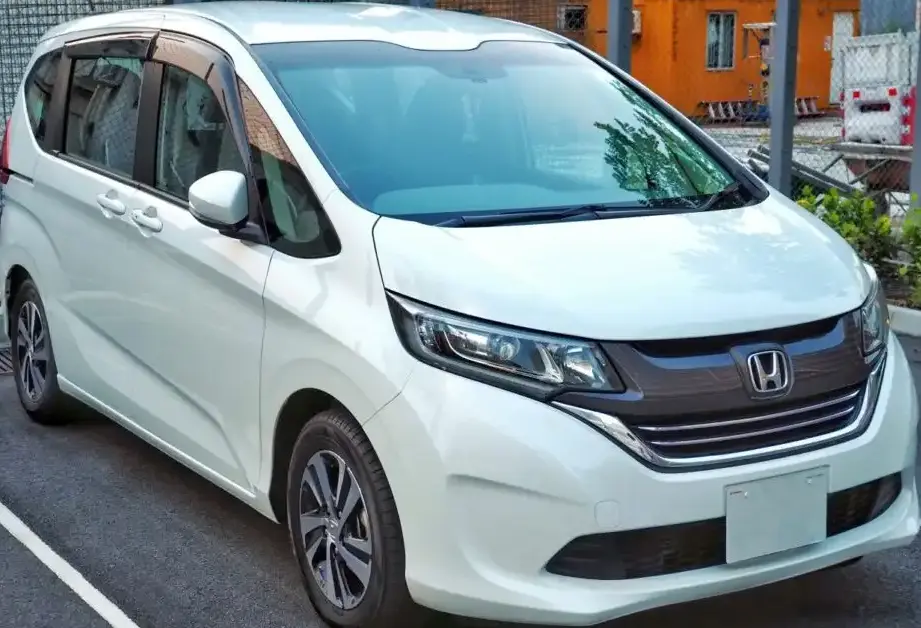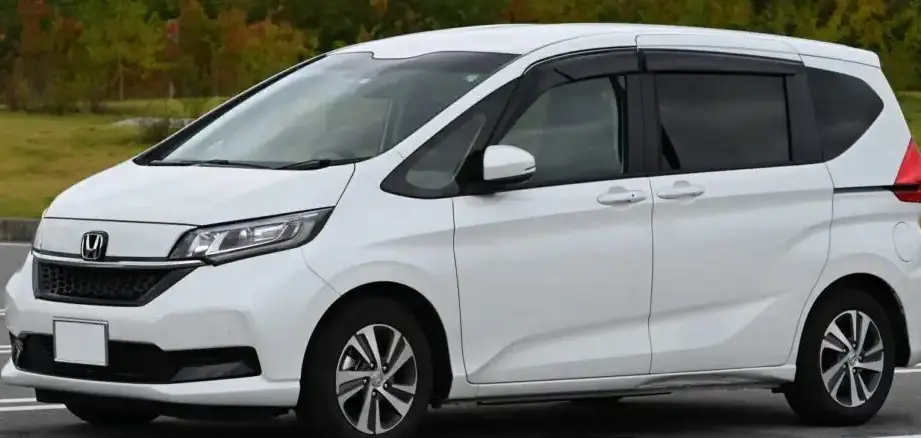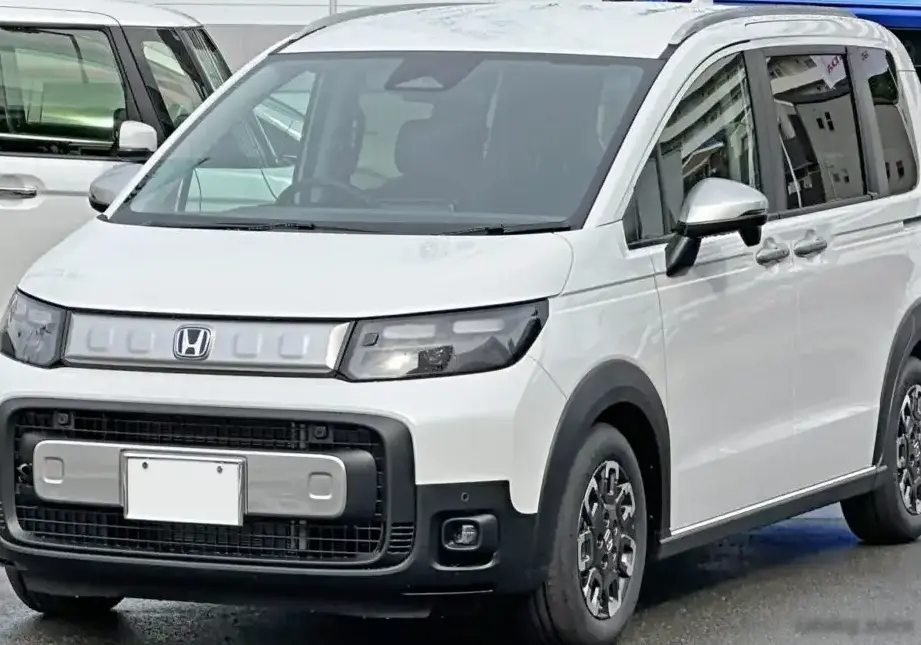
The Honda Freed III 1.5 (118 hp) CVT, introduced in June 2024, represents the latest iteration of Honda’s compact multi-purpose vehicle (MPV), primarily aimed at the Japanese domestic market (JDM). Positioned as a practical and family-oriented vehicle, the Freed III continues Honda’s tradition of maximizing interior space within a relatively small footprint. This specific 1.5-liter variant, paired with a Continuously Variable Transmission (CVT), serves as a mainstream offering within the Freed lineup, balancing affordability with reasonable performance and fuel efficiency. It builds upon the foundation of the second-generation Freed (GB5/GB6), utilizing an updated platform and incorporating modern convenience features. The Freed is not officially sold in the United States.
Technical Specifications
| Brand | Honda |
| Model | Freed |
| Generation | Freed III |
| Type (Engine) | 1.5 (118 Hp) CVT |
| Start of production | June, 2024 |
| Powertrain Architecture | Internal Combustion engine |
| Body type | MPV |
| Seats | 6-7 |
| Doors | 5 |
| Fuel consumption (economy) – urban (WLTC) | 8.2-8.3 l/100 km (28.7 – 28.3 US mpg) |
| Fuel consumption (economy) – extra urban (WLTC) | 5.3-5.4 l/100 km (44.4 – 43.6 US mpg) |
| Fuel consumption (economy) – combined (WLTC) | 6.1-6.2 l/100 km (38.6 – 37.9 US mpg) |
| Fuel Type | Petrol (Gasoline) |
| Weight-to-power ratio | 11.6 kg/Hp, 86.1 Hp/tonne |
| Weight-to-torque ratio | 9.6 kg/Nm, 103.6 Nm/tonne |
| Power | 118 Hp @ 6600 rpm |
| Power per litre | 78.9 Hp/l |
| Torque | 142 Nm @ 4300 rpm (104.73 lb.-ft. @ 4300 rpm) |
| Engine layout | Front, Transverse |
| Engine Model/Code | L15D |
| Engine displacement | 1496 cm3 (91.29 cu. in.) |
| Number of cylinders | 4 |
| Engine configuration | Inline |
| Cylinder Bore | 73 mm (2.87 in.) |
| Piston Stroke | 89.4 mm (3.52 in.) |
| Compression ratio | 10.6:1 |
| Number of valves per cylinder | 4 |
| Fuel injection system | Direct injection |
| Engine aspiration | Naturally aspirated engine |
| Valvetrain | DOHC, i-VTEC |
| Engine systems | Start & Stop System |
| Kerb Weight | 1370-1440 kg (3020.33 – 3174.66 lbs.) |
| Fuel tank capacity | 42 l (11.1 US gal | 9.24 UK gal) |
| Length | 4310 mm (169.69 in.) |
| Width | 1695-1720 mm (66.73 – 67.72 in.) |
| Height | 1755 mm (69.09 in.) |
| Wheelbase | 2740 mm (107.87 in.) |
| Front track | 1480 mm (58.27 in.) |
| Rear (Back) track | 1485 mm (58.46 in.) |
| Ride height (ground clearance) | 135 mm (5.31 in.) |
| Minimum turning circle (turning diameter) | 10.4 m (34.12 ft.) |
| Drivetrain Architecture | The Internal combustion engine (ICE) drives the front wheels of the vehicle. |
| Drive wheel | Front wheel drive |
| Number of gears and type of gearbox | automatic transmission CVT |
| Front suspension | Independent, type McPherson with coil spring and anti-roll bar |
| Rear suspension | Coil spring, Torsion |
| Front brakes | Ventilated discs |
| Rear brakes | Disc |
| Assisting systems | ABS (Anti-lock braking system) |
| Steering type | Steering rack and pinion |
| Power steering | Electric Steering |
| Tires size | 185/65 R15 88S |
| Wheel rims size | 6J x 15 |
Introduction
The Honda Freed III 1.5 CVT is a five-door MPV designed to cater to the needs of families requiring flexible seating and ample cargo space. Introduced in 2024, it represents the third generation of the Freed, building upon the success of its predecessors in the Japanese market. The Freed distinguishes itself with its low floor and sliding rear doors, facilitating easy access, particularly in tight parking situations. The 1.5-liter engine and CVT combination is a core offering, providing a balance between fuel economy and usability for everyday driving. It’s available in both 6 and 7-seat configurations, making it a versatile option for various family sizes.
Powertrain & Engine Architecture
At the heart of the Freed III 1.5 CVT lies the L15D engine, a 1.5-liter inline-four cylinder gasoline engine. This engine utilizes Honda’s direct injection technology to improve fuel efficiency and power delivery. The engine features a double overhead camshaft (DOHC) valvetrain with Honda’s intelligent Variable Valve Timing and Lift Electronic Control (i-VTEC) system, optimizing valve timing for both low-end torque and high-rpm power. The engine produces 118 horsepower at 6600 rpm and 142 Nm (104.73 lb-ft) of torque at 4300 rpm.
The engine is paired with a Continuously Variable Transmission (CVT). Honda’s G-Design CVT is known for its smooth operation and efficiency. Unlike traditional automatic transmissions with fixed gear ratios, a CVT provides a virtually infinite number of ratios within its range, allowing the engine to operate at its most efficient point. This contributes to the Freed’s respectable fuel economy figures. The CVT is programmed for smooth acceleration and prioritizes fuel efficiency over sporty responsiveness.
Driving Characteristics
The Freed III 1.5 CVT offers a comfortable and predictable driving experience. While not designed for performance, the 1.5-liter engine provides adequate power for everyday driving situations, including city commutes and highway cruising. The CVT contributes to smooth acceleration, but it can sometimes feel less engaging than a traditional automatic transmission. The CVT’s programming emphasizes fuel economy, so aggressive acceleration is met with a characteristic “rubber band” effect, where engine revs rise before the vehicle speed catches up. Compared to higher-spec Freed models equipped with more powerful engines, the 1.5L CVT variant offers a more relaxed and economical driving experience. Manual transmission options are not available on this trim.
Equipment & Trim Levels
The Freed III 1.5 CVT typically comes standard with features such as air conditioning, power windows, power door locks, and a basic audio system. Higher trim levels add features like alloy wheels, a touchscreen infotainment system with smartphone integration (Apple CarPlay and Android Auto), and advanced safety features like Honda Sensing, which includes adaptive cruise control, lane keeping assist, and collision mitigation braking system. Interior upholstery is typically cloth, with optional leather available on higher trims. The dashboard layout is functional and user-friendly, prioritizing ease of use. Optional extras often include a sunroof, navigation system, and upgraded audio systems.
Chassis & Braking
The Freed III utilizes a McPherson strut suspension setup at the front and a torsion beam suspension at the rear. This configuration provides a comfortable ride quality, absorbing bumps and irregularities in the road surface effectively. The torsion beam rear suspension is a cost-effective solution that contributes to the vehicle’s compact dimensions. Braking duties are handled by ventilated discs at the front and solid discs at the rear. Anti-lock Braking System (ABS) is standard, enhancing braking performance and stability. The steering system is a rack and pinion setup with electric power steering, providing light and responsive steering feel.
Market Reception & Comparison
The Honda Freed III 1.5 CVT has been well-received in the Japanese market for its practicality, fuel efficiency, and spacious interior. Critics have praised its ease of use and family-friendly features. Compared to other MPVs in its class, the Freed offers a compelling combination of space, efficiency, and affordability. The 1.5L CVT variant is often seen as the sweet spot in the lineup, offering a good balance between price and performance. Higher-spec Freed models with more powerful engines offer more spirited driving, but at a higher cost. The Freed’s fuel economy is competitive within its segment, making it an attractive option for budget-conscious buyers.
Legacy
The L15D engine family has a proven track record of reliability in Honda vehicles. While the Freed III is a relatively new model, the underlying engine technology has been refined over several generations. The CVT transmission, while requiring regular fluid changes, is generally considered reliable. In the used car market, the Freed III 1.5 CVT is expected to hold its value well due to its practicality and reputation for reliability. Its compact size and fuel efficiency make it a popular choice for urban families, and its spacious interior ensures it remains a versatile vehicle for years to come.