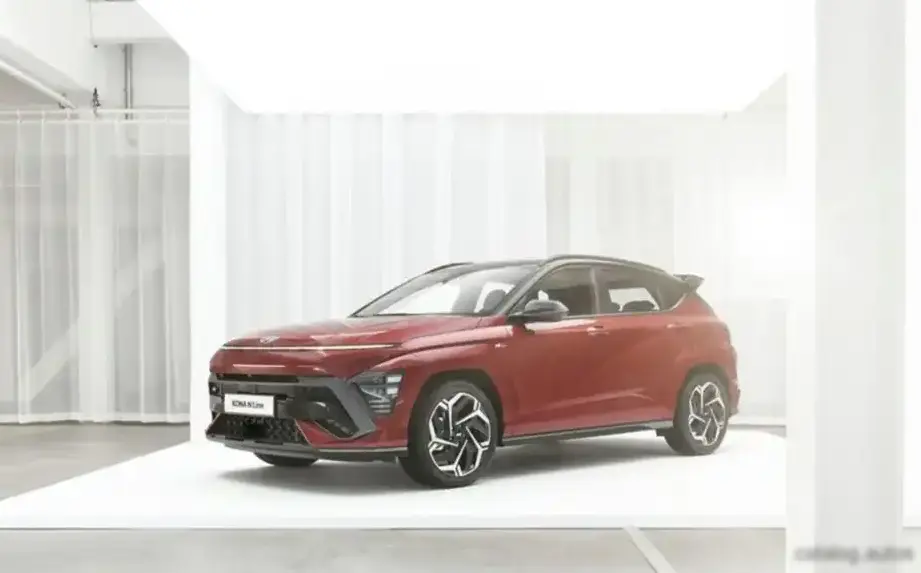
Technical Specifications
| Brand | Hyundai |
| Model | Kona |
| Generation | Kona II |
| Type (Engine) | 1.6T (198 Hp) |
| Start of production | April, 2023 |
| End of production | August, 2024 |
| Powertrain Architecture | Internal Combustion engine |
| Body type | SUV |
| Seats | 5 |
| Doors | 5 |
| CO2 emissions (WLTP) | 131-150 g/km |
| Fuel Type | Petrol (Gasoline) |
| Acceleration 0 – 100 km/h | 8.7 sec |
| Acceleration 0 – 62 mph | 8.7 sec |
| Acceleration 0 – 60 mph | 8.3 sec |
| Maximum speed | 209 km/h (129.87 mph) |
| Emission standard | Euro 6d |
| Weight-to-power ratio | 6.7 kg/Hp, 148.9 Hp/tonne |
| Weight-to-torque ratio | 5 kg/Nm, 199.2 Nm/tonne |
| Power | 198 Hp @ 6000 rpm |
| Power per litre | 123.9 Hp/l |
| Torque | 265 Nm @ 1600-4500 rpm (195.45 lb.-ft. @ 1600-4500 rpm) |
| Engine layout | Front, Transverse |
| Engine Model/Code | Smartstream |
| Engine displacement | 1598 cm3 (97.52 cu. in.) |
| Number of cylinders | 4 |
| Engine configuration | Inline |
| Cylinder Bore | 75.6 mm (2.98 in.) |
| Piston Stroke | 89 mm (3.5 in.) |
| Compression ratio | 10:1 |
| Number of valves per cylinder | 4 |
| Fuel injection system | Direct injection |
| Engine aspiration | Turbocharger, Intercooler |
| Valvetrain | DOHC |
| Engine systems | Start & Stop System, Particulate filter |
| Kerb Weight | 1330-1460 kg (2932.15 – 3218.75 lbs.) |
| Max. weight | 1885 kg (4155.71 lbs.) |
| Max load | 425-555 kg (936.96 – 1223.57 lbs.) |
| Trunk (boot) space – minimum | 466 l (16.46 cu. ft.) |
| Trunk (boot) space – maximum | 1300 l (45.91 cu. ft.) |
| Fuel tank capacity | 47 l (12.42 US gal | 10.34 UK gal) |
| Max. roof load | 100 kg (220.46 lbs.) |
| Permitted trailer load with brakes (12%) | 1300 kg (2866.01 lbs.) |
| Permitted towbar download | 80 kg (176.37 lbs.) |
| Length | 4350 mm (171.26 in.) |
| Width | 1825 mm (71.85 in.) |
| Height | 1585 mm (62.4 in.) |
| Wheelbase | 2660 mm (104.72 in.) |
| Front track | 1591 mm (62.64 in.) |
| Rear (Back) track | 1600 mm (62.99 in.) |
| Minimum turning circle | 10.6 m (34.78 ft.) |
| Drivetrain Architecture | The Internal combustion engine (ICE) drives the front wheels of the vehicle. |
| Drive wheel | Front wheel drive |
| Number of gears and type of gearbox | 6 gears, manual transmission |
| Front suspension | Independent type McPherson |
| Rear suspension | Torsion |
| Front brakes | Ventilated discs |
| Rear brakes | Disc |
| Assisting systems | ABS (Anti-lock braking system) |
| Steering type | Steering rack and pinion |
| Power steering | Electric Steering |
| Tires size | 215/60 R17; 215/55 R18 |
| Wheel rims size | 7.0J x 17; 7J x 18 |
The Hyundai Kona II 1.6T (198 hp) was introduced as part of the second-generation Kona (SX2) lineup, launched in April 2023 and continuing through August 2024. This variant utilizes Hyundai’s Smartstream engine family, offering a turbocharged four-cylinder engine paired with a six-speed manual transmission. The Kona II represented a significant step up in terms of interior space, technology, and overall refinement compared to the first-generation model. The 1.6T trim aimed to appeal to drivers who desired a more spirited driving experience without the higher price tag of the forthcoming N Line models. It was marketed towards younger buyers and those seeking a stylish and practical urban SUV.
Powertrain & Engine Architecture
At the heart of the Kona II 1.6T lies Hyundai’s Smartstream GDI (Gasoline Direct Injection) 1.6-liter turbocharged four-cylinder engine. This engine, internally designated as part of the Gamma II family, produces 198 horsepower at 6000 rpm and 265 Nm (195 lb-ft) of torque between 1600 and 4500 rpm. The direct injection system, combined with a twin-scroll turbocharger and intercooler, contributes to both improved power delivery and fuel efficiency. The engine features a DOHC (Dual Overhead Camshaft) valvetrain with four valves per cylinder. The six-speed manual transmission was the standard offering, providing drivers with a more connected feel. The transmission’s gear ratios are tuned to balance acceleration and fuel economy, with a relatively short final drive to enhance responsiveness. The engine also incorporates a start-stop system to further reduce fuel consumption in city driving.
Driving Characteristics
The 1.6T variant of the Kona II delivers a noticeably more engaging driving experience compared to the base engine options. The turbocharger provides a strong mid-range punch, making overtaking and merging onto highways relatively effortless. While not a sports car, the 198 hp output and the responsive manual transmission allow for brisk acceleration, achieving 0-60 mph in approximately 8.3 seconds. The six-speed gearbox is well-matched to the engine’s powerband, offering precise shifts and a satisfying mechanical feel. Compared to higher-output N Line models, the 1.6T offers a more relaxed and refined driving experience, prioritizing comfort and fuel efficiency over outright performance. The suspension tuning is geared towards providing a comfortable ride, although it may exhibit some body roll during aggressive cornering.
Equipment & Trim Levels
The Kona II 1.6T typically came equipped with a generous array of standard features. Interior appointments included cloth upholstery, a leather-wrapped steering wheel, and a modern dashboard layout with an 8-inch touchscreen infotainment system. Standard safety features included automatic emergency braking, lane keeping assist, and driver attention warning. Available optional extras included a larger 10.25-inch touchscreen, a premium sound system, heated front seats, and a sunroof. Trim levels varied slightly depending on the market, but generally offered progressive upgrades in terms of interior materials, technology, and exterior styling.
Chassis & Braking
The Kona II utilizes a front-wheel-drive platform with an independent McPherson strut suspension at the front and a torsion beam suspension at the rear. This setup provides a good balance of ride comfort and handling. The front brakes are ventilated discs, while the rear brakes are solid discs, providing adequate stopping power for the vehicle’s weight and performance. Electric power steering is standard, offering light and precise steering feel. The chassis is designed to be relatively lightweight, contributing to the vehicle’s agility and fuel efficiency.
Market Reception & Comparison
The Hyundai Kona II 1.6T was generally well-received by automotive critics. Reviewers praised its stylish design, spacious interior, and engaging driving experience. The 1.6T engine was considered a good compromise between performance and fuel economy. Compared to the base engine options, the 1.6T offered a significant improvement in acceleration and overall driving enjoyment. However, some critics noted that the manual transmission was not available in all markets and that the ride could be slightly firm on rough roads. In terms of fuel economy, the 1.6T typically achieved around 30-35 mpg in combined driving, depending on driving conditions and style.
Legacy
The Hyundai Kona II 1.6T represents a solid and reliable powertrain combination. The Smartstream engine has proven to be durable and relatively maintenance-free. On the used car market, these models are becoming increasingly popular due to their blend of style, practicality, and affordability. The 1.6T engine offers a good balance of performance and fuel efficiency, making it a suitable choice for both city and highway driving. With proper maintenance, these engines are expected to provide many years of reliable service. The Kona II, in general, has established itself as a strong contender in the subcompact SUV segment, and the 1.6T variant remains a desirable option for buyers seeking a well-rounded and enjoyable driving experience.