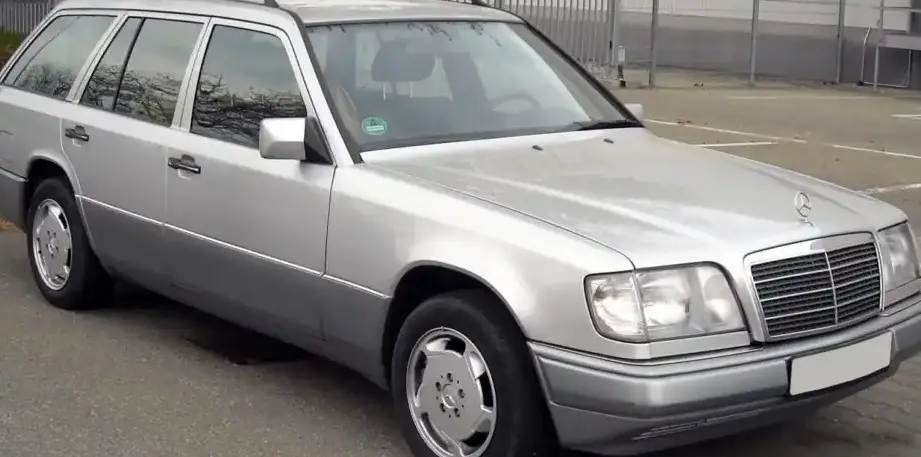
The Mercedes-Benz E 300 T D, part of the S124 series T-modell (estate) range, was produced from December 1992 to February 1996. This variant occupied a significant position within the lineup, offering a blend of practicality, fuel efficiency, and robust diesel power. It catered to buyers seeking a spacious, comfortable wagon capable of long-distance travel and hauling, without the performance focus of the gasoline-powered models. The S124 platform, renowned for its build quality and durability, provided a solid foundation for this versatile vehicle.
Technical Specifications
| Brand | Mercedes-Benz |
| Model | E-class |
| Generation | E-class T-modell (S124) |
| Type (Engine) | E 300 T D (136 Hp) |
| Start of production | December, 1992 |
| End of production | February, 1996 |
| Powertrain Architecture | Internal Combustion engine |
| Body type | Station wagon (estate) |
| Seats | 5 |
| Doors | 5 |
| Fuel consumption (urban) | 9.9 l/100 km (23.8 US mpg, 28.5 UK mpg, 10.1 km/l) |
| Fuel consumption (extra urban) | 5.9 l/100 km (39.9 US mpg, 47.9 UK mpg, 16.9 km/l) |
| Fuel consumption (combined) | 7.8 l/100 km (30.2 US mpg, 36.2 UK mpg, 12.8 km/l) |
| Fuel Type | Diesel |
| Acceleration 0 – 100 km/h | 13.7 sec |
| Acceleration 0 – 62 mph | 13.7 sec |
| Acceleration 0 – 60 mph | 13 sec |
| Maximum speed | 190 km/h (118.06 mph) |
| Weight-to-power ratio | 11.6 kg/Hp, 86.1 Hp/tonne |
| Weight-to-torque ratio | 7.5 kg/Nm, 132.9 Nm/tonne |
| Power | 136 Hp @ 5000 rpm |
| Power per litre | 45.4 Hp/l |
| Torque | 210 Nm @ 2200 rpm (154.89 lb.-ft. @ 2200 rpm) |
| Engine layout | Front, Longitudinal |
| Engine Model/Code | OM 606 D 30 / 606.910 |
| Engine displacement | 2996 cm3 (182.83 cu. in.) |
| Number of cylinders | 6 |
| Engine configuration | Inline |
| Cylinder Bore | 87 mm (3.43 in.) |
| Piston Stroke | 84 mm (3.31 in.) |
| Compression ratio | 22:1 |
| Number of valves per cylinder | 4 |
| Fuel injection system | Precombustion chamber injection |
| Engine aspiration | Naturally aspirated engine |
| Valvetrain | DOHC |
| Engine oil capacity | 7.5 l (7.93 US qt | 6.6 UK qt) |
| Coolant | 9 l (9.51 US qt | 7.92 UK qt) |
| Kerb Weight | 1580 kg (3483.3 lbs.) |
| Max. weight | 2230 kg (4916.31 lbs.) |
| Max load | 650 kg (1433 lbs.) |
| Trunk (boot) space – minimum | 530 l (18.72 cu. ft.) |
| Trunk (boot) space – maximum | 885 l (31.25 cu. ft.) |
| Fuel tank capacity | 72 l (19.02 US gal | 15.84 UK gal) |
| Length | 4765 mm (187.6 in.) |
| Width | 1740 mm (68.5 in.) |
| Height | 1490 mm (58.66 in.) |
| Wheelbase | 2800 mm (110.24 in.) |
| Front track | 1497 mm (58.94 in.) |
| Rear (Back) track | 1488 mm (58.58 in.) |
| Drivetrain Architecture | The Internal combustion engine (ICE) drives the rear wheels of the vehicle. |
| Drive wheel | Rear wheel drive |
| Number of gears and type of gearbox | 5 gears, manual transmission |
| Front suspension | Wishbone |
| Rear suspension | Independent multi-link suspension |
| Front brakes | Ventilated discs |
| Rear brakes | Disc |
| Assisting systems | ABS (Anti-lock braking system) |
| Steering type | Cone worm with recirculation balls |
| Power steering | Hydraulic Steering |
| Tires size | Front wheel tires: 195/65 R15Rear wheel tires: 195/65 R15 |
| Wheel rims size | Front wheel rims: 6.5J x 15Rear wheel rims: 6.5J x 15 |
Powertrain & Engine Architecture
The E 300 T D was powered by the OM 606 D 30 inline-six cylinder diesel engine, a 2.996-liter (182.83 cubic inches) naturally aspirated unit. This engine, identifiable by its code 606.910, was a cornerstone of Mercedes-Benz’s diesel offerings during the early to mid-1990s. It utilized a precombustion chamber injection system, a common feature in Mercedes diesels of the era, which improved combustion efficiency and reduced engine noise compared to direct injection systems. The engine featured a double overhead camshaft (DOHC) valvetrain operating four valves per cylinder. The engine produced 136 horsepower at 5000 rpm and 210 Nm (154.89 lb-ft) of torque at 2200 rpm. The five-speed manual transmission was standard, delivering power to the rear wheels.
Driving Characteristics
The E 300 T D, with its 136 hp and manual transmission, offered a driving experience focused on relaxed cruising and practicality rather than outright performance. Acceleration was modest, taking approximately 13.7 seconds to reach 62 mph (100 km/h). However, the engine’s strong low-end torque made it well-suited for hauling loads and navigating hilly terrain. The manual gearbox, while not particularly sporty, provided precise control and contributed to the vehicle’s fuel efficiency. Compared to the more powerful E 320 T models, the E 300 T D prioritized economy and durability over speed. The gear ratios were optimized for fuel efficiency and effortless highway driving.
Equipment & Trim Levels
The E 300 T D typically came with a respectable level of standard equipment, reflecting Mercedes-Benz’s commitment to comfort and quality. This included power windows, central locking, and a basic audio system. Interior upholstery was typically cloth, although leather was available as an option. Optional extras included a sunroof, automatic climate control, upgraded audio systems, and alloy wheels. The dashboard layout was typical of the S124 series, characterized by a functional and ergonomic design. Trim levels were relatively limited, with most variations stemming from optional equipment packages.
Chassis & Braking
The S124 chassis provided a robust and comfortable platform for the E 300 T D. The front suspension utilized a wishbone design, while the rear featured an independent multi-link setup, offering a good balance of ride comfort and handling. Braking was accomplished via ventilated discs at the front and solid discs at the rear, assisted by an Anti-lock Braking System (ABS). The steering was a recirculating ball system with hydraulic power assistance. Tire size was typically 195/65 R15 all around.
Market Reception & Comparison
The E 300 T D was well-received in European markets, where diesel-powered wagons were highly popular. Critics praised its fuel efficiency, spacious interior, and robust build quality. Compared to the gasoline-powered E 320 T, the E 300 T D offered significantly better fuel economy, making it a more economical choice for high-mileage drivers. However, it lacked the E 320’s performance and refinement. The E 300 T D also faced competition from other premium diesel wagons, such as the BMW 525i Touring and the Volvo 940 Estate.
Legacy
The OM 606 engine, found in the E 300 T D, is renowned for its durability and longevity. Properly maintained examples can accumulate very high mileage with minimal issues. Today, the E 300 T D is a sought-after classic among Mercedes-Benz enthusiasts, particularly those who appreciate the robustness of older diesel engines. While finding well-maintained examples can be challenging, the E 300 T D remains a testament to Mercedes-Benz’s engineering prowess and a practical, comfortable, and reliable estate car.