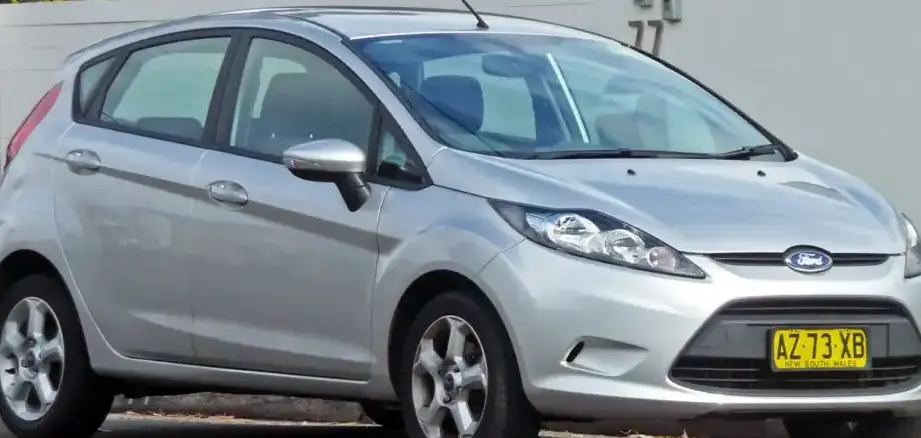
The Ford Fiesta Mk7, produced from 2008 to 2012, represented a significant step forward for Ford’s supermini. The 1.25-liter (60 horsepower) five-door variant occupied the entry-level position in the Mk7 Fiesta lineup, aimed at buyers prioritizing affordability and fuel economy. This model was particularly important in European markets, where smaller, economical cars are highly sought after. While not offered in the North American market, the Fiesta Mk7, and this specific engine configuration, played a crucial role in establishing Ford’s presence as a competitive player in the global small car segment.
Technical Specifications
| Brand | Ford |
| Model | Fiesta |
| Generation | Fiesta VII (Mk7) 5 door |
| Type (Engine) | 1.25 (60 Hp) |
| Start of production | 2008 |
| End of production | 2012 |
| Powertrain Architecture | Internal Combustion engine |
| Body type | Hatchback |
| Seats | 5 |
| Doors | 5 |
| Fuel consumption (urban) | 7.3 l/100 km (32.2 US mpg, 38.7 UK mpg, 13.7 km/l) |
| Fuel consumption (extra urban) | 4.3 l/100 km (54.7 US mpg, 65.7 UK mpg, 23.3 km/l) |
| Fuel consumption (combined) | 5.4 l/100 km (43.6 US mpg, 52.3 UK mpg, 18.5 km/l) |
| CO2 emissions | 128 g/km |
| Fuel Type | Petrol (Gasoline) |
| Acceleration 0 – 100 km/h | 16.9 sec |
| Acceleration 0 – 62 mph | 16.9 sec |
| Acceleration 0 – 60 mph | 16.1 sec |
| Maximum speed | 152 km/h (94.45 mph) |
| Emission standard | Euro 4 |
| Weight-to-power ratio | 17.3 kg/Hp |
| Weight-to-torque ratio | 9.5 kg/Nm |
| Power | 60 Hp @ 6000 rpm |
| Torque | 109 Nm @ 3600 rpm (80.39 lb.-ft. @ 3600 rpm) |
| Engine layout | Front, Transverse |
| Engine Model/Code | STJA, STJB |
| Engine displacement | 1242 cm3 (75.79 cu. in.) |
| Number of cylinders | 4 |
| Engine configuration | Inline |
| Cylinder Bore | 71.9 mm (2.83 in.) |
| Piston Stroke | 76.5 mm (3.01 in.) |
| Number of valves per cylinder | 4 |
| Fuel injection system | Multi-port manifold injection |
| Engine aspiration | Naturally aspirated engine |
| Valvetrain | OHC |
| Engine oil capacity | 3.8 l (4.02 US qt | 3.34 UK qt) |
| Coolant capacity | 5.5 l (5.81 US qt | 4.84 UK qt) |
| Kerb Weight | 1035 kg (2281.78 lbs.) |
| Max. weight | 1495 kg (3295.91 lbs.) |
| Max load | 460 kg (1014.13 lbs.) |
| Trunk (boot) space – minimum | 295 l (10.42 cu. ft.) |
| Trunk (boot) space – maximum | 979 l (34.57 cu. ft.) |
| Fuel tank capacity | 45 l (11.89 US gal | 9.9 UK gal) |
| Length | 3950 mm (155.51 in.) |
| Width | 1722 mm (67.8 in.) |
| Width including mirrors | 1973 mm (77.68 in.) |
| Height | 1481 mm (58.31 in.) |
| Wheelbase | 2489 mm (97.99 in.) |
| Front track | 1493 mm (58.78 in.) |
| Rear track | 1480 mm (58.27 in.) |
| Minimum turning circle | 10.2 m (33.46 ft.) |
| Drivetrain Architecture | Front wheel drive |
| Number of gears | 5 |
| Gearbox type | Manual transmission |
| Front suspension | Independent, McPherson with coil spring and anti-roll bar |
| Rear suspension | Coil spring, Torsion |
| Front brakes | Ventilated discs |
| Rear brakes | Drum |
| Assisting systems | ABS (Anti-lock braking system) |
| Steering type | Steering rack and pinion |
| Power steering | Electric |
| Tires size | 175/65 R14 |
| Wheel rims size | 5.5J x 14 |
Powertrain & Engine Architecture
The heart of this Fiesta variant is the Duratec 1.25-liter inline-four cylinder engine, designated with engine codes STJA or STJB depending on specific calibration and market. This engine is a naturally aspirated unit, utilizing a multi-port fuel injection system for precise fuel delivery. The engine features a single overhead camshaft (OHC) design, operating four valves per cylinder. This configuration, while simple, prioritized reliability and fuel efficiency over outright performance. The 1.25L engine produced 60 horsepower at 6000 rpm and 109 Nm (80.39 lb-ft) of torque at 3600 rpm. The engine was paired with a five-speed manual transmission, chosen for its cost-effectiveness and contribution to overall fuel economy. The transmission’s gear ratios were optimized for urban driving and maximizing fuel efficiency, rather than providing sporty acceleration.
Driving Characteristics
The 1.25-liter Fiesta was not designed for speed. Acceleration was leisurely, taking approximately 16.9 seconds to reach 100 km/h (62 mph). The focus was on providing a comfortable and economical driving experience. The engine felt strained when pushed hard, particularly when fully loaded or climbing hills. The five-speed manual transmission helped to keep the engine within its optimal operating range, but frequent downshifts were often necessary. Compared to higher-output Fiesta variants, such as the 1.6-liter models, the 1.25 felt significantly underpowered. However, the lighter engine weight contributed to nimble handling in city environments.
Equipment & Trim Levels
The base-level 1.25 Fiesta typically came equipped with basic features such as power steering, central locking, and an AM/FM radio. Air conditioning was often an optional extra. Interior upholstery was typically cloth, with a simple dashboard layout. Higher trim levels, available at an additional cost, offered features like alloy wheels, electric windows, and upgraded audio systems. Safety features included driver and passenger airbags and ABS brakes. The overall interior design was functional and durable, prioritizing practicality over luxury.
Chassis & Braking
The Fiesta Mk7 utilized a McPherson strut front suspension and a torsion beam rear suspension. This setup provided a reasonable balance between ride comfort and handling. The front brakes were ventilated discs, while the rear brakes were drums, a cost-saving measure common in entry-level models. The electric power steering provided light and easy steering, making it ideal for maneuvering in tight urban spaces. The relatively lightweight construction of the vehicle contributed to its agility.
Market Reception & Comparison
The 1.25-liter Fiesta was generally well-received as an affordable and economical city car. Critics praised its fuel efficiency and nimble handling, but noted its lack of power. Compared to other trims in the Fiesta lineup, such as the 1.6-liter variants, the 1.25 offered significantly lower performance but also a lower purchase price and better fuel economy. It competed directly with other superminis like the Volkswagen Polo, Renault Clio, and Peugeot 207, often undercutting them on price.
Legacy
The 1.25-liter Fiesta Mk7 has proven to be a relatively reliable vehicle, with the Duratec engine known for its durability. Common issues are typically related to wear and tear, such as exhaust system components and suspension bushings. On the used car market, these models are often sought after by first-time drivers or those looking for an inexpensive and economical runabout. While not a performance icon, the 1.25 Fiesta Mk7 remains a practical and affordable option for those seeking a reliable and fuel-efficient supermini.