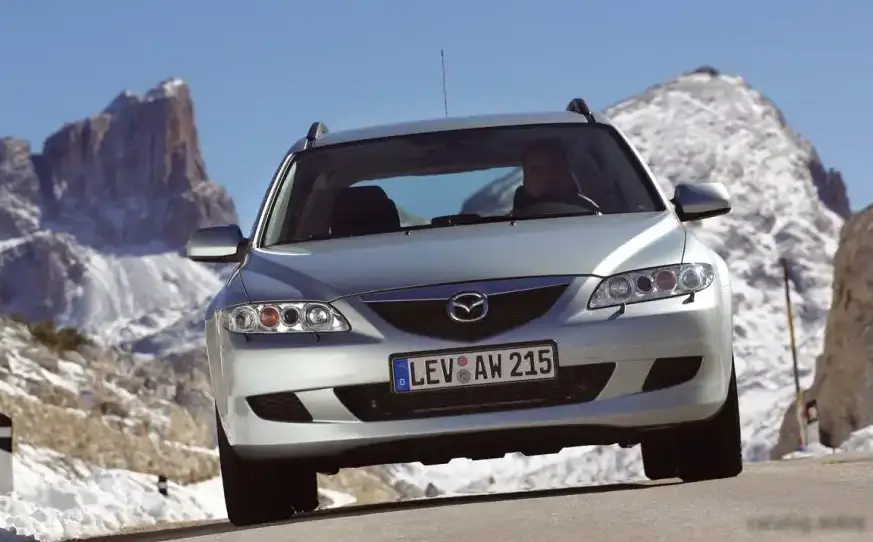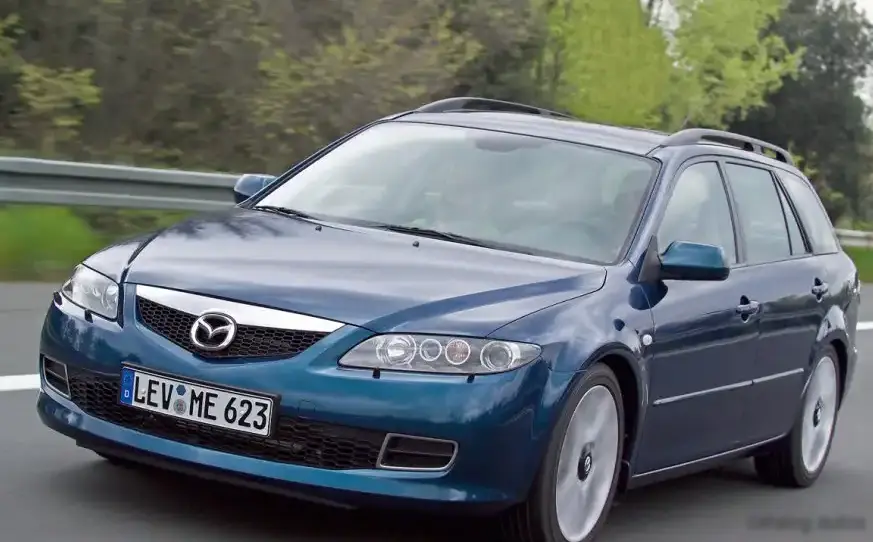
The Mazda 6 Combi (Typ GG/GY/GG1 facelift) 2.0 CD, produced from 2005 to 2008, represents a significant iteration of Mazda’s foray into the competitive mid-size wagon segment. This variant, powered by a 2.0-liter turbocharged diesel engine producing 143 horsepower, was positioned as a practical and efficient option within the broader Mazda 6 lineup. The facelifted GG/GY series, introduced in 2005, brought revised styling, improved interior materials, and refinements to the chassis and engine options, aiming to enhance the vehicle’s overall appeal and competitiveness in the European market, where wagons held a stronger presence than in North America.
Technical Specifications
| Brand | Mazda |
| Model | 6 |
| Generation | 6 I Combi (Typ GG/GY/GG1 facelift 2005) |
| Type (Engine) | 2.0 CD (143 Hp) |
| Start of production | 2005 |
| End of production | 2008 |
| Powertrain Architecture | Internal Combustion engine |
| Body type | Station wagon (estate) |
| Seats | 5 |
| Doors | 5 |
| Fuel consumption (urban) | 7.6 l/100 km (30.9 US mpg, 37.2 UK mpg, 13.2 km/l) |
| Fuel consumption (extra urban) | 5.2 l/100 km (45.2 US mpg, 54.3 UK mpg, 19.2 km/l) |
| Fuel consumption (combined) | 6.1 l/100 km (38.6 US mpg, 46.3 UK mpg, 16.4 km/l) |
| CO2 emissions | 167 g/km |
| Fuel Type | Diesel |
| Acceleration 0 – 100 km/h | 9.8 sec |
| Acceleration 0 – 62 mph | 9.8 sec |
| Acceleration 0 – 60 mph | 9.3 sec |
| Maximum speed | 201 km/h (124.9 mph) |
| Emission standard | Euro 4 |
| Weight-to-power ratio | 10.6 kg/Hp, 94.1 Hp/tonne |
| Weight-to-torque ratio | 4.2 kg/Nm, 236.8 Nm/tonne |
| Power | 143 Hp @ 3500 rpm |
| Torque | 360 Nm @ 2000 rpm (265.52 lb.-ft. @ 2000 rpm) |
| Engine layout | Front, Transverse |
| Engine Model/Code | RF7J |
| Engine displacement | 1998 cm3 (121.93 cu. in.) |
| Number of cylinders | 4 |
| Engine configuration | Inline |
| Cylinder Bore | 86 mm (3.39 in.) |
| Piston Stroke | 86 mm (3.39 in.) |
| Compression ratio | 16.7:1 |
| Number of valves per cylinder | 4 |
| Fuel injection system | Diesel Commonrail |
| Engine aspiration | Turbocharger, Intercooler |
| Valvetrain | SOHC |
| Engine oil capacity | 4.7 l (4.97 US qt | 4.14 UK qt) |
| Coolant | 9 l (9.51 US qt | 7.92 UK qt) |
| Kerb Weight | 1520 kg (3351.03 lbs.) |
| Max. weight | 2050 kg (4519.48 lbs.) |
| Max load | 530 kg (1168.45 lbs.) |
| Trunk (boot) space – minimum | 505 l (17.83 cu. ft.) |
| Trunk (boot) space – maximum | 1712 l (60.46 cu. ft.) |
| Fuel tank capacity | 64 l (16.91 US gal | 14.08 UK gal) |
| Permitted trailer load with brakes (12%) | 1600 kg (3527.4 lbs.) |
| Permitted trailer load without brakes | 550 kg (1212.54 lbs.) |
| Length | 4710 mm (185.43 in.) |
| Width | 1780 mm (70.08 in.) |
| Height | 1480 mm (58.27 in.) |
| Wheelbase | 2675 mm (105.31 in.) |
| Front track | 1540 mm (60.63 in.) |
| Rear (Back) track | 1540 mm (60.63 in.) |
| Ride height (ground clearance) | 130 mm (5.12 in.) |
| Drag coefficient (Cd) | 0.32 |
| Minimum turning circle (turning diameter) | 10.8 m (35.43 ft.) |
| Drivetrain Architecture | The Internal combustion engine (ICE) drives the front wheels of the vehicle. |
| Drive wheel | Front wheel drive |
| Number of gears and type of gearbox | 6 gears, manual transmission |
| Front brakes | Ventilated discs |
| Rear brakes | Disc |
| Assisting systems | ABS (Anti-lock braking system) |
| Steering type | Steering rack and pinion |
| Tires size | 205/55 R16 H |
| Wheel rims size | 16 |
INTRODUCTION
The Mazda 6 Combi 2.0 CD (GG/GY facelift) was introduced as a practical and fuel-efficient option for European buyers seeking a versatile family vehicle. Positioned within the first generation (GG/GY) of the Mazda 6, the Combi body style – a station wagon – was particularly popular in Europe. The 2005 facelift brought subtle but important changes to the exterior styling, interior quality, and mechanical refinements. This 2.0 CD variant, with its 143 horsepower diesel engine, aimed to balance performance with economy, appealing to drivers who frequently covered long distances. It sat in the middle of the diesel range, offering more power than the lower-spec 1.6L diesel but remaining more affordable and fuel-efficient than the higher-output 2.2L models.
Powertrain & Engine Architecture
The heart of the 2.0 CD variant is the RF7J engine, a 1998cc inline-four cylinder diesel. This engine utilizes a common-rail direct injection system, delivering fuel directly into the combustion chamber at extremely high pressure for improved efficiency and reduced emissions. The RF7J features a single overhead camshaft (SOHC) valvetrain operating four valves per cylinder. A turbocharger with an intercooler is employed to boost power output, providing 143 horsepower at 3500 rpm and a substantial 360 Nm (265.52 lb.-ft.) of torque at 2000 rpm. The engine’s design prioritized low-end torque, making it well-suited for everyday driving and hauling loads. The engine was typically paired with a six-speed manual transmission, although an automatic transmission was also available, albeit less common. The automatic transmission was a conventional torque converter type, offering smooth shifts but at the expense of some fuel economy compared to the manual.
Driving Characteristics
The 2.0 CD Combi offered a comfortable and composed driving experience. While not a performance-oriented vehicle, the 143 horsepower and 360 Nm of torque provided adequate power for most driving situations. Acceleration from 0-100 km/h (0-62 mph) took around 9.8 seconds, which was competitive for its class. The engine’s strong low-end torque meant that overtaking maneuvers were relatively effortless. Compared to the higher-output 2.2L diesel, the 2.0 CD felt less urgent in its acceleration, but it offered better fuel economy. The six-speed manual transmission allowed drivers to keep the engine in its optimal power band, while the automatic transmission provided convenience, albeit with slightly slower response times. The Combi’s suspension was tuned for comfort, absorbing bumps and imperfections in the road well, making it a pleasant long-distance cruiser.
Equipment & Trim Levels
The Mazda 6 Combi 2.0 CD typically came equipped with a reasonable level of standard features. These included air conditioning, power windows, power mirrors, a CD stereo system, and ABS brakes. Higher trim levels, such as the ‘Sport’ or ‘Luxury’ variants, added features like alloy wheels, climate control, a sunroof, and upgraded interior trim. Interior upholstery was typically cloth, with leather options available on higher-spec models. The dashboard layout was functional and well-designed, with clear instrumentation and intuitive controls. Optional extras included a navigation system, parking sensors, and a premium sound system.
Chassis & Braking
The Mazda 6 Combi featured a MacPherson strut front suspension and a multi-link rear suspension, providing a good balance of ride comfort and handling. The chassis was relatively lightweight, contributing to the vehicle’s agility. Braking duties were handled by ventilated discs at the front and solid discs at the rear. ABS (Anti-lock Braking System) was standard, enhancing safety and stability during emergency braking. The steering was a rack and pinion system, offering precise and responsive control. The 2.0 CD variant typically rode on 205/55 R16 tires, providing good grip and ride quality.
Market Reception & Comparison
The Mazda 6 Combi 2.0 CD was generally well-received by automotive critics. It was praised for its fuel efficiency, comfortable ride, and spacious interior. However, some reviewers noted that the engine could be somewhat noisy under hard acceleration. Compared to its rivals, such as the Ford Mondeo Estate and the Volkswagen Passat Variant, the Mazda 6 Combi offered a more engaging driving experience and a more stylish design. The 2.0 CD variant offered a compelling balance of performance and economy, making it a popular choice for families and long-distance commuters. The 1.6L diesel offered better fuel economy but lacked the power of the 2.0 CD, while the 2.2L diesel provided more performance but at a higher price and with slightly worse fuel consumption.
Legacy
The Mazda 6 Combi 2.0 CD (GG/GY facelift) has proven to be a relatively reliable vehicle, with the RF7J diesel engine generally considered durable. However, like all diesel engines, it is susceptible to issues related to the fuel injection system and turbocharger. Regular maintenance, including oil changes and filter replacements, is crucial for ensuring long-term reliability. Today, these vehicles can be found on the used car market at affordable prices. They represent a practical and economical option for buyers seeking a spacious and comfortable wagon. While not a collector’s item, the Mazda 6 Combi 2.0 CD remains a popular choice for those who value practicality, fuel efficiency, and a comfortable driving experience.