
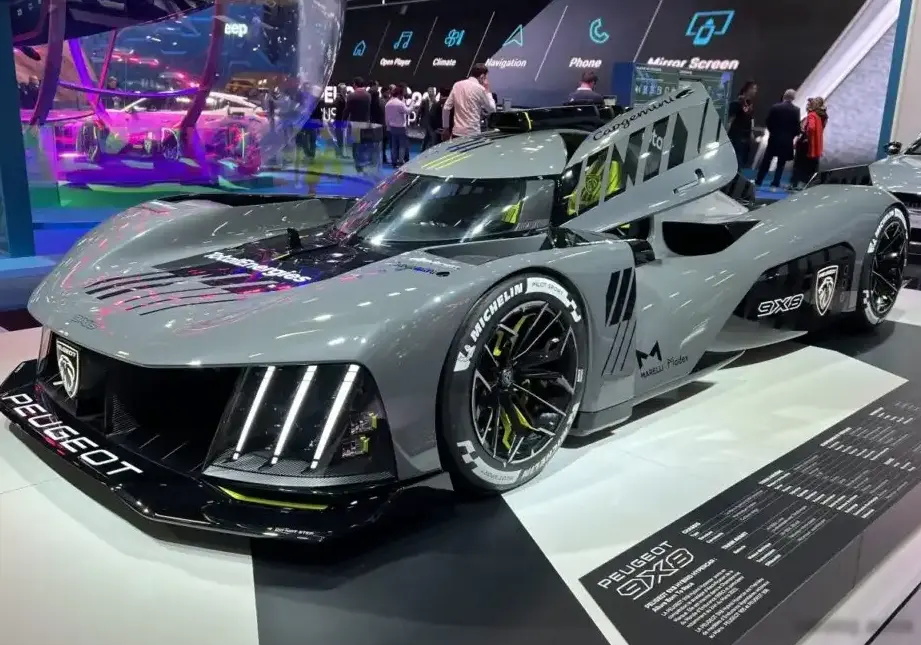
The Peugeot 9X8 is a Le Mans Hypercar (LMH) prototype built by Peugeot Sport, unveiled in 2021. Representing Peugeot’s return to top-level endurance racing, the 9X8 was designed to compete in the FIA World Endurance Championship (WEC) and, specifically, the 24 Hours of Le Mans. The vehicle’s development focused on innovative aerodynamic concepts and a highly efficient, hybrid powertrain. Production was limited to racing examples, with no road-going version planned. The 9X8 competed in the 2022 and 2023 WEC seasons, achieving notable results and showcasing Peugeot’s engineering prowess.
Technical Specifications
| Brand | Peugeot |
| Model | 9×8 |
| Generation | 9×8 (Racing Prototype) |
| Type (Engine) | 2.6 Bi-turbo V6 (680 Hp) Hybrid 4WD Automatic |
| Start of production | 2021 |
| End of production | 2021 |
| Powertrain Architecture | FHEV (Full Hybrid Electric Vehicle) |
| Body type | Coupe |
| Seats | 1 |
| Doors | 1 |
| Fuel Type | Ethanol – E85 |
| Maximum speed | 350 km/h (217.48 mph) |
| Weight-to-power ratio | 1.5 kg/Hp, 660.2 Hp/tonne |
| Battery voltage | 900 V |
| Battery location | Below the floor |
| Electric motor | 1 |
| Electric motor power | 268 Hp |
| Electric motor location | Front axle, Transverse |
| Power | 680 Hp |
| Power per litre | 261.5 Hp/l |
| Engine displacement | 2600 cm3 (158.66 cu. in.) |
| Number of cylinders | 6 |
| Engine configuration | V-engine |
| Engine aspiration | BiTurbo, Intercooler |
| Kerb Weight | 1030 kg (2270.76 lbs.) |
| Fuel tank capacity | 90 l (23.78 US gal | 19.8 UK gal) |
| Length | 4995 mm (196.65 in.) |
| Width | 2000 mm (78.74 in.) |
| Height | 1145 mm (45.08 in.) |
| Drivetrain Architecture | The Internal combustion engine (ICE) drives the rear wheels of the vehicle. One electric motor drives the front wheels. |
| Drive wheel | All wheel drive (4×4) |
| Number of gears and type of gearbox | 7 gears, automatic transmission |
| Front brakes | Ventilated discs |
| Rear brakes | Ventilated discs |
Powertrain & Engine Architecture
The heart of the Peugeot 9X8 is a 2.6-liter twin-turbocharged V6 internal combustion engine. This engine, designated as the EP2106, produces 680 horsepower. The engine’s design prioritizes compactness and efficiency, utilizing a 90-degree V-angle for optimal balance and reduced vibrations. It features direct fuel injection and a sophisticated intercooling system to manage the heat generated by the turbochargers. The engine is constructed with lightweight materials, including aluminum alloys, to minimize weight and improve power-to-weight ratio.
Complementing the V6 engine is a high-voltage hybrid system. A single electric motor, producing 268 horsepower, is mounted on the front axle. This motor provides all-wheel-drive capability and contributes to the car’s overall power output. The hybrid system utilizes a 900-volt battery pack, positioned low in the chassis to lower the center of gravity and improve handling. The combination of the ICE and electric motor results in a total system output exceeding 950 horsepower. The 7-speed sequential gearbox is fully automatic, optimized for rapid gear changes during racing conditions. The powertrain is managed by a sophisticated energy recovery system, capturing kinetic energy during braking and converting it back into electrical energy to recharge the battery.
Driving Characteristics
The Peugeot 9X8’s driving characteristics are defined by its advanced hybrid powertrain and aerodynamic design. The combination of the powerful V6 engine and the electric motor delivers instant torque and impressive acceleration. The all-wheel-drive system provides exceptional traction, particularly in challenging weather conditions. The automatic gearbox ensures smooth and precise gear changes, allowing the driver to focus on maximizing performance. The car’s low center of gravity and sophisticated suspension system contribute to its exceptional handling and stability.
The electric motor provides a boost of power at lower speeds, enhancing responsiveness and improving acceleration out of corners. The hybrid system also allows for electric-only driving at low speeds, reducing emissions and noise. The 9X8’s aerodynamic package, including its distinctive fin-like structures, generates significant downforce, improving grip and stability at high speeds. The car’s overall balance and responsiveness make it a formidable competitor on the track.
Equipment & Trim Levels
As a dedicated racing prototype, the Peugeot 9X8 does not have traditional trim levels or optional extras. The vehicle is built to a single, highly optimized specification dictated by the regulations of the FIA World Endurance Championship. The cockpit is minimalist and functional, designed to provide the driver with all the necessary information and controls. It features a single racing seat, a steering wheel with integrated displays, and a comprehensive data acquisition system. Safety features include a reinforced carbon fiber chassis, a fire suppression system, and a HALO safety device. The interior is focused entirely on performance and driver safety, with no concessions made to comfort or luxury.
Chassis & Braking
The Peugeot 9X8 features a lightweight, carbon fiber monocoque chassis, providing exceptional rigidity and strength. The chassis is designed to withstand the extreme forces encountered during endurance racing. The suspension system consists of double wishbones with adjustable dampers and springs. The suspension geometry is optimized for maximum grip and stability. The braking system utilizes ventilated carbon fiber discs and multi-piston calipers on all four wheels, providing exceptional stopping power. The braking system is also equipped with an anti-lock braking system (ABS) and traction control to enhance safety and performance.
Market Reception & Comparison
The Peugeot 9X8 received positive reception from the racing community and automotive press. Its innovative aerodynamic design and hybrid powertrain were widely praised. Compared to its competitors in the LMH class, such as the Toyota GR010 Hybrid and the Porsche 963, the 9X8 offered a unique approach to endurance racing. The 9X8’s focus on aerodynamic efficiency and hybrid technology set it apart from its rivals. While initial performance in the 2022 season was hampered by development challenges, the car demonstrated significant potential and achieved competitive results in the 2023 season.
Legacy
The Peugeot 9X8 represents a significant milestone in Peugeot’s racing history. It showcases the company’s commitment to innovation and its ability to compete at the highest level of motorsport. The technologies developed for the 9X8, such as its hybrid powertrain and aerodynamic design, are likely to influence future Peugeot road cars. The 9X8’s legacy will be defined by its contribution to the advancement of hybrid racing technology and its role in Peugeot’s return to the forefront of endurance racing. While its long-term reliability as a racing prototype is dependent on continued development and maintenance, the 9X8 has already established itself as a significant and influential vehicle in the world of motorsport.
