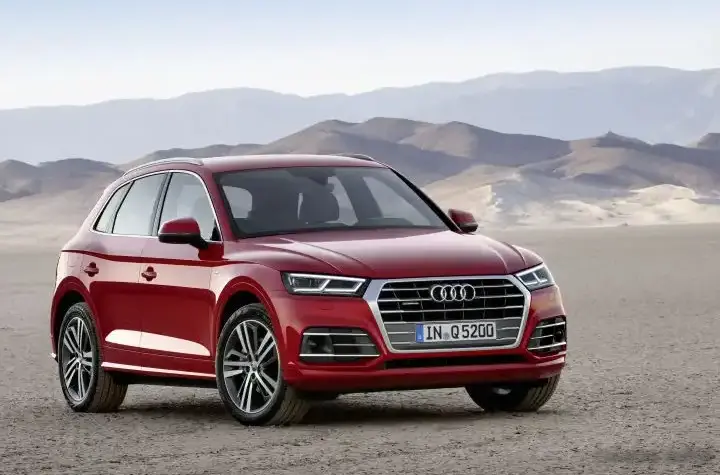
The Audi Q5 II (FY) 2.0 TDI 163 hp quattro S tronic represents a significant iteration in Audi’s popular compact luxury SUV lineup. Produced from 2016 to 2018, this variant occupied a key position within the second-generation Q5 (FY) range, offering a balance between fuel efficiency, all-weather capability, and a relatively accessible price point. It was designed primarily for the European market, where diesel engines and all-wheel drive systems are highly valued, but also saw limited sales in other regions. This model is built on the MLB Evo platform, shared with other Volkswagen Group vehicles, and aimed at buyers seeking a premium SUV experience without the higher costs associated with more powerful engine options.
Technical Specifications
| Brand | Audi |
| Model | Q5 |
| Generation | Q5 II (FY) |
| Type (Engine) | 2.0 TDI (163 Hp) quattro S tronic |
| Start of production | 2016 |
| End of production | 2018 |
| Powertrain Architecture | Internal Combustion engine |
| Body type | SUV |
| Seats | 5 |
| Doors | 5 |
| Fuel consumption (urban) | 5.3-5.5 l/100 km (44.4 – 42.8 US mpg) |
| Fuel consumption (extra urban) | 4.7-5.0 l/100 km (50 – 47 US mpg) |
| Fuel consumption (combined) | 4.9-5.2 l/100 km (48 – 45.2 US mpg) |
| CO2 emissions | 129-136 g/km |
| Fuel Type | Diesel |
| Acceleration 0 – 100 km/h | 8.9 sec |
| Acceleration 0 – 62 mph | 8.9 sec |
| Acceleration 0 – 60 mph | 8.5 sec |
| Maximum speed | 211 km/h (131.11 mph) |
| Emission standard | Euro 6 |
| Weight-to-power ratio | 10.9 kg/Hp, 92.1 Hp/tonne |
| Weight-to-torque ratio | 4.4 kg/Nm, 226 Nm/tonne |
| Power | 163 Hp @ 3000-4200 rpm |
| Torque | 400 Nm @ 1750-2750 rpm (295.02 lb.-ft. @ 1750-2750 rpm) |
| Engine layout | Front, Longitudinal |
| Engine Model/Code | DETB |
| Engine displacement | 1968 cm3 (120.09 cu. in.) |
| Number of cylinders | 4 |
| Engine configuration | Inline |
| Number of valves per cylinder | 4 |
| Fuel injection system | Diesel Commonrail |
| Engine aspiration | Turbocharger, Intercooler |
| Valvetrain | DOHC |
| Engine oil capacity | 4.7 l (4.97 US qt | 4.14 UK qt) |
| Kerb Weight | 1770 kg (3902.18 lbs.) |
| Max. weight | 2440 kg (5379.28 lbs.) |
| Max load | 670 kg (1477.1 lbs.) |
| Trunk (boot) space – minimum | 550 l (19.42 cu. ft.) |
| Trunk (boot) space – maximum | 1510 l (53.33 cu. ft.) |
| Fuel tank capacity | 65 l (17.17 US gal | 14.3 UK gal) |
| AdBlue tank | 12 l (3.17 US gal | 2.64 UK gal) |
| Max. roof load | 75 kg (165.35 lbs.) |
| Permitted trailer load with brakes (8%) | 2400 kg (5291.09 lbs.) |
| Permitted trailer load with brakes (12%) | 2400 kg (5291.09 lbs.) |
| Permitted trailer load without brakes | 750 kg (1653.47 lbs.) |
| Permitted towbar download | 100 kg (220.46 lbs.) |
| Length | 4663 mm (183.58 in.) |
| Width | 1893 mm (74.53 in.) |
| Width including mirrors | 2140 mm (84.25 in.) |
| Height | 1659 mm (65.31 in.) |
| Wheelbase | 2819 mm (110.98 in.) |
| Front track | 1616 mm (63.62 in.) |
| Rear (Back) track | 1609 mm (63.35 in.) |
| Front overhang | 899 mm (35.39 in.) |
| Rear overhang | 945 mm (37.2 in.) |
| Minimum turning circle (turning diameter) | 11.7 m (38.39 ft.) |
| Drive wheel | All wheel drive (4×4) |
| Number of gears and type of gearbox | 7 gears, automatic transmission S tronic |
| Front suspension | Independent multi-link suspension |
| Rear suspension | Independent multi-link suspension |
| Front brakes | Ventilated discs |
| Rear brakes | Ventilated discs |
| Assisting systems | ABS (Anti-lock braking system) |
| Tires size | 235/55 R17; 235/60 R18; 235/55 R19 |
| Wheel rims size | 17; 18; 19 |
Powertrain & Engine Architecture
At the heart of the Q5 2.0 TDI quattro S tronic lies the Volkswagen Group’s DETB engine, a 2.0-liter inline-four cylinder diesel engine. This engine utilizes a common rail direct injection system, delivering fuel at extremely high pressures for optimized combustion. The DETB features a single turbocharger with an intercooler, boosting power and torque output. The engine produces 163 horsepower at 3000-4200 rpm and a substantial 400 Nm (295 lb-ft) of torque between 1750 and 2750 rpm. The engine employs a Double Overhead Camshaft (DOHC) valvetrain with four valves per cylinder. The “S tronic” transmission is a seven-speed dual-clutch transmission (DCT) known for its quick and smooth shifts. This transmission contributes to both performance and fuel efficiency. The longitudinal engine layout, combined with Audi’s quattro all-wheel-drive system, provides excellent traction and stability in various driving conditions.
Driving Characteristics
The 2.0 TDI with the S tronic transmission delivers a refined and capable driving experience. While not as overtly sporty as higher-powered Q5 variants, the 163 hp engine provides adequate performance for everyday driving and highway cruising. Acceleration from 0 to 60 mph takes approximately 8.5 seconds. The S tronic transmission’s quick shifts and well-chosen gear ratios help to maximize the available power. The quattro all-wheel-drive system provides confident handling and stability, particularly in inclement weather. Compared to the manual transmission versions of the same engine, the S tronic offers greater convenience and ease of use, although some enthusiasts may prefer the more engaging feel of a manual gearbox. The power delivery is linear and predictable, making it easy to modulate throttle inputs.
Equipment & Trim Levels
The Q5 2.0 TDI quattro S tronic typically came well-equipped as standard. Common features included automatic climate control, a multi-function steering wheel, Audi’s MMI infotainment system with a central display screen, and cloth upholstery. Optional extras included leather upholstery, a panoramic sunroof, navigation system, advanced driver-assistance systems (such as adaptive cruise control and lane departure warning), and upgraded sound systems. Trim levels varied slightly depending on the market, but generally, this variant sat in the mid-range of the Q5 lineup, offering a good balance of features and affordability.
Chassis & Braking
The Q5 II (FY) features an independent multi-link suspension at both the front and rear axles, providing a comfortable ride and good handling characteristics. The suspension is tuned to prioritize comfort over outright sportiness, but still offers a secure and controlled feel. Braking duties are handled by ventilated discs on all four wheels, providing ample stopping power. The ABS (Anti-lock Braking System) is standard, enhancing safety and stability during emergency braking maneuvers. Stabilizer bars are fitted to both axles to reduce body roll during cornering.
Market Reception & Comparison
The Audi Q5 2.0 TDI quattro S tronic was generally well-received by automotive critics. It was praised for its fuel efficiency, comfortable ride, and refined interior. The combination of the diesel engine and S tronic transmission was seen as a practical and efficient choice for those who frequently drive long distances. Compared to the more powerful Q5 variants (such as the 3.0 TDI or 2.0 TFSI), the 2.0 TDI offered lower running costs and comparable practicality. However, some critics noted that the engine could feel slightly underpowered when fully loaded or when tackling steep hills. Fuel economy figures typically ranged from 48 to 45.2 US mpg on the combined cycle, making it an attractive option for budget-conscious buyers.
Legacy
The 2.0 TDI engine and S tronic transmission pairing in the Q5 II (FY) has proven to be relatively reliable over the long term. While diesel engines can be susceptible to issues with the diesel particulate filter (DPF) and fuel injectors, these problems are not uncommon to this specific engine. The S tronic transmission, while generally robust, requires regular maintenance (fluid changes) to ensure optimal performance and longevity. Today, used examples of the Q5 2.0 TDI quattro S tronic represent a good value proposition for buyers seeking a premium SUV with reasonable running costs. Its blend of practicality, comfort, and all-weather capability continues to make it a popular choice in the used car market.