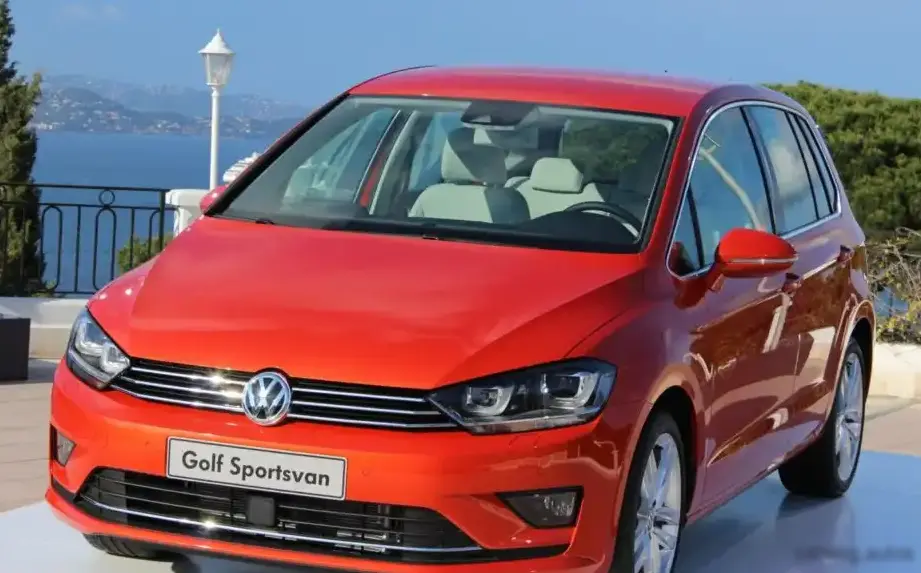
The Volkswagen Golf VII Sportsvan 1.6 TDI (110 hp) was a compact minivan produced between June 2013 and April 2017, positioned as a practical and fuel-efficient option within the broader Golf VII range. Part of the A7 platform family (internally designated as the 5G), the Sportsvan aimed to bridge the gap between the standard Golf hatchback and larger MPVs, offering increased interior space and versatility. This particular variant, powered by the 1.6-liter diesel engine, represented an entry-level offering in the Sportsvan lineup, prioritizing economy over outright performance. It was primarily marketed in Europe, where compact MPVs enjoyed significant popularity.
Technical Specifications
| Brand | Volkswagen |
| Model | Golf |
| Generation | Golf VII Sportsvan |
| Type (Engine) | 1.6 TDI (110 Hp) |
| Start of production | June, 2013 |
| End of production | April, 2017 |
| Powertrain Architecture | Internal Combustion engine |
| Body type | Minivan |
| Seats | 5 |
| Doors | 5 |
| Fuel consumption (urban) | 4.5-4.6 l/100 km (52.3 – 51.1 US mpg) |
| Fuel consumption (extra urban) | 3.5-3.7 l/100 km (67.2 – 63.6 US mpg) |
| Fuel consumption (combined) | 3.9-4.1 l/100 km (60.3 – 57.4 US mpg) |
| CO2 emissions | 101-106 g/km |
| Fuel Type | Diesel |
| Acceleration 0 – 100 km/h | 11.3 sec |
| Acceleration 0 – 62 mph | 11.3 sec |
| Acceleration 0 – 60 mph | 10.7 sec |
| Maximum speed | 192 km/h (119.3 mph) |
| Weight-to-power ratio | 12.9 kg/Hp, 77.5 Hp/tonne |
| Weight-to-torque ratio | 5.7 kg/Nm, 176.1 Nm/tonne |
| Power | 110 Hp @ 3200-4000 rpm |
| Power per litre | 68.8 Hp/l |
| Torque | 250 Nm @ 1500-3000 rpm (184.39 lb.-ft. @ 1500-3000 rpm) |
| Engine layout | Front, Transverse |
| Engine Model/Code | CRKB, CXXB, DBKA |
| Engine displacement | 1598 cm3 (97.52 cu. in.) |
| Number of cylinders | 4 |
| Engine configuration | Inline |
| Fuel injection system | Diesel Commonrail |
| Engine aspiration | Turbocharger, Intercooler |
| Valvetrain | DOHC |
| Engine oil capacity | 4.6 l (4.86 US qt | 4.05 UK qt) |
| Kerb Weight | 1420 kg (3130.56 lbs) |
| Max. weight | 1920 kg (4232.88 lbs) |
| Max load | 500 kg (1102.31 lbs) |
| Trunk (boot) space – minimum | 500 l (17.66 cu. ft) |
| Trunk (boot) space – maximum | 1520 l (53.68 cu. ft) |
| Fuel tank capacity | 50 l (13.21 US gal | 11 UK gal) |
| Length | 4338 mm (170.79 in) |
| Width | 1807 mm (71.14 in) |
| Height | 1578 mm (62.13 in) |
| Wheelbase | 2685 mm (105.71 in) |
| Front track | 1543 mm (60.75 in) |
| Rear (Back) track | 1514 mm (59.61 in) |
| Minimum turning circle | 11.1 m (36.42 ft) |
| Drivetrain Architecture | The Internal combustion engine (ICE) drives the front wheels of the vehicle. |
| Drive wheel | Front wheel drive |
| Number of gears | 5 gears, manual transmission |
| Assisting systems | ABS (Anti-lock braking system) |
| Steering type | Steering rack and pinion |
Powertrain & Engine Architecture
The heart of the Golf VII Sportsvan 1.6 TDI was the 1.6-liter inline-four cylinder diesel engine, available in several iterations denoted by engine codes CRKB, CXXB, and DBKA. This engine belonged to Volkswagen’s modular engine family, designed for efficiency and reduced emissions. It featured a common rail direct injection system, delivering fuel directly into the combustion chamber at extremely high pressure. This, combined with a turbocharger and intercooler, allowed for a good balance of power and fuel economy. The engine utilized a Double Overhead Camshaft (DOHC) valvetrain, optimizing airflow for improved performance. The 5-speed manual transmission was standard, chosen for its simplicity and contribution to fuel efficiency. While a 7-speed DSG dual-clutch transmission was available on higher trim levels and with more powerful engines, it wasn’t offered with this specific 110 hp configuration.
Driving Characteristics
The 1.6 TDI engine, producing 110 horsepower and 250 Nm (184 lb-ft) of torque, provided adequate, but not exhilarating, performance. Acceleration from 0-60 mph took around 10.7 seconds, and top speed was 119.3 mph. The engine’s torque curve was relatively flat, offering usable power from low engine speeds, making it suitable for everyday driving and overtaking maneuvers. However, compared to the more powerful 2.0 TDI variants or even the petrol-powered Golf Sportsvans, this version felt noticeably slower. The 5-speed gearbox was well-matched to the engine’s characteristics, but the relatively long gearing emphasized fuel economy over responsiveness. The Sportsvan’s increased weight compared to the standard Golf hatchback was also noticeable, particularly when fully loaded.
Equipment & Trim Levels
The 1.6 TDI variant typically served as the entry point to the Sportsvan range. Standard equipment generally included air conditioning, a basic infotainment system with a touchscreen display, electric front windows, and central locking. Safety features such as ABS, ESP (Electronic Stability Program), and multiple airbags were also standard. Higher trim levels, such as Comfortline and Highline, added features like alloy wheels, upgraded infotainment systems with navigation, automatic climate control, parking sensors, and more luxurious interior trim. Optional extras included a panoramic sunroof, adaptive cruise control, and various driver assistance systems.
Chassis & Braking
The Golf VII Sportsvan utilized a MacPherson strut front suspension and a multi-link rear suspension, providing a comfortable and controlled ride. The suspension was tuned to prioritize comfort over sporty handling. Braking systems varied slightly depending on the specific trim level, but generally consisted of disc brakes on the front wheels and drum brakes on the rear. ABS (Anti-lock Braking System) was standard. Stabilizer bars were fitted front and rear to reduce body roll during cornering, though they were typically thinner in diameter on the base 1.6 TDI models compared to higher-spec variants.
Market Reception & Comparison
The Golf VII Sportsvan 1.6 TDI was generally well-received by automotive critics as a practical and economical family vehicle. Its fuel efficiency was a major selling point, with combined fuel consumption figures ranging from 3.9 to 4.1 liters per 100 kilometers (60.3 – 57.4 US mpg). However, its performance was often criticized as being underwhelming, particularly when compared to more powerful engine options. Compared to the 2.0 TDI models, the 1.6 TDI offered significantly lower running costs but sacrificed performance. The petrol-powered variants provided a more engaging driving experience but at the expense of fuel economy. The Sportsvan, in general, was seen as a more spacious and versatile alternative to the standard Golf hatchback, but it came with a price premium.
Legacy
The 1.6 TDI engine, while not known for being particularly exciting, proved to be relatively reliable in the Golf VII Sportsvan. Common issues were generally related to the diesel particulate filter (DPF) and the dual-mass flywheel, particularly on vehicles that were primarily used for short journeys. The Sportsvan itself has become a popular choice in the used car market, offering a good balance of practicality, fuel efficiency, and affordability. However, potential buyers should be aware of the potential maintenance costs associated with the diesel engine and its associated components. The Golf VII Sportsvan 1.6 TDI remains a testament to Volkswagen’s commitment to providing efficient and versatile transportation for families.