
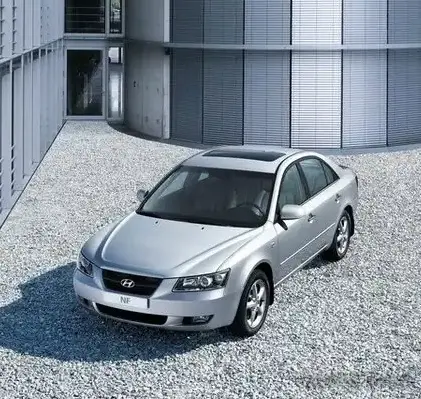
The Hyundai NF 3.3 i V6 24V, producing 233 horsepower, represents a significant step forward for Hyundai in the mid-size sedan segment. Produced from 2004 to 2010, this variant of the NF Sonata (sold as the NF in many markets outside of North America) was positioned as the premium offering within the range, boasting a larger displacement engine and more refined features compared to its four-cylinder siblings. It played a crucial role in establishing Hyundai’s reputation for value and increasingly sophisticated engineering, particularly in markets where larger sedans were favored. This model competed directly with established Japanese and American brands like Toyota Camry, Honda Accord, and Ford Fusion.
Technical Specifications
| Brand | Hyundai |
| Model | NF |
| Generation | NF |
| Type (Engine) | 3.3 i V6 24V (233 Hp) |
| Start of production | 2004 |
| End of production | 2010 |
| Powertrain Architecture | Internal Combustion engine |
| Body type | Sedan |
| Seats | 5 |
| Doors | 4 |
| Fuel Type | Petrol (Gasoline) |
| Acceleration 0 – 100 km/h | 7.8 sec |
| Acceleration 0 – 62 mph | 7.8 sec |
| Acceleration 0 – 60 mph | 7.4 sec |
| Maximum speed | 228 km/h (141.67 mph) |
| Weight-to-power ratio | 6.7 kg/Hp, 148.3 Hp/tonne |
| Weight-to-torque ratio | 5.2 kg/Nm, 193.5 Nm/tonne |
| Power | 233 Hp @ 6000 rpm |
| Power per litre | 69.7 Hp/l |
| Torque | 304 Nm @ 3500 rpm (224.22 lb.-ft. @ 3500 rpm) |
| Engine layout | Front, Transverse |
| Engine Model/Code | Lambda / G6DB |
| Engine displacement | 3342 cm3 (203.94 cu. in.) |
| Number of cylinders | 6 |
| Engine configuration | V-engine |
| Cylinder Bore | 92 mm (3.62 in.) |
| Piston Stroke | 83.8 mm (3.3 in.) |
| Compression ratio | 10.4:1 |
| Number of valves per cylinder | 4 |
| Fuel injection system | Multi-port manifold injection |
| Engine aspiration | Naturally aspirated engine |
| Valvetrain | DOHC |
| Engine oil capacity | 5.2 l (5.49 US qt | 4.58 UK qt) |
| Coolant | 8.2 l (8.66 US qt | 7.21 UK qt) |
| Kerb Weight | 1571 kg (3463.46 lbs) |
| Max. weight | 2130 kg (4695.85 lbs) |
| Max load | 559 kg (1232.38 lbs) |
| Trunk (boot) space – minimum | 523 l (18.47 cu. ft.) |
| Fuel tank capacity | 70 l (18.49 US gal | 15.4 UK gal) |
| Length | 4800 mm (188.98 in.) |
| Width | 1832 mm (72.13 in.) |
| Height | 1474 mm (58.03 in.) |
| Wheelbase | 2730 mm (107.48 in.) |
| Front track | 1565 mm (61.61 in.) |
| Rear (Back) track | 1550 mm (61.02 in.) |
| Drivetrain Architecture | The Internal combustion engine (ICE) drives the front wheels of the vehicle. |
| Drive wheel | Front wheel drive |
| Number of gears and type of gearbox | 5 gears, automatic transmission |
| Front suspension | Double wishbone |
| Rear suspension | Transverse stabilizer |
| Front brakes | Ventilated discs |
| Rear brakes | Disc |
| Assisting systems | ABS (Anti-lock braking system) |
| Steering type | Steering rack and pinion |
| Tires size | 215/60 R16 |
| Wheel rims size | 6.5J X 16 |
Powertrain & Engine Architecture
The heart of the NF 3.3 i is the Hyundai Lambda engine, specifically the G6DB variant. This 3.3-liter, naturally aspirated V6 engine utilizes a 60-degree V-angle configuration for improved balance and smoothness. It features a dual overhead camshaft (DOHC) valvetrain with four valves per cylinder, contributing to its respectable power output. The engine employs multi-port fuel injection, a common technology at the time, delivering fuel directly into the intake ports. The Lambda engine was a significant achievement for Hyundai, representing a move towards more sophisticated engine designs. It was designed to be relatively lightweight and compact for a V6, aiding in the car’s handling characteristics. Paired with this engine is a 5-speed automatic transmission. While not the most advanced transmission available at the time, it provided smooth and adequate shifting for everyday driving. The transmission was tuned for comfort and fuel efficiency rather than outright performance.
Driving Characteristics
The 233 hp and 224 lb-ft of torque delivered by the 3.3L V6 provided a noticeable performance upgrade over the base four-cylinder models. Acceleration from 0-60 mph was achieved in approximately 7.4 to 7.8 seconds, making it competitive with other mid-size sedans of the era. The automatic transmission, while smooth, did result in some power loss compared to a manual transmission. The gear ratios were optimized for cruising comfort, meaning the engine sometimes felt strained during aggressive acceleration. Overall, the driving experience was characterized by a comfortable ride and adequate power for most driving situations. It wasn’t a sports sedan, but it offered a refined and enjoyable driving experience.
Equipment & Trim Levels
The 3.3 i V6 trim typically included a generous array of standard features. These often included power windows, power locks, air conditioning, a CD player, and alloy wheels. Higher-spec versions could be equipped with leather upholstery, a sunroof, upgraded audio systems, and automatic climate control. Safety features such as ABS were standard. The interior design was generally conservative but functional, with a focus on providing a comfortable and spacious cabin for passengers.
Chassis & Braking
The NF Sonata utilized a front-wheel-drive layout with a double wishbone suspension in the front and a transverse stabilizer in the rear. This suspension setup provided a comfortable ride, absorbing bumps and imperfections in the road effectively. The braking system consisted of ventilated discs in the front and solid discs in the rear, providing adequate stopping power for the vehicle’s weight and performance. ABS was standard, enhancing safety during emergency braking situations.
Market Reception & Comparison
The Hyundai NF 3.3 i V6 was generally well-received by automotive critics. It was praised for its spacious interior, comfortable ride, and strong value proposition. However, some critics noted that the automatic transmission could feel sluggish at times and that the handling wasn’t as sharp as some of its competitors. Compared to the four-cylinder versions of the NF Sonata, the 3.3 i V6 offered a significant performance boost but came at a higher price point. Fuel economy was also slightly lower due to the larger engine. In terms of reliability, the Lambda engine proved to be relatively robust, although routine maintenance was essential to prevent issues.
Legacy
The Hyundai NF 3.3 i V6 represents an important milestone in Hyundai’s history. It demonstrated the company’s ability to produce a competitive mid-size sedan with a powerful and refined engine. While not without its flaws, the NF Sonata helped to elevate Hyundai’s brand image and establish it as a serious contender in the automotive market. Today, well-maintained examples of the NF 3.3 i V6 can still be found on the used car market, offering a comfortable and affordable option for those seeking a reliable and spacious sedan. The Lambda engine family continued to be developed and refined by Hyundai, becoming a mainstay in many of its subsequent models.
