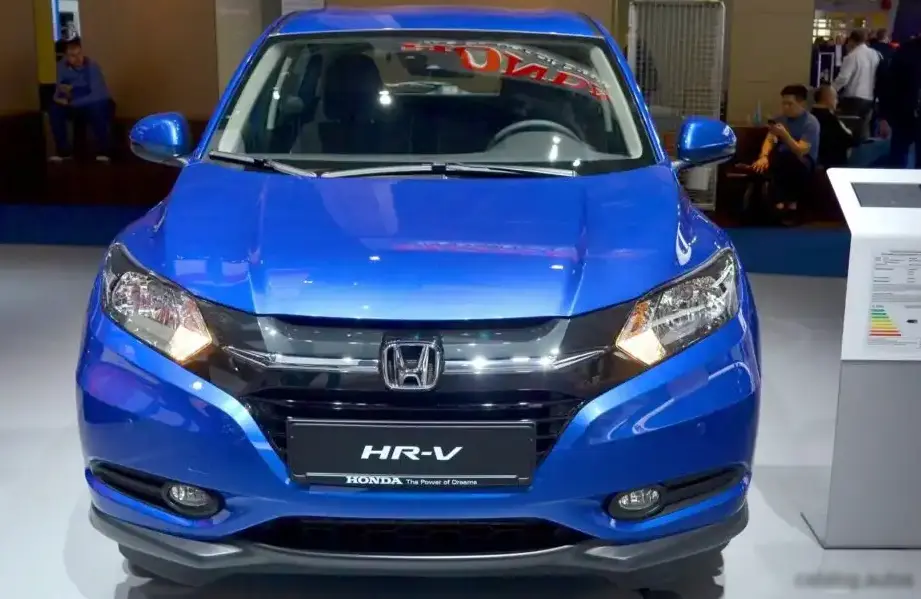
The Honda HR-V III, specifically the facelifted 2024 model offered in the United States with the 2.0-liter engine and Continuously Variable Transmission (CVT), represents Honda’s entry-level compact SUV offering. Production of this configuration began in May 2025 for the 2025 model year. Positioned as a practical and fuel-efficient option, it slots below the CR-V in Honda’s SUV lineup. This iteration builds upon the global HR-V (Vezel) platform, tailored for the North American market with distinct styling and features. The 2024 facelift brought updated styling cues and minor technological enhancements to maintain competitiveness in the crowded compact SUV segment.
Technical Specifications
| Brand | Honda |
| Model | HR-V |
| Generation | HR-V III (facelift 2024) |
| Type (Engine) | 2.0 (158 Hp) CVT (USA) |
| Start of production | May, 2025 |
| Powertrain Architecture | Internal Combustion engine |
| Body type | SUV, Crossover |
| Seats | 5 |
| Doors | 5 |
| Fuel consumption (economy) – urban (EPA) | 9 l/100 km (26.1 US mpg) |
| Fuel consumption (economy) – extra urban (EPA) | 7.4 l/100 km (31.8 US mpg) |
| Fuel consumption (economy) – combined (EPA) | 8.4 l/100 km (28 US mpg) |
| Fuel Type | Petrol (Gasoline) |
| Emission standard | LEV4-SULEV30 |
| Weight-to-power ratio | 9.1 kg/Hp |
| Weight-to-torque ratio | 7.7 kg/Nm |
| Power | 158 Hp @ 6500 rpm |
| Power per litre | 79.2 Hp/l |
| Torque | 187 Nm @ 4200 rpm (137.92 lb.-ft. @ 4200 rpm) |
| Maximum engine speed | 6800 rpm |
| Engine layout | Front, Transverse |
| Engine Model/Code | K20Z5 |
| Engine displacement | 1996 cm3 (121.8 cu. in.) |
| Number of cylinders | 4 |
| Engine configuration | Inline |
| Cylinder Bore | 86 mm (3.39 in.) |
| Piston Stroke | 85.9 mm (3.38 in.) |
| Compression ratio | 10.8:1 |
| Number of valves per cylinder | 4 |
| Fuel injection system | Multi-port manifold injection |
| Engine aspiration | Naturally aspirated engine |
| Valvetrain | DOHC, i-VTEC |
| Engine oil capacity | 4.2 l (4.44 US qt | 3.7 UK qt) |
| Coolant | 5.93 l (6.27 US qt | 5.22 UK qt) |
| Kerb Weight | 1433-1461 kg (3159.22 – 3220.95 lbs.) |
| Trunk (boot) space – minimum | 691 l (24.4 cu. ft.) |
| Trunk (boot) space – maximum | 1560 l (55.09 cu. ft.) |
| Fuel tank capacity | 53 l (14 US gal | 11.66 UK gal) |
| Length | 4567 mm (179.8 in.) |
| Width | 1839 mm (72.4 in.) |
| Height | 1610-1621 mm (63.39 – 63.82 in.) |
| Wheelbase | 2654 mm (104.49 in.) |
| Front track | 1590 mm (62.6 in.) |
| Rear (Back) track | 1605 mm (63.19 in.) |
| Ride height (ground clearance) | 178-185 mm (7.01 – 7.28 in.) |
| Minimum turning circle (turning diameter) | 10.7-11.3 m (35.1 – 37.07 ft.) |
| Front brakes | Ventilated discs, 312.42 mm |
| Rear brakes | Disc, 309.88 mm |
| Number of gears and type of gearbox | automatic transmission CVT |
INTRODUCTION
The 2024 Honda HR-V, as sold in the US market, represents the third generation of the model, based on Honda’s global small SUV architecture (internally designated as the PG8). This facelifted version, introduced for the 2025 model year, focuses on refining the design and enhancing the overall driving experience. The 2.0-liter engine paired with a CVT is the sole powertrain option for the US market, aiming to provide a balance of fuel efficiency and adequate performance for daily commuting and light-duty tasks. It’s positioned as a more mature and refined alternative to subcompact crossovers, appealing to buyers seeking practicality and Honda’s reputation for reliability.
Powertrain & Engine Architecture
At the heart of the 2024 HR-V is the K20Z5 2.0-liter inline-four cylinder engine. This naturally aspirated engine utilizes multi-point fuel injection and Honda’s i-VTEC (intelligent Variable valve Timing and lift Electronic Control) valvetrain technology. The i-VTEC system allows for variable valve timing and lift, optimizing engine performance across a wider RPM range. The engine produces 158 horsepower at 6500 rpm and 187 Nm (137.92 lb-ft) of torque at 4200 rpm. The engine is transversely mounted in the front of the vehicle. The K20Z5 is known for its relatively simple design, contributing to its reliability. The engine is mated to a Continuously Variable Transmission (CVT), which prioritizes fuel efficiency over traditional stepped gear changes. This CVT is programmed to simulate gear changes to provide a more natural driving feel, but ultimately operates without fixed gear ratios.
Driving Characteristics
The 2.0-liter engine and CVT combination in the HR-V delivers adequate, but not exhilarating, performance. Acceleration is linear and predictable, suitable for merging onto highways and navigating city streets. The CVT effectively keeps the engine in its optimal power band, but can sometimes exhibit a “rubber band” feel during hard acceleration, where engine RPMs rise quickly without a corresponding increase in speed. Compared to potential higher-output turbocharged engines found in competitors, the HR-V’s powertrain feels less responsive. The CVT’s programming includes simulated shift points to mimic a traditional automatic transmission, which helps to mitigate the rubber band effect. The focus is clearly on fuel economy and smooth operation rather than sporty driving dynamics. The gear ratios are optimized for efficiency, resulting in a comfortable cruising experience at highway speeds.
Equipment & Trim Levels
The 2024 HR-V 2.0 CVT (USA) typically comes standard with features such as a 7-inch touchscreen infotainment system with Apple CarPlay and Android Auto compatibility, LED headlights, Honda Sensing suite of safety features (including adaptive cruise control and lane keeping assist), and automatic climate control. Higher trim levels, such as the EX and Sport, add features like a larger 9-inch touchscreen, heated front seats, a power moonroof, and upgraded audio systems. Interior upholstery is typically cloth on the base LX trim, with leather options available on higher trims. Optional extras include premium paint colors, all-weather floor mats, and cargo area accessories.
Chassis & Braking
The HR-V utilizes an independent McPherson strut front suspension and an independent multi-link rear suspension. This setup provides a comfortable ride quality, absorbing bumps and irregularities in the road surface effectively. Front brakes are ventilated discs measuring 312.42 mm, while rear brakes are solid discs measuring 309.88 mm. The braking system is assisted by ABS (Anti-lock Braking System) and electronic brake-force distribution. Stabilizer bars are present on both the front and rear axles to reduce body roll during cornering. The suspension tuning is geared towards comfort and stability rather than sporty handling.
Market Reception & Comparison
Critics generally praised the 2024 HR-V for its spacious interior, comfortable ride, and standard safety features. However, the powertrain received mixed reviews, with some finding it underpowered compared to competitors. Fuel economy is a strong point, achieving an EPA-estimated 28 mpg combined. Compared to other trims in the HR-V lineup (there are no other engine options in the US market), the 2.0L CVT offers the best balance of affordability and fuel efficiency. Competitors such as the Mazda CX-5, Toyota Corolla Cross, and Hyundai Kona offer more powerful engine options, but often at a higher price point. The HR-V’s reliability record is generally positive, consistent with Honda’s reputation.
Legacy
The K20Z5 engine, while not a groundbreaking powerplant, is known for its durability and relatively low maintenance requirements. The CVT transmission, while offering fuel efficiency benefits, may require more diligent fluid changes compared to traditional automatic transmissions. In the used car market, the 2024 HR-V is expected to hold its value reasonably well due to Honda’s brand reputation and the vehicle’s practicality. The combination of a reliable engine, comfortable interior, and standard safety features makes it a compelling option for buyers seeking a dependable and fuel-efficient compact SUV.