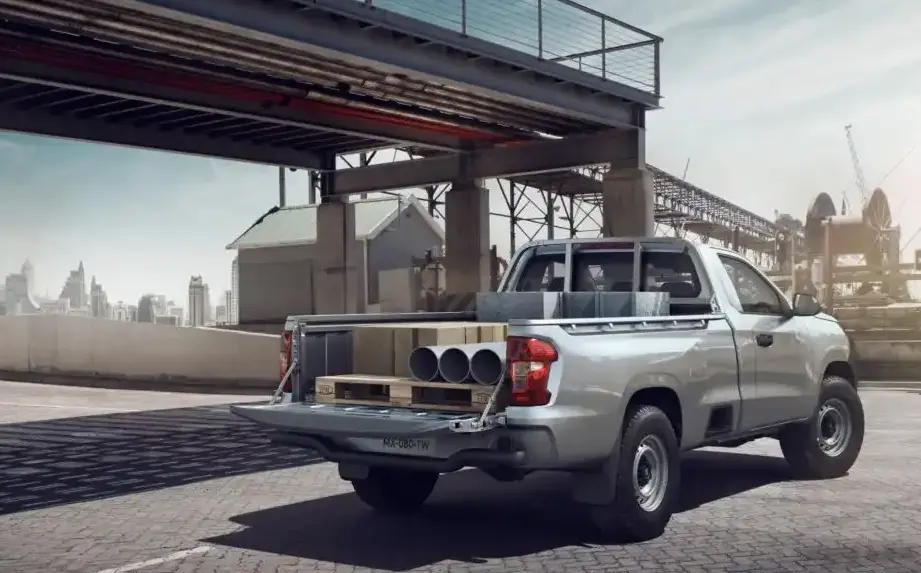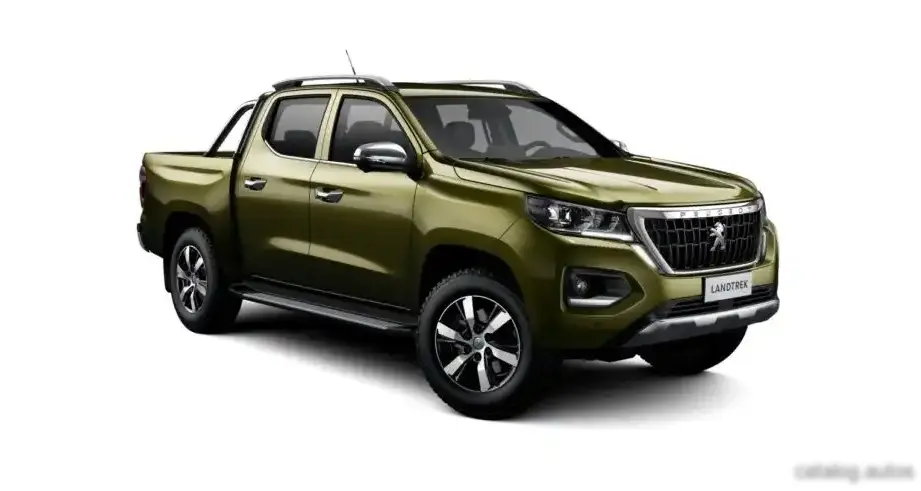
The Peugeot Landtrek Double Cab 1.9d (150 hp) 4×4, launched in February 2020, represents Peugeot’s entry into the competitive mid-size pickup truck segment. Developed primarily for markets outside of Europe – notably Latin America – the Landtrek aimed to provide a robust and versatile vehicle capable of both work and family duties. Positioned as a workhorse with a degree of comfort, this variant occupied a middle ground in the Landtrek lineup, offering a balance between affordability and capability compared to higher-trim levels with more powerful engines or luxurious features. The Landtrek is built on a ladder-frame chassis, a common construction method for pickup trucks, and shares some components with the Changan Kaichengyue, reflecting a joint venture between Peugeot and Chinese automaker Changan Automobile.
Technical Specifications
| Brand | Peugeot |
| Model | Landtrek |
| Generation | Landtrek Double Cab |
| Type (Engine) | 1.9d (150 Hp) 4×4 |
| Start of production | February, 2020 |
| Powertrain Architecture | Internal Combustion engine |
| Body type | Pick-up |
| Seats | 6 |
| Doors | 4 |
| Fuel consumption (combined) | 8.1 l/100 km (29 US mpg, 34.9 UK mpg, 12.3 km/l) |
| CO2 emissions | 212 g/km |
| Fuel Type | Diesel |
| Acceleration 0 – 100 km/h | 15.8 sec |
| Acceleration 0 – 62 mph | 15.8 sec |
| Acceleration 0 – 60 mph | 15 sec |
| Maximum speed | 171 km/h (106.25 mph) |
| Emission standard | Euro 4 |
| Weight-to-power ratio | 13.7 kg/Hp, 72.8 Hp/tonne |
| Weight-to-torque ratio | 5.9 kg/Nm, 169.9 Nm/tonne |
| Power | 150 Hp @ 4000 rpm |
| Power per litre | 78.5 Hp/l |
| Torque | 350 Nm @ 1800-2800 rpm (258.15 lb.-ft. @ 1800-2800 rpm) |
| Engine layout | Front, Transverse |
| Engine Model/Code | D20TCID |
| Engine displacement | 1910 cm3 (116.56 cu. in.) |
| Number of cylinders | 4 |
| Engine configuration | Inline |
| Number of valves per cylinder | 4 |
| Fuel injection system | Diesel Commonrail |
| Engine aspiration | Turbocharger, Intercooler |
| Engine oil capacity | 5.5 l (5.81 US qt | 4.84 UK qt) |
| Kerb Weight | 2060 kg (4541.52 lbs.) |
| Fuel tank capacity | 80 l (21.13 US gal | 17.6 UK gal) |
| Length | 5330 mm (209.84 in.) |
| Width | 1963 mm (77.28 in.) |
| Width including mirrors | 2221 mm (87.44 in.) |
| Height | 1897 mm (74.69 in.) |
| Wheelbase | 3180 mm (125.2 in.) |
| Front track | 1610 mm (63.39 in.) |
| Rear (Back) track | 1630 mm (64.17 in.) |
| Front overhang | 925 mm (36.42 in.) |
| Rear overhang | 1225 mm (48.23 in.) |
| Ride height (ground clearance) | 214-235 mm (8.43 – 9.25 in.) |
| Approach angle | 29.0° |
| Departure angle | 27.0° |
| Ramp-over (brakeover) angle | 25.0° |
| Wading depth | 600 mm (23.62 in.) |
| Drivetrain Architecture | All wheel drive (4×4). ICE drives rear wheels, front wheels engaged via clutch. |
| Number of gears and type of gearbox | 6 gears, manual transmission |
| Tires size | 265/65 R17 |
| Wheel rims size | 17 |
Introduction
The Peugeot Landtrek Double Cab 1.9d 4×4, introduced in 2020, marked Peugeot’s re-entry into the pickup truck market after a lengthy absence. Designed with the needs of Latin American buyers in mind, the Landtrek aimed to offer a compelling alternative to established players like the Toyota Hilux and Ford Ranger. This particular variant, powered by the 1.9-liter diesel engine and equipped with a six-speed manual transmission and four-wheel drive, was intended to appeal to customers seeking a practical and capable truck for both work and leisure. It’s built on a robust ladder frame chassis, prioritizing durability and load-carrying capacity. The Landtrek Double Cab offers seating for six passengers, making it suitable for families or work crews.
Powertrain & Engine Architecture
At the heart of the Landtrek 1.9d 4×4 lies the D20TCID engine, a 1.9-liter inline-four cylinder diesel. This engine utilizes a common rail direct injection system, delivering fuel directly into the combustion chamber at high pressure for improved efficiency and reduced emissions. A turbocharger with an intercooler further enhances performance by forcing more air into the engine, boosting power output. The engine produces 150 horsepower at 4000 rpm and 350 Nm (258 lb-ft) of torque between 1800 and 2800 rpm. The six-speed manual transmission provides precise gear changes and allows the driver to maintain optimal engine speed for various driving conditions. The 4×4 system features a selectable drive mode, allowing the driver to switch between two-wheel drive for fuel efficiency and four-wheel drive for enhanced traction in challenging terrain.
Driving Characteristics
The Landtrek 1.9d 4×4 offers a driving experience geared towards practicality rather than outright performance. The 150 hp engine, while adequate, doesn’t provide particularly brisk acceleration – 0-100 km/h takes 15.8 seconds. However, the engine’s strong low-end torque makes it well-suited for hauling loads and navigating rough terrain. The six-speed manual transmission allows for good control over the engine’s power band. Compared to potential higher-output versions (which were not widely available in all markets), this variant prioritizes fuel economy and affordability. The suspension is tuned for comfort and durability, providing a reasonably smooth ride even on uneven surfaces. The 4×4 system provides confident traction in off-road conditions, although it’s not designed for extreme rock crawling.
Equipment & Trim Levels
The Landtrek 1.9d 4×4 Double Cab typically came equipped with a range of standard features, including air conditioning, power windows, central locking, and a basic audio system. Safety features included ABS brakes, airbags, and a rear parking sensor. Interior upholstery was typically cloth, with a functional and durable design. Optional extras could include alloy wheels, a touchscreen infotainment system with navigation, and a rearview camera. The trim level of this variant generally positioned it as a mid-range offering, providing a good balance of features and affordability. It lacked some of the more luxurious appointments found in higher-trim models.
Chassis & Braking
The Landtrek utilizes a traditional ladder-frame chassis, providing a robust and durable foundation for the vehicle. The suspension consists of double wishbones at the front and leaf springs at the rear. This configuration is common for pickup trucks, offering a good balance of load-carrying capacity and ride comfort. Braking duties are handled by disc brakes at the front and drum brakes at the rear. While the drum brakes at the rear are a cost-saving measure, they provide adequate stopping power for most driving conditions. The steering is hydraulic, providing a direct and responsive feel.
Market Reception & Comparison
The Peugeot Landtrek received mixed reviews upon its launch. Critics praised its robust construction, spacious interior, and competitive pricing. However, some reviewers noted that the 1.9-liter diesel engine felt underpowered compared to some of its rivals, particularly when fully loaded. Fuel economy was generally considered to be good for a vehicle of its size and type, achieving around 8.1 l/100 km. Compared to other trims in the Landtrek lineup, the 1.9d 4×4 offered a more affordable entry point, making it attractive to budget-conscious buyers. It provided a good balance between capability and economy, but those requiring more power or luxury would likely opt for a higher-trim model.
Legacy
The Peugeot Landtrek, while a relatively new entrant to the pickup truck market, has established itself as a viable option in certain regions, particularly in Latin America. The 1.9-liter diesel engine, while not the most powerful available, has proven to be relatively reliable. In the used car market, the Landtrek 1.9d 4×4 represents a good value proposition for buyers seeking a practical and capable pickup truck. Its durability and relatively low running costs make it an attractive option for those who need a workhorse vehicle. Long-term reliability reports are still emerging, but initial indications suggest that the Landtrek is a well-built and dependable truck.