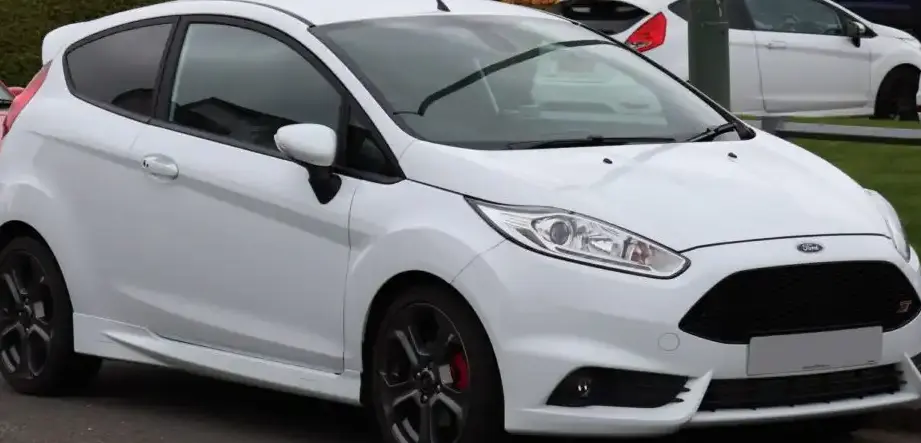
The Ford Fiesta VII, specifically the facelifted model introduced in 2013, represented a significant evolution of Ford’s popular subcompact car. The 3-door 1.6 TDCi variant, producing 95 horsepower, was offered between 2013 and 2015. This model occupied a key position in the Fiesta lineup, aimed at buyers prioritizing fuel efficiency and lower running costs without sacrificing practicality. It sat below the higher-powered petrol and diesel options, and above the base specification models, offering a balance of features and economy. The Mk7 Fiesta, built on the B2E platform, was a crucial model for Ford in Europe, and this particular engine/body style combination was tailored to the European market’s demand for economical diesel hatchbacks.
Technical Specifications
| Brand | Ford |
| Model | Fiesta |
| Generation | Fiesta VII (Mk7, facelift 2013) 3 door |
| Type (Engine) | 1.6 TDCi (95 Hp) |
| Start of production | 2013 |
| End of production | 2015 |
| Powertrain Architecture | Internal Combustion engine |
| Body type | Hatchback |
| Seats | 5 |
| Doors | 3 |
| Fuel consumption (urban) | 4.4 l/100 km (53.5 US mpg, 64.2 UK mpg, 22.7 km/l) |
| Fuel consumption (extra urban) | 3.2 l/100 km (73.5 US mpg, 88.3 UK mpg, 31.3 km/l) |
| Fuel consumption (combined) | 3.6 l/100 km (65.3 US mpg, 78.5 UK mpg, 27.8 km/l) |
| CO2 emissions | 95 g/km |
| Fuel Type | Diesel |
| Acceleration 0 – 100 km/h | 11.7 sec |
| Acceleration 0 – 62 mph | 11.7 sec |
| Acceleration 0 – 60 mph | 11.1 sec |
| Maximum speed | 175 km/h (108.74 mph) |
| Emission standard | Euro 5 |
| Weight-to-power ratio | 10.9 kg/Hp |
| Weight-to-torque ratio | 5.2 kg/Nm |
| Power | 95 Hp @ 3800 rpm |
| Torque | 200 Nm @ 1750-3000 rpm (147.51 lb.-ft. @ 1750-3000 rpm) |
| Engine layout | Front, Transverse |
| Engine Model/Code | TZJA, T3DA, T3DB |
| Engine displacement | 1560 cm3 (95.2 cu. in.) |
| Number of cylinders | 4 |
| Engine configuration | Inline |
| Fuel injection system | Diesel Commonrail |
| Engine aspiration | Turbocharger, Intercooler |
| Engine oil capacity | 3.85 l (4.07 US qt, 3.39 UK qt) |
| Kerb Weight | 1033 kg (2277.38 lbs.) |
| Max. weight | 1570 kg (3461.26 lbs.) |
| Max load | 537 kg (1183.88 lbs.) |
| Trunk (boot) space – minimum | 281 l (9.92 cu. ft.) |
| Trunk (boot) space – maximum | 965 l (34.08 cu. ft.) |
| Fuel tank capacity | 40 l (10.57 US gal, 8.8 UK gal) |
| Permitted trailer load with brakes (8%) | 900 kg (1984.16 lbs.) |
| Permitted trailer load with brakes (12%) | 750 kg (1653.47 lbs.) |
| Permitted trailer load without brakes | 550 kg (1212.54 lbs.) |
| Length | 3969 mm (156.26 in.) |
| Width | 1722 mm (67.8 in.) |
| Width with mirrors folded | 1787 mm (70.35 in.) |
| Width including mirrors | 1973 mm (77.68 in.) |
| Height | 1495 mm (58.86 in.) |
| Wheelbase | 2489 mm (97.99 in.) |
| Minimum turning circle | 10.2 m (33.46 ft.) |
| Drivetrain Architecture | Front wheel drive |
| Number of gears and type of gearbox | 5 gears, manual transmission |
| Front suspension | Independent, type McPherson with coil spring and anti-roll bar |
| Rear suspension | Coil spring, Torsion |
| Front brakes | Ventilated discs |
| Rear brakes | Drum |
| Assisting systems | ABS (Anti-lock braking system) |
| Steering type | Steering rack and pinion |
| Power steering | Electric Steering |
| Tires size | 175/65 R14; 195/55 R15 |
| Wheel rims size | 5.5J x 14; 6J x 15 |
Powertrain & Engine Architecture
The heart of this Fiesta variant is the 1.6-liter TDCi diesel engine, specifically utilizing engine codes TZJA, T3DA, or T3DB depending on the exact specification and market. This engine is a four-cylinder, inline configuration, employing a turbocharger with intercooling to boost power and efficiency. The engine utilizes a common-rail direct fuel injection system, delivering fuel directly into the combustion chamber at extremely high pressure for optimized combustion. The valvetrain features two valves per cylinder (DOHC). The 95 horsepower output is achieved at 3800 rpm, while peak torque of 200 Nm (147.51 lb.-ft.) is available between 1750 and 3000 rpm, providing a useful spread of power for everyday driving. The engine is transversely mounted at the front of the vehicle. The 5-speed manual transmission was the standard offering, chosen for its simplicity and contribution to fuel economy.
Driving Characteristics
The 1.6 TDCi 95 hp Fiesta offered a practical and economical driving experience. Acceleration to 60 mph took around 11.1 seconds, and top speed was 175 km/h (108.74 mph). While not a performance-oriented variant, the engine’s torque delivery made it feel responsive in everyday driving situations. The gear ratios in the 5-speed manual transmission were geared towards maximizing fuel efficiency, meaning the engine could feel slightly strained when accelerating hard or climbing hills. Compared to the higher-output 1.6 TDCi variants (typically around 115 hp), this version felt noticeably less powerful, but it offered superior fuel economy. Against petrol-powered Fiestas of similar price, the diesel offered significantly better fuel consumption, but at the cost of some refinement and a slightly heavier engine.
Equipment & Trim Levels
The 1.6 TDCi 95 hp Fiesta typically came equipped with features such as air conditioning, power steering, electric front windows, and a basic audio system. Higher trim levels, such as Zetec, added alloy wheels, front fog lights, and upgraded interior trim. Optional extras included a trip computer, heated front windscreen, and parking sensors. Interior upholstery was typically cloth, with a functional and durable design. The dashboard layout was typical of the Mk7 Fiesta, with a clear instrument cluster and logically arranged controls. Safety features included ABS, driver and passenger airbags, and seatbelt pretensioners.
Chassis & Braking
The Fiesta Mk7 utilized a McPherson strut front suspension and a torsion beam rear suspension. This setup provided a good balance between ride comfort and handling. The front brakes were ventilated discs, offering good stopping power, while the rear brakes were drums, a cost-saving measure common in this segment. The electric power steering provided light and precise steering feel. Stabilizer bars were fitted to both the front and rear axles to reduce body roll during cornering. The weight of the 1.6 TDCi variant (around 1033 kg / 2277.38 lbs) was relatively low, contributing to its agility.
Market Reception & Comparison
The 1.6 TDCi 95 hp Fiesta was well-received by critics and buyers alike, particularly those seeking an economical and practical hatchback. It was praised for its fuel efficiency, low running costs, and comfortable ride. However, some reviewers noted that the engine could feel underpowered, especially when fully loaded or driving on steep hills. Compared to the more powerful diesel variants, this version offered a more affordable entry point into the Fiesta range. Its fuel economy was significantly better than the petrol-powered models, making it a popular choice for high-mileage drivers. Reliability was generally good, although, like all diesel engines, it was susceptible to issues with the diesel particulate filter (DPF) if not driven on longer journeys regularly.
Legacy
The 1.6 TDCi engine proved to be a durable and reliable unit when properly maintained. In the used car market, these Fiesta variants remain popular due to their affordability and fuel efficiency. However, potential buyers should be aware of the potential for DPF issues and ensure the car has been regularly serviced. The Mk7 Fiesta, and this engine variant in particular, helped solidify the Fiesta’s reputation as a class-leading subcompact car, offering a compelling combination of practicality, economy, and driving enjoyment. The 1.6 TDCi engine continued to be used in other Ford models, demonstrating its versatility and reliability.