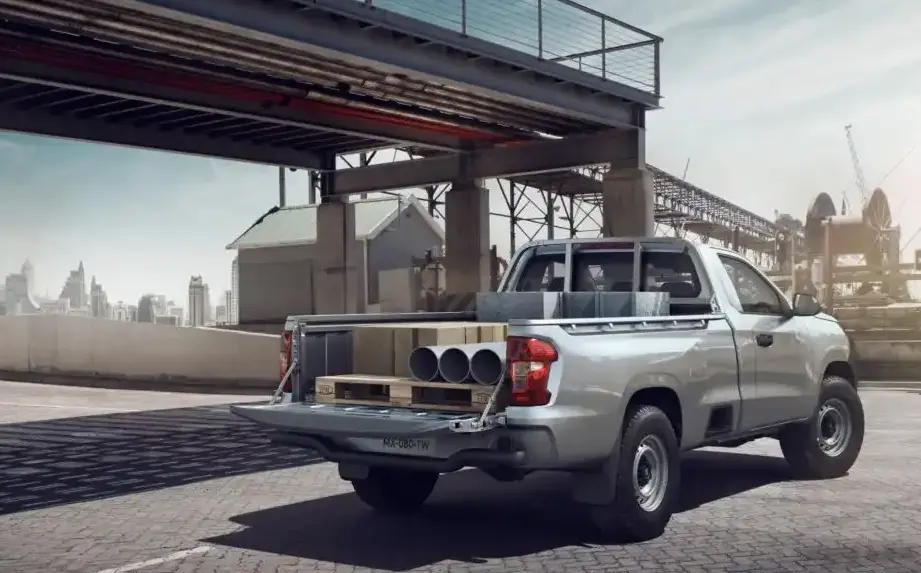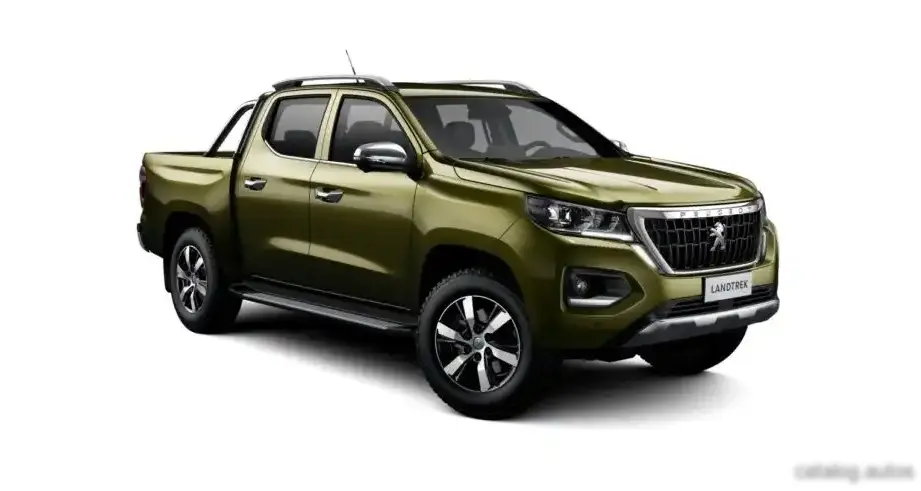
The Peugeot Landtrek Double Cab 2.4i (210 Hp) 4×4 Automatic, launched in February 2020, represents Peugeot’s entry into the competitive mid-size pickup truck segment. Developed primarily for markets outside of Europe – notably Latin America, Africa, and parts of Asia – the Landtrek aimed to provide a robust and versatile vehicle capable of both work and family duties. It’s built on a rugged ladder-frame chassis and positioned as a more affordable and practical alternative to established players like the Toyota Hilux and Ford Ranger. This particular variant, featuring the 2.4-liter turbocharged gasoline engine paired with a six-speed automatic transmission and four-wheel drive, sits towards the upper end of the Landtrek lineup, offering a balance of performance and convenience.
Technical Specifications
| Brand | Peugeot |
| Model | Landtrek |
| Generation | Landtrek Double Cab |
| Type (Engine) | 2.4i (210 Hp) 4×4 Automatic |
| Start of production | February, 2020 |
| Powertrain Architecture | Internal Combustion engine |
| Body type | Pick-up |
| Seats | 6 |
| Doors | 4 |
| Fuel consumption (combined) | 11 l/100 km (21.4 US mpg, 25.7 UK mpg, 9.1 km/l) |
| CO2 emissions | 256 g/km |
| Fuel Type | Petrol (Gasoline) |
| Acceleration 0 – 100 km/h | 11.2 sec |
| Acceleration 0 – 62 mph | 11.2 sec |
| Acceleration 0 – 60 mph | 10.6 sec |
| Maximum speed | 177 km/h (109.98 mph) |
| Emission standard | Euro 5 |
| Weight-to-power ratio | 9.7 kg/Hp, 103.4 Hp/tonne |
| Weight-to-torque ratio | 6.3 kg/Nm, 157.6 Nm/tonne |
| Power | 210 Hp @ 5600 rpm |
| Power per litre | 88.3 Hp/l |
| Torque | 320 Nm @ 2000-4000 rpm (236.02 lb.-ft. @ 2000-4000 rpm) |
| Engine layout | Front, Longitudinal |
| Engine Model/Code | 4K22D4T |
| Engine displacement | 2378 cm3 (145.11 cu. in.) |
| Number of cylinders | 4 |
| Engine configuration | Inline |
| Cylinder Bore | 87 mm (3.43 in.) |
| Piston Stroke | 100 mm (3.94 in.) |
| Compression ratio | 9.6:1 |
| Number of valves per cylinder | 4 |
| Fuel injection system | Multi-port manifold injection |
| Engine aspiration | Turbocharger, Intercooler |
| Engine oil capacity | 4.3 l (4.54 US qt | 3.78 UK qt) |
| Kerb Weight | 2030 kg (4475.38 lbs.) |
| Fuel tank capacity | 80 l (21.13 US gal | 17.6 UK gal) |
| Length | 5330 mm (209.84 in.) |
| Width | 1963 mm (77.28 in.) |
| Width including mirrors | 2221 mm (87.44 in.) |
| Height | 1897 mm (74.69 in.) |
| Wheelbase | 3180 mm (125.2 in.) |
| Front track | 1610 mm (63.39 in.) |
| Rear (Back) track | 1630 mm (64.17 in.) |
| Front overhang | 925 mm (36.42 in.) |
| Rear overhang | 1225 mm (48.23 in.) |
| Ride height (ground clearance) | 214-235 mm (8.43 – 9.25 in.) |
| Approach angle | 29.0° |
| Departure angle | 27.0° |
| Ramp-over (brakeover) angle | 25.0° |
| Wading depth | 600 mm (23.62 in.) |
| Drivetrain Architecture | The Internal combustion engine (ICE) drives the rear wheels permanently, and the front wheels are driven through an electrically or mechanically operated clutch if necessary. |
| Drive wheel | All wheel drive (4×4) |
| Number of gears and type of gearbox | 6 gears, automatic transmission |
| Front suspension | Double wishbone |
| Rear suspension | Leaf spring |
| Front brakes | Ventilated discs |
| Rear brakes | Drum |
| Assisting systems | ABS (Anti-lock braking system) |
| Steering type | Steering rack and pinion |
| Power steering | Hydraulic Steering |
| Tires size | 265/65 R17 |
| Wheel rims size | 17 |
Powertrain & Engine Architecture
The Landtrek 2.4i utilizes Peugeot’s 4K22D4T engine, a 2.4-liter inline-four cylinder gasoline engine equipped with a turbocharger and intercooler. This engine is not a common powerplant in Peugeot’s European lineup, indicating its specific development for markets where gasoline engines are more prevalent or preferred for pickup trucks. The engine employs multi-port fuel injection and boasts a compression ratio of 9.6:1. The six-speed automatic transmission is sourced from Drivetrain Systems, a well-regarded supplier, and is designed to handle the engine’s 320 Nm (236 lb-ft) of torque. The transmission features a conventional torque converter and aims for smooth shifts in both on-road and off-road conditions. The engine is longitudinally mounted, contributing to a more balanced weight distribution.
Driving Characteristics
The 210 horsepower and 320 Nm of torque provide adequate, though not exceptional, performance for a mid-size pickup. Acceleration from 0-60 mph takes around 10.6 seconds, and the top speed is rated at 177 km/h (109.98 mph). Compared to diesel-powered Landtrek variants, the 2.4i feels less responsive at low RPMs, requiring more frequent downshifts from the automatic transmission to maintain momentum, especially when carrying a load or tackling inclines. The automatic transmission is generally well-behaved, but can sometimes feel hesitant during quick acceleration. The 4×4 system offers selectable drive modes (2H, 4H, 4L) allowing drivers to adapt to varying terrain conditions. The ride quality, while acceptable, is typical of a body-on-frame pickup – firm and occasionally bumpy, particularly when unladen.
Equipment & Trim Levels
The Landtrek Double Cab 2.4i 4×4 Automatic typically comes standard with features such as air conditioning, power windows and locks, a basic audio system with Bluetooth connectivity, and ABS brakes. Higher trim levels add features like a touchscreen infotainment system, rear parking sensors, a reversing camera, alloy wheels, and upgraded interior upholstery. Safety features are generally basic, with dual front airbags being standard. Optional extras often include a bed liner, a roll bar, and various accessories for enhancing the truck’s utility.
Chassis & Braking
The Landtrek utilizes a traditional body-on-frame construction, providing a robust and durable platform for demanding applications. The front suspension consists of a double wishbone setup, while the rear employs leaf springs – a common configuration for pickup trucks designed for load-carrying capacity. The braking system features ventilated discs at the front and drum brakes at the rear. ABS (Anti-lock Braking System) is standard. The steering is rack and pinion with hydraulic power assistance, offering reasonable precision and feedback.
Market Reception & Comparison
The Landtrek has been generally well-received in its target markets, praised for its competitive pricing, robust construction, and practical features. Critics have noted that the 2.4i gasoline engine, while adequate, lacks the low-end torque and fuel efficiency of the diesel options. Compared to the diesel-powered Landtrek variants, the 2.4i offers a quieter and smoother driving experience, but at the expense of fuel economy and towing capacity. Against competitors like the Toyota Hilux and Ford Ranger, the Landtrek offers a compelling value proposition, particularly for buyers prioritizing affordability and practicality.
Legacy
The Peugeot Landtrek represents a significant step for Peugeot into the global pickup truck market. While long-term reliability data is still emerging, the 4K22D4T engine and the Drivetrain Systems automatic transmission have proven to be reasonably durable in other applications. On the used car market, the Landtrek 2.4i 4×4 Automatic is likely to appeal to buyers seeking a capable and affordable pickup truck with a comfortable driving experience. Its relatively simple mechanical design should translate to lower maintenance costs compared to more complex modern pickups.