
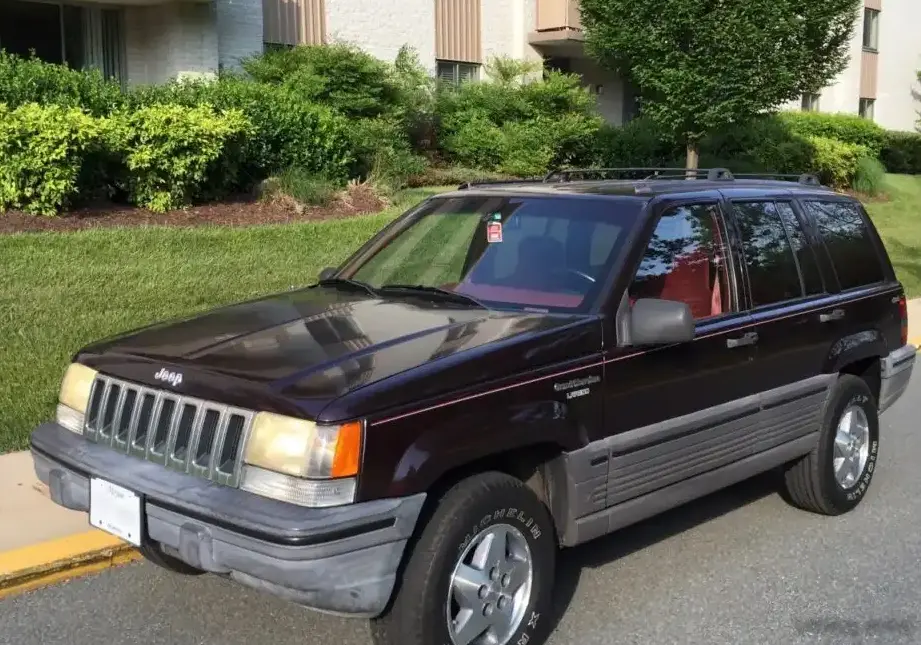
Technical Specifications
| Brand | Jeep |
| Model | Grand Cherokee |
| Generation | Grand Cherokee I (ZJ) |
| Type (Engine) | 5.2i V8 (223 Hp) Automatic |
| Start of production | 1996 |
| End of production | 1997 |
| Powertrain Architecture | Internal Combustion engine |
| Body type | SUV |
| Seats | 5 |
| Doors | 5 |
| Fuel consumption (urban) | 16.8 l/100 km (14 US mpg, 16.8 UK mpg, 6 km/l) |
| Fuel consumption (extra urban) | 13.1 l/100 km (18 US mpg, 21.6 UK mpg, 7.6 km/l) |
| Fuel consumption (combined) | 14.7 l/100 km (16 US mpg, 19.2 UK mpg, 6.8 km/l) |
| Fuel Type | Petrol (Gasoline) |
| Weight-to-power ratio | 7.6 kg/Hp, 131.3 Hp/tonne |
| Weight-to-torque ratio | 4.2 kg/Nm, 239.7 Nm/tonne |
| Power | 223 Hp @ 4400 rpm |
| Power per litre | 42.8 Hp/l |
| Torque | 407 Nm @ 2800 rpm (300.19 lb.-ft. @ 2800 rpm) |
| Engine layout | Front, Longitudinal |
| Engine Model/Code | ELF |
| Engine displacement | 5210 cm3 (317.93 cu. in.) |
| Number of cylinders | 8 |
| Engine configuration | V-engine |
| Cylinder Bore | 99.31 mm (3.91 in.) |
| Piston Stroke | 84.07 mm (3.31 in.) |
| Compression ratio | 9.1:1 |
| Number of valves per cylinder | 2 |
| Fuel injection system | Multi-port manifold injection |
| Engine aspiration | Naturally aspirated engine |
| Valvetrain | OHV |
| Engine oil capacity | 4.7 l (4.97 US qt | 4.14 UK qt) |
| Coolant capacity | 14.1 l (14.9 US qt | 12.41 UK qt) |
| Kerb Weight | 1698 kg (3743.45 lbs.) |
| Fuel tank capacity | 87 l (22.98 US gal | 19.14 UK gal) |
| Length | 4501 mm (177.2 in.) |
| Width | 1760 mm (69.29 in.) |
| Height | 1648 mm (64.88 in.) |
| Wheelbase | 2690 mm (105.91 in.) |
| Front track | 1486 mm (58.5 in.) |
| Rear track | 1460 mm (57.48 in.) |
| Ride height (ground clearance) | 210 mm (8.27 in.) |
| Drag coefficient (Cd) | 0.45 |
| Minimum turning circle | 11.2 m (36.75 ft.) |
| Approach angle | 37° |
| Departure angle | 30° |
| Ramp-over angle | 22° |
| Drivetrain Architecture | Rear wheel drive |
| Number of gears | 4 |
| Gearbox type | Automatic transmission |
| Front brakes | Ventilated discs |
| Rear brakes | Ventilated discs |
| Assisting systems | ABS (Anti-lock braking system) |
| Steering type | Steering rack and pinion |
| Power steering | Hydraulic Steering |
| Tires size | 215/75 R15 |
| Wheel rims size | 15 |
The Jeep Grand Cherokee ZJ 5.2i, produced from 1996 to 1997, represented a significant offering in the burgeoning SUV market of the mid-1990s. Positioned as a premium trim within the ZJ generation (1993-1998), the 5.2i featured a robust V8 engine paired with a four-speed automatic transmission. This combination aimed to deliver a blend of power and convenience, appealing to buyers seeking a capable and comfortable full-size SUV. It was the top-of-the-line engine option for the ZJ, offering a substantial performance upgrade over the inline-six and 4.0L V6 models.
Powertrain & Engine Architecture
At the heart of the 5.2i was the LA-series 5.2-liter (318 cubic inch) V8 engine, internally designated as the ELF. This engine, a staple of Chrysler Corporation vehicles for decades, featured a cast iron block and cylinder heads, and an overhead valve (OHV) valvetrain. It utilized a multi-port fuel injection system, delivering fuel directly to each cylinder for improved efficiency and performance. The 5.2L V8 produced 223 horsepower at 4400 rpm and 300 lb-ft of torque at 2800 rpm. The engine’s robust construction and relatively simple design contributed to its reputation for reliability. Paired with the 5.2L was a Chrysler-built 42RE four-speed automatic transmission. This transmission was chosen for its durability and ability to handle the V8’s torque output. The 42RE featured electronic control for smoother shifting and improved fuel economy compared to earlier iterations.
Driving Characteristics
The 5.2i Grand Cherokee offered a noticeable performance advantage over its six-cylinder counterparts. While not a sports car, the V8 provided ample power for highway cruising, towing, and off-road adventures. Acceleration was brisk, and the engine delivered a satisfying amount of torque for navigating challenging terrain. The four-speed automatic transmission, while not as sophisticated as modern transmissions, provided adequate gear ratios for most driving situations. Compared to the manual transmission options available on other Grand Cherokee trims, the automatic prioritized convenience over outright performance. The automatic’s shift points were calibrated for smooth operation and fuel efficiency, resulting in a more relaxed driving experience. However, drivers seeking more aggressive acceleration or greater control might have preferred the manual transmission.
Equipment & Trim Levels
The 5.2i Grand Cherokee typically came well-equipped, reflecting its position as the premium trim level. Standard features often included air conditioning, power windows and locks, cruise control, and an upgraded sound system. Interior upholstery was typically cloth or leather, with woodgrain trim accents. Optional extras included a sunroof, premium sound system with a CD changer, and upgraded leather seating. The 5.2i also often featured a heavy-duty suspension package, designed to handle the added weight of the V8 engine and provide improved towing capacity. The dashboard configuration was consistent across the ZJ range, featuring a straightforward layout with easy-to-read gauges.
Chassis & Braking
The ZJ Grand Cherokee utilized a body-on-frame construction, providing a robust and durable platform. The suspension consisted of a traditional setup with coil springs and shock absorbers. The front suspension featured an independent double-wishbone design, while the rear suspension utilized a solid axle with coil springs. Braking duties were handled by ventilated disc brakes on all four wheels, providing adequate stopping power for the vehicle’s weight. An Anti-lock Braking System (ABS) was standard, enhancing safety and control during emergency braking situations. The 5.2i models often featured a thicker stabilizer bar compared to the base models, further improving handling and reducing body roll.
Market Reception & Comparison
The 5.2i Grand Cherokee was generally well-received by automotive critics, who praised its powerful engine and comfortable ride. However, its fuel economy was a common criticism, as the V8 engine consumed significantly more fuel than the six-cylinder options. Compared to the 4.0L inline-six, the 5.2i offered a substantial performance boost but at the cost of increased fuel consumption and a higher purchase price. The 4.0L V6 offered a compromise between performance and fuel economy, appealing to buyers who didn’t require the V8’s extra power. Reliability was generally good, although the 5.2L engine was known to be prone to oil leaks as it aged.
Legacy
The ZJ Grand Cherokee 5.2i remains a popular choice among collectors and enthusiasts today. Its robust construction, powerful engine, and relatively simple mechanical design make it a relatively easy vehicle to maintain and repair. While fuel economy is a concern, the 5.2i’s performance and capability continue to appeal to those seeking a classic American SUV. The LA-series V8 engine is known for its durability and longevity, and many examples are still running strong after decades of service. In the used car market, the 5.2i typically commands a higher price than the six-cylinder models, reflecting its desirability and rarity.
