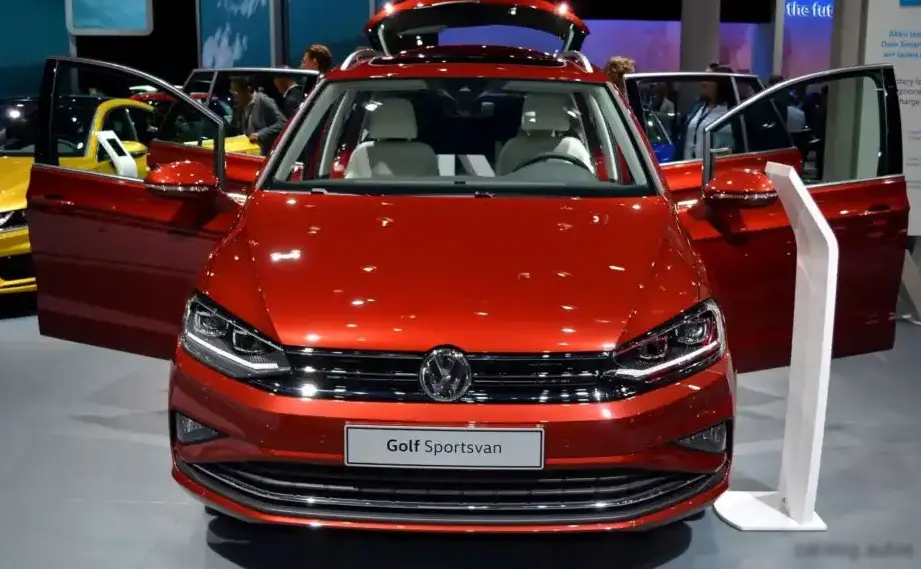
The Volkswagen Golf VII Sportsvan, specifically the 1.0 TSI (85 horsepower) variant produced from March 2017 to 2019, represents an entry-level offering within the broader Sportsvan lineup. Positioned as a compact minivan based on the Volkswagen Group’s MQB platform (specifically the A3/1HX0 iteration), it aimed to provide a practical and fuel-efficient option for families and individuals seeking a versatile vehicle. This facelifted version, introduced in 2017, brought styling updates and refined engine options to the existing Sportsvan model, which itself was a more spacious alternative to the standard Golf hatchback.
Technical Specifications
| Brand | Volkswagen |
| Model | Golf |
| Generation | Golf VII Sportsvan (facelift 2017) |
| Type (Engine) | 1.0 TSI (85 Hp) |
| Start of production | March, 2017 |
| End of production | 2019 |
| Powertrain Architecture | Internal Combustion engine |
| Body type | Minivan |
| Seats | 5 |
| Doors | 5 |
| Fuel consumption (urban) | 6 l/100 km (39.2 US mpg, 47.1 UK mpg, 16.7 km/l) |
| Fuel consumption (extra urban) | 4.3 l/100 km (54.7 US mpg, 65.7 UK mpg, 23.3 km/l) |
| Fuel consumption (combined) | 4.9 l/100 km (48 US mpg, 57.6 UK mpg, 20.4 km/l) |
| CO2 emissions | 112 g/km |
| Fuel Type | Petrol (Gasoline) |
| Acceleration 0 – 100 km/h | 13 sec |
| Acceleration 0 – 62 mph | 13 sec |
| Acceleration 0 – 60 mph | 12.4 sec |
| Maximum speed | 177 km/h (109.98 mph) |
| Emission standard | Euro 6 |
| Weight-to-power ratio | 15.7 kg/Hp, 63.7 Hp/tonne |
| Weight-to-torque ratio | 7.6 kg/Nm, 131.1 Nm/tonne |
| Power | 85 Hp |
| Power per litre | 85.1 Hp/l |
| Torque | 175 Nm @ 2000-3000 rpm (129.07 lb.-ft. @ 2000-3000 rpm) |
| Engine layout | Front, Transverse |
| Engine Model/Code | CHZF, CHZK |
| Engine displacement | 999 cm3 (60.96 cu. in.) |
| Engine configuration | Inline |
| Fuel injection system | Direct injection |
| Engine aspiration | Turbocharger, Intercooler |
| Engine oil capacity | 4 l (4.23 US qt | 3.52 UK qt) |
| Kerb Weight | 1335 kg (2943.17 lbs.) |
| Max. weight | 1850 kg (4078.55 lbs.) |
| Max load | 515 kg (1135.38 lbs.) |
| Trunk (boot) space – maximum | 1520 l (53.68 cu. ft.) |
| Fuel tank capacity | 50 l (13.21 US gal | 11 UK gal) |
| Max. roof load | 75 kg (165.35 lbs.) |
| Permitted trailer load with brakes (8%) | 1300 kg (2866.01 lbs.) |
| Permitted trailer load with brakes (12%) | 1100 kg (2425.08 lbs.) |
| Permitted trailer load without brakes | 660 kg (1455.05 lbs.) |
| Permitted towbar download | 80 kg (176.37 lbs.) |
| Length | 4351 mm (171.3 in.) |
| Width | 1807 mm (71.14 in.) |
| Height | 1613 mm (63.5 in.) |
| Wheelbase | 2670 mm (105.12 in.) |
| Front track | 1533-1549 mm (60.35 – 60.98 in.) |
| Rear (Back) track | 1504-1520 mm (59.21 – 59.84 in.) |
| Drive wheel | Front wheel drive |
| Number of gears and type of gearbox | 5 gears, manual transmission |
| Front brakes | Ventilated discs |
| Rear brakes | Disc |
| Assisting systems | ABS (Anti-lock braking system) |
| Steering type | Steering rack and pinion |
| Power steering | Electric Steering |
Powertrain & Engine Architecture
The heart of this Sportsvan variant is the 1.0 TSI engine, specifically the CHZF or CHZK engine codes. This is a three-cylinder, turbocharged gasoline engine utilizing direct fuel injection. The engine’s compact size and turbocharging contribute to a balance between fuel efficiency and reasonable performance. The direct injection system allows for precise fuel delivery, optimizing combustion and reducing emissions. The engine features a single overhead camshaft (SOHC) valvetrain with four valves per cylinder. The 1.0 TSI engine is known for its relatively quiet operation, though some owners have reported a slight characteristic three-cylinder thrum. Paired with this engine is a five-speed manual transmission, chosen for its simplicity and cost-effectiveness in this entry-level trim. The transmission’s gear ratios are geared towards fuel economy, with a taller final drive compared to higher-output versions.
Driving Characteristics
The 85 horsepower output and 175 Nm (129 lb-ft) of torque deliver adequate, but not exhilarating, performance. Acceleration from 0-60 mph takes around 12.4 seconds, and top speed is around 109.98 mph. In real-world driving, the 1.0 TSI feels best suited for city and highway cruising. Overtaking maneuvers require planning, and the engine can feel strained when climbing steep hills or carrying a full load. The five-speed manual transmission is relatively smooth, but the gear ratios are spaced to prioritize fuel economy over spirited driving. Compared to the more powerful 1.4 TSI or diesel variants, this 1.0 TSI feels noticeably slower, but it offers a more economical driving experience.
Equipment & Trim Levels
The 1.0 TSI Sportsvan typically came with a base level of equipment. Standard features generally included air conditioning, a basic infotainment system with a touchscreen display, power windows, and central locking. Safety features such as ABS, electronic stability control, and multiple airbags were also standard. Interior upholstery was typically cloth, and the dashboard featured a functional, if somewhat basic, design. Optional extras included alloy wheels, upgraded infotainment systems with navigation, parking sensors, and a panoramic sunroof. The trim level often sat as the entry point to the Sportsvan range, making it attractive to budget-conscious buyers.
Chassis & Braking
The Sportsvan’s chassis utilizes a MacPherson strut front suspension and a multi-link rear suspension, providing a comfortable ride quality. The suspension is tuned for comfort rather than sporty handling. Braking duties are handled by ventilated discs on the front wheels and solid discs on the rear. ABS (Anti-lock Braking System) is standard. The weight distribution is fairly balanced, contributing to predictable handling. Stabilizer bars are present on both axles, helping to reduce body roll during cornering.
Market Reception & Comparison
The 1.0 TSI Sportsvan was generally well-received as a practical and affordable family vehicle. Critics praised its fuel efficiency and spacious interior, but noted its lack of outright performance. Compared to the 1.4 TSI and diesel variants, the 1.0 TSI offered lower running costs but sacrificed performance. The 1.4 TSI provided a noticeable power boost, while the diesel models offered even better fuel economy and torque. However, the 1.0 TSI’s lower price point made it an attractive option for buyers prioritizing affordability and fuel efficiency.
Legacy
The 1.0 TSI engine has proven to be a relatively reliable powertrain, although some owners have reported issues with the timing chain, particularly on earlier versions. Regular maintenance, including oil changes and timing chain inspections, is crucial for ensuring long-term reliability. In the used car market, the 1.0 TSI Sportsvan represents a good value proposition for buyers seeking a practical and economical family vehicle. Its relatively low running costs and spacious interior make it a popular choice for those who prioritize practicality over performance. The Sportsvan, in general, offered a compelling alternative to traditional MPVs, and the 1.0 TSI variant broadened its appeal to a wider range of buyers.