
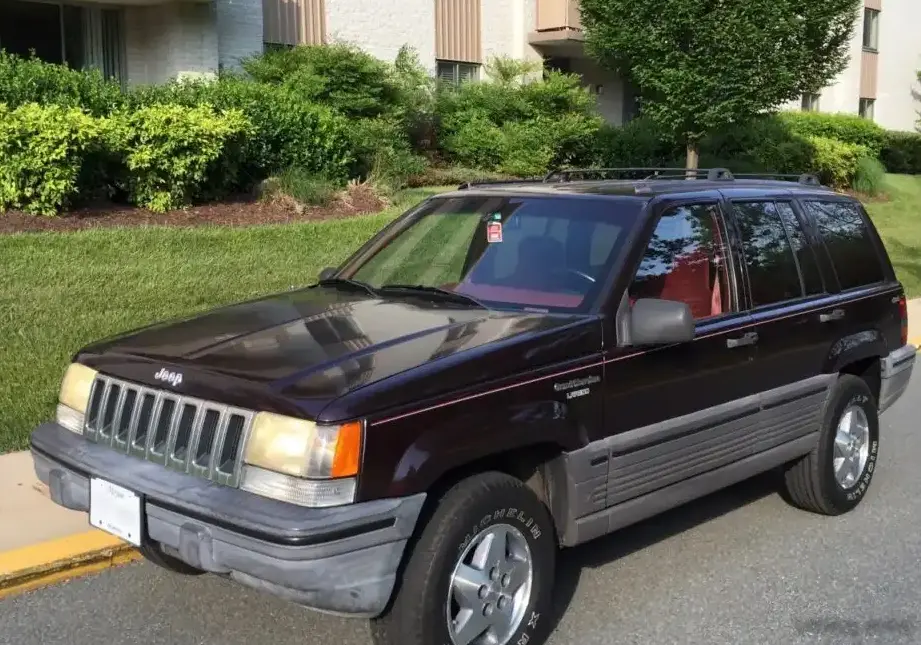
The Jeep Grand Cherokee ZJ, produced from 1993 to 1998, represented a significant step forward for the Jeep brand, moving it into the burgeoning luxury SUV market. The 5.9i V8 4×4 Automatic variant, available from 1997-1998, was the top-of-the-line offering, positioned as the premium, high-performance model within the ZJ range. It catered to buyers seeking a powerful and capable SUV with a more refined driving experience than the base inline-six or 4.0L V6 models. This model year marked the end of the ZJ generation, making the 5.9i a desirable collector’s item for Jeep enthusiasts.
Technical Specifications
| Brand | Jeep |
| Model | Grand Cherokee |
| Generation | Grand Cherokee I (ZJ) |
| Type (Engine) | 5.9i V8 (241 Hp) 4×4 Automatic |
| Start of production | 1997 |
| End of production | 1998 |
| Powertrain Architecture | Internal Combustion engine |
| Body type | SUV |
| Seats | 5 |
| Doors | 5 |
| Fuel consumption (urban) | 26.1 l/100 km (9 US mpg, 10.8 UK mpg, 3.8 km/l) |
| Fuel consumption (extra urban) | 13.3 l/100 km (17.7 US mpg, 21.2 UK mpg, 7.5 km/l) |
| Fuel consumption (combined) | 17.9 l/100 km (13.1 US mpg, 15.8 UK mpg, 5.6 km/l) |
| Fuel Type | Petrol (Gasoline) |
| Acceleration 0 – 100 km/h | 8.2 sec |
| Acceleration 0 – 62 mph | 8.2 sec |
| Acceleration 0 – 60 mph | 7.8 sec |
| Maximum speed | 200 km/h (124.27 mph) |
| Weight-to-power ratio | 8 kg/Hp, 124.7 Hp/tonne |
| Weight-to-torque ratio | 4.1 kg/Nm, 244.2 Nm/tonne |
| Power | 241 Hp @ 4050 rpm |
| Power per litre | 40.9 Hp/l |
| Torque | 472 Nm @ 3050 rpm (348.13 lb.-ft. @ 3050 rpm) |
| Engine layout | Front, Longitudinal |
| Engine Model/Code | EML |
| Engine displacement | 5898 cm3 (359.92 cu. in.) |
| Number of cylinders | 8 |
| Engine configuration | V-engine |
| Cylinder Bore | 101.6 mm (4 in.) |
| Piston Stroke | 90.93 mm (3.58 in.) |
| Compression ratio | 8.7:1 |
| Number of valves per cylinder | 2 |
| Fuel injection system | Multi-port manifold injection |
| Engine aspiration | Naturally aspirated engine |
| Engine oil capacity | 4.7 l (4.97 US qt | 4.14 UK qt) |
| Coolant capacity | 14.1 l (14.9 US qt | 12.41 UK qt) |
| Kerb Weight | 1933 kg (4261.54 lbs.) |
| Max. weight | 2440 kg (5379.28 lbs.) |
| Max load | 507 kg (1117.74 lbs.) |
| Trunk (boot) space – minimum | 1135 l (40.08 cu. ft.) |
| Trunk (boot) space – maximum | 2255 l (79.63 cu. ft.) |
| Fuel tank capacity | 87 l (22.98 US gal | 19.14 UK gal) |
| Length | 4500 mm (177.17 in.) |
| Width | 1800 mm (70.87 in.) |
| Height | 1720 mm (67.72 in.) |
| Wheelbase | 2690 mm (105.91 in.) |
| Front track | 1486 mm (58.5 in.) |
| Rear (Back) track | 1494 mm (58.82 in.) |
| Ride height (ground clearance) | 193 mm (7.6 in.) |
| Drag coefficient (Cd) | 0.45 |
| Minimum turning circle | 11.43 m (37.5 ft.) |
| Approach angle | 36.8° |
| Departure angle | 29.6° |
| Ramp-over angle | 17° |
| Drive wheel | All wheel drive (4×4) |
| Number of gears | 4 |
| Gearbox type | Automatic transmission |
| Front brakes | Ventilated discs |
| Rear brakes | Ventilated discs |
| Assisting systems | ABS (Anti-lock braking system) |
| Steering type | Steering rack and pinion |
| Power steering | Hydraulic Steering |
| Tires size | 225/70 R16 |
| Wheel rims size | 16 |
Powertrain & Engine Architecture
The heart of the 5.9i Grand Cherokee is the EML 5.9-liter (359.92 cubic inch) V8 engine. This engine, a member of the LA series V8 family, is a robust and relatively simple design. It features a cast iron block, aluminum cylinder heads, and a two-valve-per-cylinder configuration. Fuel delivery is handled by a multi-port fuel injection system, providing precise fuel metering for improved efficiency and performance. The 5.9L V8 produces 241 horsepower at 4050 rpm and 348 lb-ft of torque at 3050 rpm. The engine is longitudinally mounted, driving all four wheels through a four-speed automatic transmission (typically the 42RE or 45RFE). This transmission was chosen for its durability and ability to handle the engine’s substantial torque output. The automatic transmission featured electronic control for smoother shifting and improved fuel economy compared to earlier iterations.
Driving Characteristics
The 5.9i Grand Cherokee offered a noticeable performance advantage over its lower-displacement siblings. The substantial torque output of the 5.9L V8 provided strong acceleration, especially at lower speeds, making it well-suited for towing and off-road driving. While the 0-60 mph time of around 7.8 seconds wasn’t groundbreaking, it was respectable for a full-size SUV of that era. The four-speed automatic transmission, while not as sophisticated as modern transmissions, provided adequate gear ratios for both on-road cruising and off-road crawling. Compared to the manual transmission options available on other Grand Cherokee trims, the automatic prioritized ease of use and comfort over outright performance. The heavier weight of the 5.9i, combined with the automatic transmission, did result in slightly lower fuel economy compared to the 4.0L inline-six or V6 models.
Equipment & Trim Levels
The 5.9i Grand Cherokee typically came well-equipped, reflecting its position as the premium trim level. Standard features included leather upholstery, power-adjustable front seats, air conditioning, a premium sound system, and alloy wheels. Optional extras included a sunroof, upgraded audio systems, and a rear entertainment system. The interior trim was generally more luxurious than lower trims, with woodgrain accents and higher-quality materials. The 5.9i also often featured a more comprehensive suite of electronic features, such as automatic climate control and a trip computer.
Chassis & Braking
The ZJ Grand Cherokee utilized a body-on-frame construction, providing a robust and durable platform. The 5.9i model featured a heavy-duty suspension system designed to handle the increased weight and power of the V8 engine. Front suspension consisted of a double wishbone setup with coil springs, while the rear suspension utilized a multi-link design with coil springs. Braking duties were handled by ventilated disc brakes on all four wheels, providing ample stopping power. An Anti-lock Braking System (ABS) was standard, enhancing safety and control during emergency braking situations.
Market Reception & Comparison
The 5.9i Grand Cherokee was generally well-received by automotive critics, who praised its powerful engine, comfortable ride, and luxurious interior. However, its fuel economy was often criticized, as was typical for a large V8-powered SUV. Compared to the 4.0L inline-six and V6 models, the 5.9i offered significantly more performance but at a higher price point and with reduced fuel efficiency. It competed with other luxury SUVs of the time, such as the Ford Explorer Limited and the Chevrolet Tahoe, offering a unique blend of off-road capability and on-road refinement.
Legacy
The 5.9i Grand Cherokee ZJ has become a sought-after vehicle among Jeep collectors and enthusiasts. The EML 5.9L V8 engine is known for its durability and relative simplicity, making it a relatively easy engine to maintain and repair. While fuel economy is a concern by modern standards, the 5.9i remains a capable and enjoyable SUV. Well-maintained examples command a premium in the used car market, reflecting their rarity and desirability. The ZJ generation, and particularly the 5.9i variant, played a crucial role in establishing the Grand Cherokee as a leading SUV in the American market.
