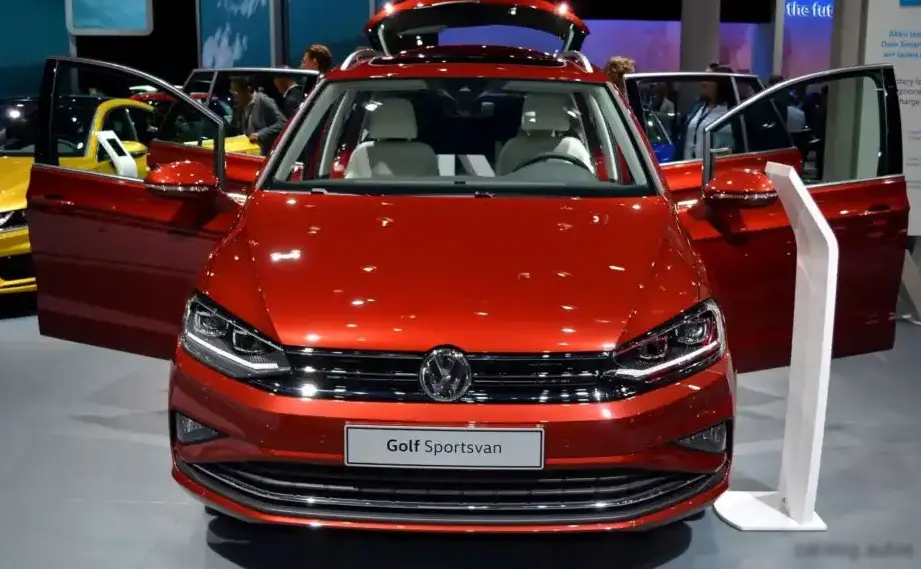
The Volkswagen Golf VII Sportsvan, specifically the 1.6 TDI SCR variant produced from April 2017 to 2019, represents a practical and fuel-efficient offering within the broader Golf VII range. Positioned as a compact minivan, or multi-purpose vehicle (MPV) in European terminology, the Sportsvan aimed to bridge the gap between the standard Golf hatchback and larger vehicles like the Touran. This particular engine and transmission combination – a 1.6-liter turbocharged diesel producing 116 horsepower paired with a five-speed manual gearbox – was a common choice for buyers prioritizing economy and usability over outright performance. It was a mid-range offering, sitting below the more powerful diesel variants and gasoline engines in the Sportsvan lineup.
Technical Specifications
| Brand | Volkswagen |
| Model | Golf |
| Generation | Golf VII Sportsvan (facelift 2017) |
| Type (Engine) | 1.6 TDI SCR (116 Hp) |
| Start of production | April, 2017 |
| End of production | 2019 |
| Powertrain Architecture | Internal Combustion engine |
| Body type | Minivan |
| Seats | 5 |
| Doors | 5 |
| Fuel consumption (urban) | 4.8-5.1 l/100 km (49 – 46.1 US mpg, 58.9 – 55.4 UK mpg, 20.8 – 19.6 km/l) |
| Fuel consumption (extra urban) | 4.0-4.2 l/100 km (58.8 – 56 US mpg, 70.6 – 67.3 UK mpg, 25 – 23.8 km/l) |
| Fuel consumption (combined) | 4.3 l/100 km (54.7 US mpg, 65.7 UK mpg, 23.3 km/l) |
| CO2 emissions | 113-116 g/km |
| Fuel Type | Diesel |
| Acceleration 0 – 100 km/h | 11.1 sec |
| Acceleration 0 – 62 mph | 11.1 sec |
| Acceleration 0 – 60 mph | 10.5 sec |
| Maximum speed | 194 km/h (120.55 mph) |
| Emission standard | Euro 6d-TEMP |
| Weight-to-power ratio | 12.5 kg/Hp, 80.3 Hp/tonne |
| Weight-to-torque ratio | 5.8 kg/Nm, 173 Nm/tonne |
| Power | 116 Hp |
| Power per litre | 72.6 Hp/l |
| Torque | 250 Nm @ 1750-3200 rpm (184.39 lb.-ft. @ 1750-3200 rpm) |
| Engine layout | Front, Transverse |
| Engine Model/Code | DDYA, DGTE |
| Engine displacement | 1598 cm3 (97.52 cu. in.) |
| Number of cylinders | 4 |
| Engine configuration | Inline |
| Number of valves per cylinder | 4 |
| Fuel injection system | Diesel Commonrail |
| Engine aspiration | Turbocharger, Intercooler |
| Engine oil capacity | 4.7 l (4.97 US qt | 4.14 UK qt) |
| Kerb Weight | 1445 kg (3185.68 lbs.) |
| Max. weight | 1950 kg (4299.01 lbs.) |
| Max load | 505 kg (1113.33 lbs.) |
| Trunk (boot) space – minimum | 590 l (20.84 cu. ft.) |
| Trunk (boot) space – maximum | 1520 l (53.68 cu. ft.) |
| Fuel tank capacity | 50 l (13.21 US gal | 11 UK gal) |
| AdBlue tank | 12 l (3.17 US gal | 2.64 UK gal) |
| Max. roof load | 75 kg (165.35 lbs.) |
| Permitted trailer load with brakes (8%) | 1800 kg (3968.32 lbs.) |
| Permitted trailer load with brakes (12%) | 1500 kg (3306.93 lbs.) |
| Permitted trailer load without brakes | 720 kg (1587.33 lbs.) |
| Permitted towbar download | 80 kg (176.37 lbs.) |
| Length | 4351 mm (171.3 in.) |
| Width | 1807 mm (71.14 in.) |
| Width including mirrors | 2050 mm (80.71 in.) |
| Height | 1613 mm (63.5 in.) |
| Wheelbase | 2670 mm (105.12 in.) |
| Front track | 1533-1549 mm (60.35 – 60.98 in.) |
| Rear (Back) track | 1504-1520 mm (59.21 – 59.84 in.) |
| Minimum turning circle | 11.1 m (36.42 ft.) |
| Drive wheel | Front wheel drive |
| Number of gears and type of gearbox | 5 gears, manual transmission |
| Assisting systems | ABS (Anti-lock braking system) |
| Steering type | Steering rack and pinion |
| Power steering | Electric Steering |
| Tires size | 205/55 R16; 205/50 R17 |
| Wheel rims size | 6.5J x 16; 6J x 17 |
Powertrain & Engine Architecture
The heart of this Sportsvan variant is the 1.6-liter (1598cc) inline-four cylinder diesel engine, identified by engine codes DDYA or DGTE. This engine belongs to Volkswagen’s EA188 family, a widely used and continually developed engine platform. It utilizes a turbocharger with an intercooler to boost power and efficiency. The fuel injection system is a common rail direct injection system, delivering fuel directly into the combustion chamber at high pressure for optimized combustion. The engine features four valves per cylinder (16 valves total) and is designed for relatively low-end torque delivery. The SCR (Selective Catalytic Reduction) system, integrated into the exhaust, uses AdBlue (Diesel Exhaust Fluid) to reduce nitrogen oxide (NOx) emissions, ensuring compliance with Euro 6d-TEMP emission standards. The five-speed manual transmission provides a straightforward and reliable means of transferring power to the front wheels. Gear ratios are geared towards fuel efficiency rather than rapid acceleration.
Driving Characteristics
The 116 horsepower and 250 Nm (184 lb-ft) of torque produced by this engine configuration provide adequate, but not exhilarating, performance. Acceleration from 0-60 mph takes around 10.5 seconds, and top speed is approximately 120.55 mph. The engine’s torque peak, available from 1750-3200 rpm, means that it feels reasonably responsive in everyday driving situations, such as overtaking or merging onto highways. However, compared to higher-output diesel versions (like the 2.0 TDI) or even gasoline engines in the Sportsvan range, this variant feels noticeably slower. The five-speed manual transmission, while simple, lacks the extra gear found in some competitors, which can lead to higher engine speeds on the highway. The focus is clearly on providing a comfortable and economical driving experience rather than sporty handling.
Equipment & Trim Levels
The 1.6 TDI SCR Sportsvan typically came with a reasonable level of standard equipment. This included air conditioning, a touchscreen infotainment system (usually Composition Colour), electric front windows, and central locking. Safety features such as ABS, ESC (Electronic Stability Control), and multiple airbags were standard. Interior upholstery was typically cloth, and dashboard trim was functional rather than luxurious. Optional extras included features like parking sensors, automatic climate control, upgraded infotainment systems (Discover Media or Discover Pro), alloy wheels, and a panoramic sunroof. Trim levels varied by market, but this engine was often found in the base or mid-range trims.
Chassis & Braking
The Golf Sportsvan utilizes a MacPherson strut front suspension and a multi-link rear suspension, providing a comfortable ride quality. The suspension setup is tuned for everyday usability rather than aggressive cornering. Braking systems typically consisted of disc brakes on the front wheels and drum brakes on the rear wheels, although some higher-trim models may have featured rear disc brakes. The steering is electrically assisted, providing light and easy steering feel. Stabilizer bars are present on both axles to reduce body roll during cornering.
Market Reception & Comparison
The 1.6 TDI SCR Sportsvan was generally well-received by critics as a practical and economical family vehicle. Its fuel efficiency was a major selling point, and its spacious interior made it a good choice for those needing extra cargo capacity. However, some reviewers noted that the engine lacked the punch of more powerful alternatives. Compared to the 2.0 TDI Sportsvan, the 1.6 TDI offered lower running costs but significantly reduced performance. Against competitors like the Citroën C4 Picasso or Renault Scenic, the Golf Sportsvan was often praised for its build quality and driving dynamics, but sometimes criticized for its higher price.
Legacy
The 1.6 TDI engine, in various iterations, proved to be a relatively reliable powertrain. However, like many modern diesel engines, it is susceptible to issues with the diesel particulate filter (DPF) if not driven on longer journeys regularly. The SCR system also requires periodic AdBlue refills. In the used car market, these Sportsvans represent a good value proposition for buyers seeking an economical and practical MPV. Maintenance costs are generally reasonable, and parts availability is good. The combination of fuel efficiency, practicality, and the Volkswagen badge continues to make this variant a popular choice for budget-conscious families.