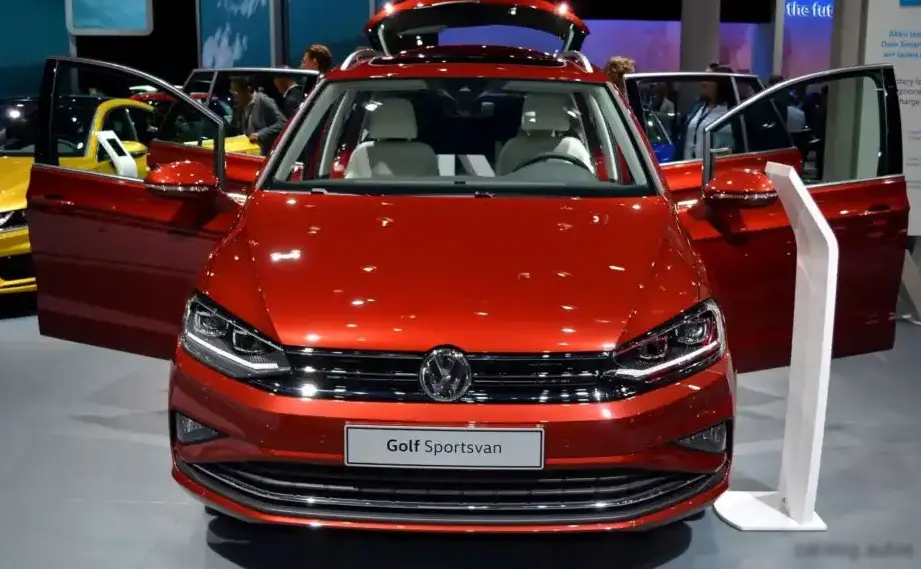
The Volkswagen Golf VII Sportsvan, specifically the 2.0 TDI SCR variant with 150 horsepower and a dual-clutch gearbox (DSG), was produced from 2017 to 2019. This model represents a facelift within the seventh generation of the Golf Sportsvan, a compact minivan designed to offer increased practicality and space compared to the standard Golf hatchback. Positioned as a mid-range offering within the Sportsvan lineup, it aimed to balance fuel efficiency, performance, and family-oriented features. The Sportsvan, marketed primarily in Europe, filled a niche between the traditional hatchback and larger MPV (Multi-Purpose Vehicle) segments.
Technical Specifications
| Brand | Volkswagen |
| Model | Golf |
| Generation | Golf VII Sportsvan (facelift 2017) |
| Type (Engine) | 2.0 TDI SCR (150 Hp) DSG |
| Start of production | 2017 |
| End of production | 2019 |
| Powertrain Architecture | Internal Combustion engine |
| Body type | Minivan |
| Seats | 5 |
| Doors | 5 |
| Fuel consumption (urban) | 5.4-5.5 l/100 km (43.6 – 42.8 US mpg) |
| Fuel consumption (extra urban) | 4.1-4.2 l/100 km (57.4 – 56 US mpg) |
| Fuel consumption (combined) | 4.6-4.7 l/100 km (51.1 – 50 US mpg) |
| CO2 emissions | 120-122 g/km |
| Fuel Type | Diesel |
| Acceleration 0 – 100 km/h | 9.3 sec |
| Acceleration 0 – 62 mph | 9.3 sec |
| Acceleration 0 – 60 mph | 8.8 sec |
| Maximum speed | 210 km/h (130.49 mph) |
| Emission standard | Euro 6d-TEMP |
| Weight-to-power ratio | 10.2 kg/Hp |
| Weight-to-torque ratio | 4.5 kg/Nm |
| Power | 150 Hp |
| Torque | 340 Nm @ 1750-3000 rpm (250.77 lb.-ft. @ 1750-3000 rpm) |
| Engine layout | Front, Transverse |
| Engine Model/Code | CRLB, DCYA, DEJA, DFGA |
| Engine displacement | 1968 cm3 (120.09 cu. in.) |
| Number of cylinders | 4 |
| Engine configuration | Inline |
| Number of valves per cylinder | 4 |
| Fuel injection system | Diesel Commonrail |
| Engine aspiration | Turbocharger, Intercooler |
| Engine oil capacity | 4.7 l (4.97 US qt | 4.14 UK qt) |
| Kerb Weight | 1535 kg (3384.1 lbs.) |
| Max. weight | 2020 kg (4453.34 lbs.) |
| Max load | 485 kg (1069.24 lbs.) |
| Trunk (boot) space – minimum | 590 l (20.84 cu. ft.) |
| Trunk (boot) space – maximum | 1520 l (53.68 cu. ft.) |
| Fuel tank capacity | 50 l (13.21 US gal | 11 UK gal) |
| AdBlue tank | 12 l (3.17 US gal | 2.64 UK gal) |
| Max. roof load | 75 kg (165.35 lbs.) |
| Permitted trailer load with brakes (8%) | 1800 kg (3968.32 lbs.) |
| Permitted trailer load with brakes (12%) | 1600 kg (3527.4 lbs.) |
| Permitted trailer load without brakes | 750 kg (1653.47 lbs.) |
| Permitted towbar download | 80 kg (176.37 lbs.) |
| Length | 4351 mm (171.3 in.) |
| Width | 1807 mm (71.14 in.) |
| Width including mirrors | 2050 mm (80.71 in.) |
| Height | 1613 mm (63.5 in.) |
| Wheelbase | 2670 mm (105.12 in.) |
| Drive wheel | Front wheel drive |
| Number of gears and type of gearbox | 7 gears, automatic transmission DSG |
INTRODUCTION
The Volkswagen Golf VII Sportsvan, launched in 2014 and facelifted in 2017, was designed to bridge the gap between the standard Golf and larger MPV offerings like the Touran. Built on the Volkswagen Group’s MQB platform (specifically the A3 variant, also known as 1HX0), the Sportsvan prioritized interior space and versatility. The 2.0 TDI SCR 150 hp DSG variant was a popular choice, offering a balance of performance and fuel economy for families and drivers seeking a practical yet refined vehicle. This engine and transmission combination was a key part of the Sportsvan’s appeal in European markets where diesel engines remained dominant.
Powertrain & Engine Architecture
The heart of this Sportsvan is the 2.0-liter four-cylinder diesel engine, identified by engine codes such as CRLB, DCYA, DEJA, and DFGA. This engine utilizes a common rail direct injection system, delivering fuel directly into the combustion chamber at extremely high pressure for optimized combustion. A turbocharger with an intercooler is employed to boost power output and improve efficiency. The engine also incorporates Selective Catalytic Reduction (SCR) technology, utilizing AdBlue (Diesel Exhaust Fluid) to reduce nitrogen oxide (NOx) emissions, ensuring compliance with stringent Euro 6d-TEMP emission standards. The 150 horsepower output is achieved at 4,200 rpm, while the substantial 340 Nm (250.77 lb.-ft.) of torque is available from 1,750 to 3,000 rpm, providing strong pulling power. The engine is transversely mounted in the front of the vehicle. The 7-speed DSG (Direct-Shift Gearbox) is a dual-clutch transmission known for its quick and smooth gear changes. It operates similarly to two manual gearboxes in one, allowing for seamless shifts and contributing to improved fuel efficiency.
Driving Characteristics
The 2.0 TDI SCR 150 hp/DSG combination in the Golf Sportsvan delivers a comfortable and capable driving experience. While not overtly sporty, the engine provides ample power for everyday driving and overtaking maneuvers. The DSG transmission contributes to brisk acceleration, with a 0-62 mph (0-100 km/h) time of around 9.3 seconds. The broad torque curve ensures responsive performance at lower engine speeds, making it well-suited for city driving and highway cruising. Compared to the lower-powered 1.6 TDI variants, the 2.0 TDI offers noticeably more punch. However, it doesn’t match the performance of the more expensive and less common petrol-powered Golf Sportsvans. The DSG transmission’s gear ratios are optimized for both fuel efficiency and performance, providing a good balance between the two. The steering is precise and well-weighted, and the suspension offers a comfortable ride, absorbing bumps and imperfections in the road surface effectively.
Equipment & Trim Levels
The 2.0 TDI SCR 150 hp DSG Sportsvan typically came equipped with a generous level of standard features. These included air conditioning, an infotainment system with a touchscreen display, Bluetooth connectivity, alloy wheels, and a suite of safety features such as ABS, ESP (Electronic Stability Program), and multiple airbags. Higher trim levels offered additional features such as automatic climate control, a larger infotainment screen with navigation, parking sensors, adaptive cruise control, and leather upholstery. Interior upholstery was typically cloth on base models, with optional leather upgrades available. The dashboard layout was similar to that of the standard Golf VII, with a focus on ergonomics and user-friendliness.
Chassis & Braking
The Golf Sportsvan’s chassis is based on the MQB platform, providing a solid and stable foundation. The suspension consists of independent MacPherson struts at the front and a multi-link setup at the rear. The braking system typically features disc brakes on all four wheels, although some base models may have drum brakes on the rear axle. ABS (Anti-lock Braking System) and ESP (Electronic Stability Program) are standard features, enhancing safety and stability. Stabilizer bars are fitted to both the front and rear axles to reduce body roll during cornering.
Market Reception & Comparison
The Golf Sportsvan 2.0 TDI SCR 150 hp DSG was generally well-received by automotive critics. It was praised for its spacious interior, comfortable ride, and fuel efficiency. The DSG transmission was also a highlight, offering smooth and quick gear changes. Compared to other compact minivans, the Sportsvan was considered to be more refined and engaging to drive. The 2.0 TDI engine offered a good balance between performance and economy, making it a practical choice for families. However, some critics noted that the price was relatively high compared to some competitors. Fuel economy figures of 4.6-4.7 l/100 km (51.1 – 50 US mpg) were competitive for its class.
Legacy
The 2.0 TDI engine, in various iterations, has proven to be a reliable and durable powertrain. However, like many modern diesel engines, it’s important to adhere to recommended maintenance schedules, including regular oil changes and AdBlue refills. The DSG transmission, while generally reliable, can be susceptible to issues if not properly maintained. In the used car market, the Golf Sportsvan 2.0 TDI SCR 150 hp DSG remains a popular choice, offering a practical and well-equipped vehicle at a reasonable price. Its combination of space, efficiency, and refinement continues to appeal to buyers seeking a versatile family car.