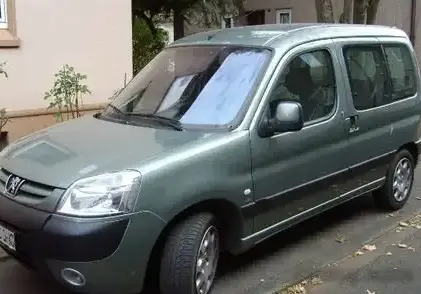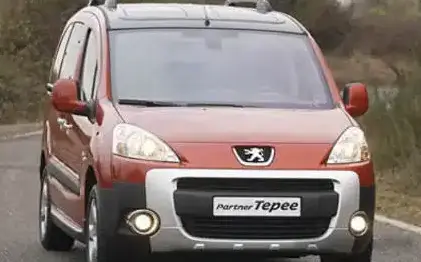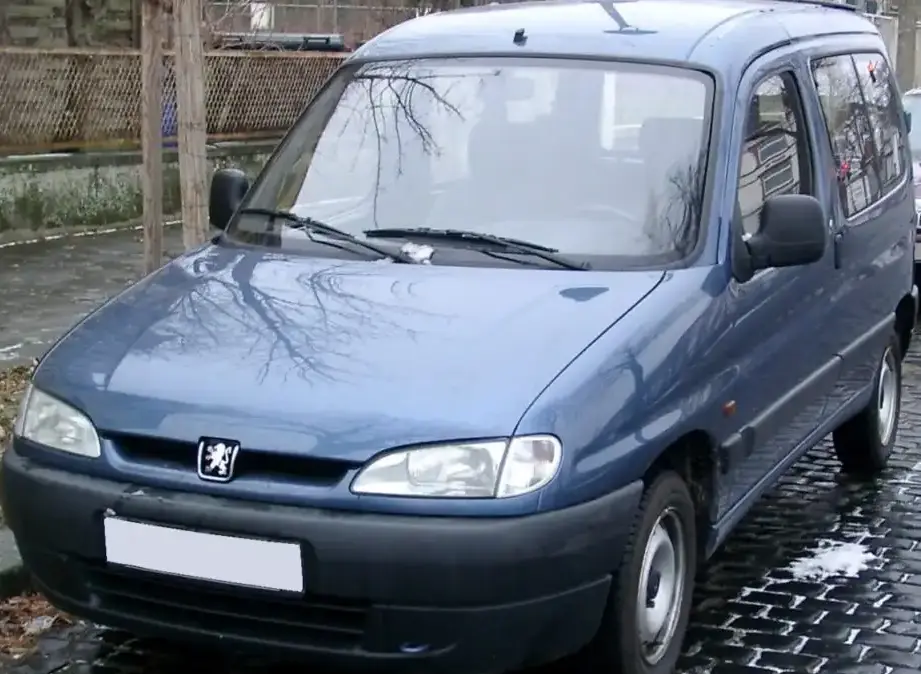
The Peugeot Partner I (Phase I) Dangel 1.8 (90 hp) 4×4, produced between 1999 and 2000, represents a niche offering within the first generation of the Peugeot Partner. This variant, developed in collaboration with Dangel – a French specialist in four-wheel-drive conversions – aimed to provide enhanced practicality and all-weather capability to the Partner’s already versatile platform. Based on the 1HX0 chassis, shared with the Citroën Berlingo, the Dangel 1.8 4×4 targeted customers needing a robust, compact van for both commercial and leisure purposes. It occupied a unique position in the Partner lineup, offering a more capable alternative to the standard front-wheel-drive models, but without the bulk or cost of larger commercial vehicles.
Technical Specifications
| Brand | Peugeot |
| Model | Partner |
| Generation | Partner I (Phase I) |
| Type | Dangel 1.8 (90 Hp) 4×4 |
| Start of production | 1999 |
| End of production | 2000 |
| Powertrain Architecture | Internal Combustion engine |
| Body type | Minivan |
| Seats | 5 |
| Doors | 4 |
| Fuel Type | Petrol (Gasoline) |
| Maximum speed | 149 km/h (92.58 mph) |
| Weight-to-power ratio | 14.9 kg/Hp, 67.1 Hp/tonne |
| Weight-to-torque ratio | 9.1 kg/Nm, 109.6 Nm/tonne |
| Power | 90 Hp @ 5000 rpm |
| Power per litre | 51.1 Hp/l |
| Torque | 147 Nm @ 2600 rpm (108.42 lb.-ft. @ 2600 rpm) |
| Engine layout | Front, Transverse |
| Engine Model/Code | XU7JB |
| Engine displacement | 1761 cm3 (107.46 cu. in.) |
| Number of cylinders | 4 |
| Engine configuration | Inline |
| Cylinder Bore | 83 mm (3.27 in.) |
| Piston Stroke | 81.4 mm (3.2 in.) |
| Number of valves per cylinder | 2 |
| Fuel injection system | Multi-port manifold injection |
| Engine aspiration | Naturally aspirated engine |
| Valvetrain | SOHC |
| Engine oil capacity | 5 l (5.28 US qt | 4.4 UK qt) |
| Coolant | 8 l (8.45 US qt | 7.04 UK qt) |
| Kerb Weight | 1341 kg (2956.4 lbs.) |
| Max. weight | 1780 kg (3924.23 lbs.) |
| Max load | 439 kg (967.83 lbs.) |
| Fuel tank capacity | 60 l (15.85 US gal | 13.2 UK gal) |
| Length | 4108 mm (161.73 in.) |
| Width | 1719 mm (67.68 in.) |
| Height | 1915 mm (75.39 in.) |
| Wheelbase | 2705 mm (106.5 in.) |
| Front track | 1434 mm (56.46 in.) |
| Rear track | 1462 mm (57.56 in.) |
| Ride height (ground clearance) | 215 mm (8.46 in.) |
| Minimum turning circle | 11.55 m (37.89 ft.) |
| Approach angle | 29° |
| Departure angle | 43° |
| Ramp-over angle | 28° |
| Climb angle | 35° |
| Drivetrain Architecture | The Internal combustion engine (ICE) drives the front wheels permanently, and the rear wheels are driven through an electrically or mechanically operated clutch if necessary. |
| Drive wheel | All wheel drive (4×4) |
| Number of gears | 5 gears, manual transmission |
| Front suspension | Independent type McPherson |
| Rear suspension | Torsion |
| Front brakes | Disc |
| Rear brakes | Drum |
| Assisting systems | ABS (Anti-lock braking system) |
| Steering type | Steering rack and pinion |
| Power steering | Hydraulic Steering |
| Tires size | 195/70 R15 |
| Wheel rims size | 6J x 15 |
Powertrain & Engine Architecture
The heart of the Partner I Dangel 1.8 4×4 is the XU7JB engine, a 1.8-liter inline-four cylinder petrol engine. This engine, a staple in many Peugeot and Citroën vehicles of the era, is known for its relative simplicity and durability. The XU7JB utilizes a single overhead camshaft (SOHC) valvetrain operating two valves per cylinder. Fuel delivery is managed by a multi-port fuel injection system, providing adequate, though not exceptional, performance. The engine produces 90 horsepower at 5000 rpm and 147 Nm (108.42 lb-ft) of torque at 2600 rpm. The transmission is a five-speed manual gearbox, chosen for its robustness and suitability for the vehicle’s intended use. The Dangel four-wheel-drive system employs a viscous coupling to engage the rear wheels when front wheel slip is detected, providing automatic all-wheel drive functionality. This system isn’t a full-time 4×4; rather, it’s an on-demand system designed to enhance traction in slippery conditions.
Driving Characteristics
The 90 hp output and the added weight of the four-wheel-drive system result in performance that is best described as adequate. Acceleration is not brisk, and the vehicle feels most comfortable at steady cruising speeds. The five-speed manual transmission is well-matched to the engine’s characteristics, allowing for reasonable flexibility in various driving situations. Compared to the standard front-wheel-drive Partner 1.8, the Dangel 4×4 exhibits noticeably improved traction, particularly on loose surfaces like gravel, snow, or mud. However, the added weight and drivetrain complexity do result in a slight decrease in fuel economy. The gear ratios are geared towards usability rather than outright performance, prioritizing fuel efficiency and ease of driving over spirited acceleration.
Equipment & Trim Levels
The Partner I Dangel 1.8 4×4 was typically equipped with a relatively basic level of trim, reflecting its commercial vehicle origins. Standard features generally included power steering, central locking, and a basic audio system. Interior upholstery was typically hard-wearing cloth. Optional extras could include air conditioning, electric windows, and upgraded audio systems. The dashboard layout is functional and straightforward, prioritizing practicality over aesthetics. The focus was on providing a durable and easy-to-clean interior suitable for both work and leisure.
Chassis & Braking
The Partner I utilizes an independent McPherson strut suspension at the front, providing a comfortable ride and reasonable handling. The rear suspension employs a torsion beam setup, which is simple, robust, and space-efficient. Braking is handled by disc brakes at the front and drum brakes at the rear. An Anti-lock Braking System (ABS) was typically included as standard equipment, enhancing safety by preventing wheel lockup during hard braking. The increased weight of the 4×4 variant necessitated a slightly more robust suspension setup compared to the standard front-wheel-drive models.
Market Reception & Comparison
The Peugeot Partner I Dangel 1.8 4×4 was generally well-received by those seeking a compact, versatile van with enhanced all-weather capability. Critics praised its practicality, durability, and improved traction compared to the standard Partner. However, the relatively modest power output and slightly higher fuel consumption were noted as potential drawbacks. Compared to the standard 1.8L front-wheel-drive Partner, the Dangel 4×4 commanded a premium price. Against competitors like the Citroën Berlingo 4×4 (which shared the same Dangel conversion), the Partner offered a similar package, with brand preference often being the deciding factor. The 1.9 TDI diesel version of the Partner offered superior fuel economy and torque, but at the expense of refinement and initial purchase price.
Legacy
The Peugeot Partner I Dangel 1.8 4×4, while a relatively short-lived variant, has gained a reputation for reliability and durability. The XU7JB engine is known to be a robust unit, and the Dangel four-wheel-drive system is generally considered to be well-engineered. In the used car market, these vehicles are sought after by those needing a practical and capable van for various applications, including rural work, outdoor pursuits, and light commercial use. Parts availability is generally good, thanks to the widespread use of the XU7JB engine and the Partner platform. However, potential buyers should be aware of the possibility of corrosion, particularly on older examples, and ensure that the four-wheel-drive system is functioning correctly.