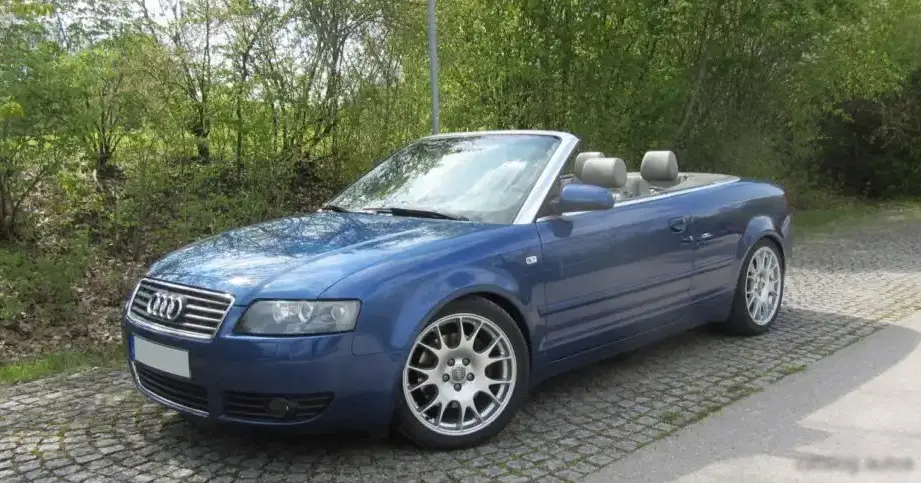
The Audi A4 Cabriolet (B6 8H) 2.5 TDI V6, produced from July 2002 to 2005, represented a compelling blend of open-air motoring and diesel efficiency within the premium compact segment. Positioned as a mid-range offering in the B6 Cabriolet lineup, it slotted between the lower-powered 1.8L petrol variants and the more potent 3.0L V6 models. This variant was primarily aimed at European markets where diesel engines enjoyed significant popularity due to their fuel economy and torque characteristics. The B6 generation A4 Cabriolet, built on the Volkswagen Group’s 1HX0/A3 platform, offered a more refined and spacious interior compared to its predecessor, along with improved handling and safety features.
Technical Specifications
| Brand | Audi |
| Model | A4 |
| Generation | A4 Cabriolet (B6 8H) |
| Type (Engine) | 2.5 TDI V6 (163 Hp) |
| Start of production | July, 2002 |
| End of production | 2005 |
| Powertrain Architecture | Internal Combustion engine |
| Body type | Cabriolet |
| Seats | 4 |
| Doors | 2 |
| Fuel consumption (urban) | 10 l/100 km (23.5 US mpg, 28.2 UK mpg, 10 km/l) |
| Fuel consumption (extra urban) | 5.7 l/100 km (41.3 US mpg, 49.6 UK mpg, 17.5 km/l) |
| Fuel consumption (combined) | 7.2 l/100 km (32.7 US mpg, 39.2 UK mpg, 13.9 km/l) |
| CO2 emissions | 194 g/km |
| Fuel Type | Diesel |
| Acceleration 0 – 100 km/h | 9.7 sec |
| Acceleration 0 – 62 mph | 9.7 sec |
| Acceleration 0 – 60 mph | 9.2 sec |
| Maximum speed | 225 km/h (139.81 mph) |
| Emission standard | Euro 4 |
| Weight-to-power ratio | 10.4 kg/Hp, 96.4 Hp/tonne |
| Weight-to-torque ratio | 4.8 kg/Nm, 207.1 Nm/tonne |
| Power | 163 Hp @ 4000 rpm |
| Power per litre | 65.3 Hp/l |
| Torque | 350 Nm @ 1500-3000 rpm (258.15 lb.-ft. @ 1500-3000 rpm) |
| Engine layout | Front, Longitudinal |
| Engine Model/Code | BDG, BFC |
| Engine displacement | 2496 cm3 (152.32 cu. in.) |
| Number of cylinders | 6 |
| Engine configuration | V-engine |
| Cylinder Bore | 78.3 mm (3.08 in.) |
| Piston Stroke | 86.4 mm (3.4 in.) |
| Compression ratio | 18:1 |
| Number of valves per cylinder | 4 |
| Fuel injection system | Direct injection |
| Engine aspiration | Turbocharger, Intercooler |
| Valvetrain | DOHC |
| Engine oil capacity | 5.5 l (5.81 US qt | 4.84 UK qt) |
| Coolant | 12 l (12.68 US qt | 10.56 UK qt) |
| Kerb Weight | 1690 kg (3725.81 lbs.) |
| Max. weight | 2170 kg (4784.03 lbs.) |
| Max load | 480 kg (1058.22 lbs.) |
| Trunk (boot) space – minimum | 246 l (8.69 cu. ft.) |
| Trunk (boot) space – maximum | 315 l (11.12 cu. ft.) |
| Fuel tank capacity | 70 l (18.49 US gal | 15.4 UK gal) |
| Permitted trailer load with brakes (8%) | 1800 kg (3968.32 lbs.) |
| Permitted trailer load with brakes (12%) | 1600 kg (3527.4 lbs.) |
| Permitted trailer load without brakes | 750 kg (1653.47 lbs.) |
| Permitted towbar download | 80 kg (176.37 lbs.) |
| Length | 4573 mm (180.04 in.) |
| Width | 1777 mm (69.96 in.) |
| Height | 1391 mm (54.76 in.) |
| Wheelbase | 2654 mm (104.49 in.) |
| Front track | 1523 mm (59.96 in.) |
| Rear (Back) track | 1523 mm (59.96 in.) |
| Drag coefficient (Cd) | 0.30 |
| Minimum turning circle (turning diameter) | 11.1 m (36.42 ft.) |
| Drivetrain Architecture | The Internal combustion engine (ICE) drives the front wheels of the vehicle. |
| Drive wheel | Front wheel drive |
| Number of gears and type of gearbox | 6 gears, manual transmission |
| Front suspension | Independent multi-link suspension |
| Rear suspension | Independent multi-link suspension |
| Front brakes | Ventilated discs |
| Rear brakes | Disc |
| Assisting systems | ABS (Anti-lock braking system) |
| Steering type | Steering rack and pinion |
| Power steering | Hydraulic Steering |
| Tires size | 215/55 R16 |
| Wheel rims size | 7J x 16 |
Powertrain & Engine Architecture
The heart of the A4 Cabriolet 2.5 TDI V6 was the BDG or BFC engine code, a 2.5-liter V6 diesel engine. This engine utilized a common rail direct injection system, delivering fuel directly into the combustion chamber at extremely high pressure. This technology, coupled with a variable geometry turbocharger and intercooler, allowed for a broad torque curve and efficient combustion. The engine featured a double overhead camshaft (DOHC) valvetrain with four valves per cylinder, optimizing gas flow and contributing to its power output. The engine’s longitudinal mounting and front-wheel-drive configuration were typical for Audi’s at the time. The 6-speed manual transmission was the standard offering, providing precise gear changes and contributing to the car’s overall driving experience. While an automatic transmission was available on other A4 models, it was less common with the 2.5 TDI V6 due to the engine’s high torque output and the desire for more driver control.
Driving Characteristics
The 2.5 TDI V6 with the 6-speed manual gearbox offered a distinctly different driving experience compared to the petrol-powered A4 Cabriolets. The substantial 350 Nm (258 lb-ft) of torque, available from just 1500 rpm, provided strong acceleration in everyday driving situations. While not a sports car, the 9.7-second 0-62 mph acceleration was respectable for a comfortable convertible. The manual transmission allowed drivers to fully exploit the engine’s torque band, making overtaking maneuvers effortless. Compared to the 1.8L petrol versions, the 2.5 TDI offered significantly more pulling power, especially when fully loaded. However, it lacked the high-revving eagerness of the petrol engines. The gear ratios were well-chosen to balance acceleration and fuel economy, making it a capable long-distance cruiser.
Equipment & Trim Levels
The 2.5 TDI V6 Cabriolet typically came equipped with a generous level of standard features. This included climate control, power windows and mirrors, a multi-function steering wheel, and a basic audio system. Upholstery was usually a cloth or leatherette combination, with full leather options available as an upgrade. Optional extras included a premium Bose sound system, heated front seats, parking sensors, and a wind deflector to reduce turbulence in the cabin when the roof was down. The trim level often dictated the exterior styling details, such as the type of alloy wheels and the finish of the interior trim.
Chassis & Braking
The A4 Cabriolet’s chassis featured independent multi-link suspension at both the front and rear, providing a comfortable ride and good handling characteristics. The suspension was tuned to balance comfort and stability, making it suitable for both city driving and longer journeys. Braking duties were handled by ventilated discs at the front and solid discs at the rear, assisted by an Anti-lock Braking System (ABS). The steering was a hydraulic power-assisted rack and pinion system, offering precise and responsive control. The car’s weight, at approximately 1690 kg (3725 lbs), was relatively high, but the robust suspension and braking system coped well with the demands of open-top motoring.
Market Reception & Comparison
The Audi A4 Cabriolet 2.5 TDI V6 was generally well-received by automotive critics. It was praised for its refined engine, comfortable ride, and well-appointed interior. The diesel engine’s fuel economy was a major selling point, particularly in Europe. Compared to the petrol-powered A4 Cabriolets, the TDI offered superior torque and fuel efficiency, but it was slightly more expensive to purchase. Against competitors like the BMW 3 Series Convertible and Mercedes-Benz CLK Cabriolet, the A4 offered a compelling combination of value, performance, and practicality. However, some critics noted that the diesel engine was slightly noisier than the petrol alternatives.
Legacy
The 2.5 TDI V6 engine, in general, proved to be a durable and reliable unit when properly maintained. The B6 A4 Cabriolet, including this variant, has developed a following among enthusiasts. Today, well-maintained examples are sought after by those looking for a stylish and comfortable open-top car with good fuel economy. Common issues include wear and tear on suspension components, turbocharger failure (if not properly serviced), and potential problems with the common rail injection system. However, with regular maintenance and attention to detail, these cars can provide many years of enjoyable motoring. The 2.5 TDI V6 remains a testament to Audi’s engineering prowess and its commitment to providing a premium driving experience.