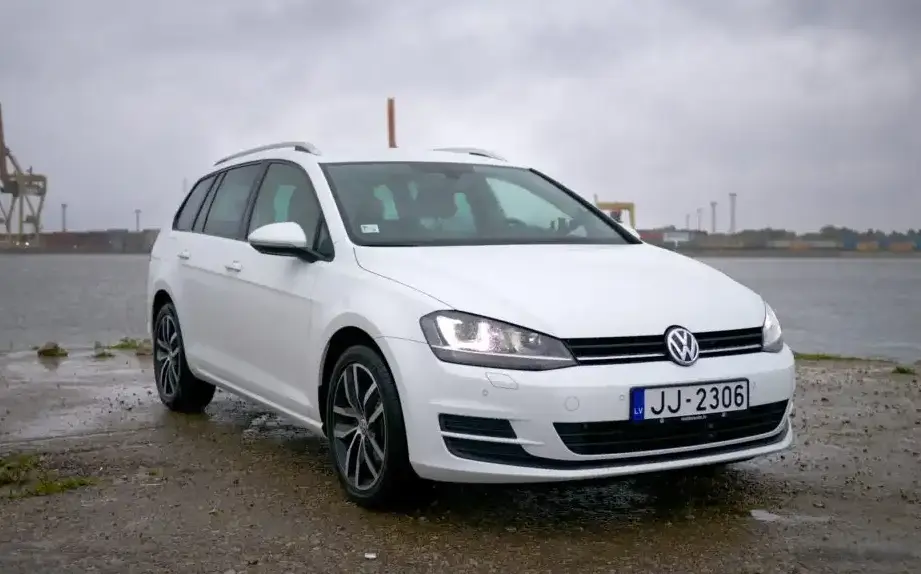
The Volkswagen Golf VII Variant 1.4 TGI (110 hp) BlueMotion, produced from April 2013 to 2017, represents a unique offering within the seventh generation Golf lineup. This variant, a station wagon (estate) body style, distinguished itself by its bi-fuel capability, running on both gasoline and Compressed Natural Gas (CNG). Positioned as an economy-focused option, it aimed to provide lower running costs and reduced emissions compared to its purely gasoline-powered siblings. The Golf VII Variant, built on the Volkswagen Group’s MQB (Modular Transverse Matrix) platform, offered increased space and practicality over the standard Golf hatchback while maintaining the model’s renowned driving characteristics.
Technical Specifications
| Brand | Volkswagen |
| Model | Golf |
| Generation | Golf VII Variant |
| Type (Engine) | 1.4 TGI (110 Hp) BlueMotion |
| Start of production | April, 2013 |
| End of production | 2017 |
| Powertrain Architecture | Internal Combustion engine |
| Body type | Station wagon (estate) |
| Seats | 5 |
| Doors | 5 |
| Fuel consumption (economy) – urban | 6.9 l/100 km (34.1 US mpg, 40.9 UK mpg, 14.5 km/l) |
| Fuel consumption (economy) – urban (CNG) | 4.5 kg/100 km |
| Fuel consumption (economy) – extra urban | 4.4 l/100 km (53.5 US mpg, 64.2 UK mpg, 22.7 km/l) |
| Fuel consumption (economy) – extra urban (CNG) | 2.9 kg/100 km |
| Fuel consumption (economy) – combined | 5.3 l/100 km (44.4 US mpg, 53.3 UK mpg, 18.9 km/l) |
| Fuel consumption (economy) – combined (CNG) | 3.5 kg/100 km |
| CO2 emissions | 124 g/km |
| CO2 emissions (CNG) | 94 g/km |
| Fuel Type | Petrol / CNG |
| Acceleration 0 – 100 km/h | 10.9 sec |
| Acceleration 0 – 62 mph | 10.9 sec |
| Acceleration 0 – 60 mph | 10.4 sec |
| Maximum speed | 195 km/h (121.17 mph) |
| Emission standard | Euro 6 |
| Weight-to-power ratio | 11.9 kg/Hp, 84.3 Hp/tonne |
| Weight-to-torque ratio | 6.5 kg/Nm, 153.3 Nm/tonne |
| Power | 110 Hp @ 4800-6000 rpm |
| Power per litre | 78.9 Hp/l |
| Torque | 200 Nm @ 1500-3500 rpm (147.51 lb.-ft. @ 1500-3500 rpm) |
| Engine layout | Front, Transverse |
| Engine Model/Code | CPWA |
| Engine displacement | 1395 cm3 (85.13 cu. in.) |
| Number of cylinders | 4 |
| Engine configuration | Inline |
| Number of valves per cylinder | 4 |
| Fuel injection system | Direct injection |
| Engine aspiration | Turbocharger |
| Engine oil capacity | 4 l (4.23 US qt | 3.52 UK qt) |
| Kerb Weight | 1305 kg (2877.03 lbs.) |
| Max. weight | 1860 kg (4100.6 lbs.) |
| Max load | 555 kg (1223.57 lbs.) |
| Trunk (boot) space – minimum | 424 l (14.97 cu. ft.) |
| Trunk (boot) space – maximum | 1439 l (50.82 cu. ft.) |
| Fuel tank capacity | 50 l (13.21 US gal | 11 UK gal) |
| CNG cylinder capacity | 15 kg |
| Max. roof load | 75 kg (165.35 lbs.) |
| Permitted trailer load with brakes (8%) | 1700 kg (3747.86 lbs.) |
| Permitted trailer load with brakes (12%) | 1400 kg (3086.47 lbs.) |
| Permitted trailer load without brakes | 690 kg (1521.19 lbs.) |
| Permitted towbar download | 80 kg (176.37 lbs.) |
| Length | 4562 mm (179.61 in.) |
| Width | 1799 mm (70.83 in.) |
| Width including mirrors | 2027 mm (79.8 in.) |
| Height | 1481 mm (58.31 in.) |
| Wheelbase | 2635 mm (103.74 in.) |
| Front track | 1549 mm (60.98 in.) |
| Rear (Back) track | 1520 mm (59.84 in.) |
| Ride height (ground clearance) | 140 mm (5.51 in.) |
| Minimum turning circle (turning diameter) | 10.9 m (35.76 ft.) |
| Drivetrain Architecture | The Internal combustion engine (ICE) drives the front wheels of the vehicle. |
| Drive wheel | Front wheel drive |
| Number of gears and type of gearbox | 6 gears, manual transmission |
| Front brakes | Ventilated discs |
| Rear brakes | Disc |
| Assisting systems | ABS (Anti-lock braking system) |
| Steering type | Steering rack and pinion |
| Power steering | Electric Steering |
| Tires size | 195/65 R15; 205/55 R16 |
| Wheel rims size | 6J x 15; 6.5J x 16 |
INTRODUCTION
The Volkswagen Golf VII Variant 1.4 TGI BlueMotion, launched in 2013, was a key component of Volkswagen’s strategy to offer alternative fuel vehicles in the European market. The “TGI” designation signified a dedicated natural gas (CNG) powertrain, while “BlueMotion” denoted Volkswagen’s efficiency-focused engineering. This variant aimed to appeal to environmentally conscious buyers and those seeking to reduce fuel costs, particularly in countries with well-developed CNG infrastructure. It sat within the Golf VII Variant range, offering a more affordable and eco-friendly alternative to the petrol and diesel models. The Golf VII platform, known internally as the MQB, allowed for a flexible and modular approach to vehicle design, resulting in a spacious and practical estate car.
Powertrain & Engine Architecture
At the heart of the Golf VII Variant 1.4 TGI BlueMotion lies the CPWA engine code, a 1.4-liter turbocharged inline-four cylinder petrol engine modified for bi-fuel operation. This engine utilizes direct fuel injection (FSI) and a turbocharger to deliver 110 horsepower at 4800-6000 rpm and 200 Nm (147.51 lb-ft) of torque between 1500-3500 rpm. The engine is capable of running on either gasoline or CNG, with an automatic switchover between fuels. When running on CNG, the engine management system adjusts parameters to optimize combustion for the different fuel characteristics. The 6-speed manual transmission was standard, chosen for its efficiency and cost-effectiveness. The transmission’s gear ratios were tuned to maximize fuel economy and provide adequate acceleration, though it wasn’t geared for outright performance.
Driving Characteristics
The 1.4 TGI BlueMotion offered a comfortable and refined driving experience, prioritizing fuel efficiency over sporty performance. Acceleration from 0-100 km/h (0-62 mph) took approximately 10.9 seconds, which was noticeably slower than the more powerful petrol or diesel variants. However, the engine provided sufficient power for everyday driving situations, with the turbocharger providing a boost in torque at lower engine speeds. The manual transmission, while efficient, required more driver involvement than an automatic. When running on CNG, the engine’s power output was slightly reduced compared to gasoline operation, but the lower fuel cost often offset this difference. The suspension was tuned for comfort, providing a smooth ride over most road surfaces.
Equipment & Trim Levels
The Golf VII Variant 1.4 TGI BlueMotion typically came with a reasonable level of standard equipment. This included air conditioning, electric front windows, a basic audio system, and stability control. Interior upholstery was typically cloth, with a functional and durable design. Optional extras included alloy wheels, a touchscreen infotainment system, parking sensors, and a panoramic sunroof. Trim levels varied depending on the market, but generally offered progressively more features as you moved up the range. The focus remained on practicality and value, rather than luxury.
Chassis & Braking
The Golf VII Variant 1.4 TGI BlueMotion utilized a MacPherson strut front suspension and a multi-link rear suspension, providing a good balance of ride comfort and handling. The braking system consisted of ventilated discs on the front wheels and solid discs on the rear. Anti-lock Braking System (ABS) was standard. The suspension was tuned to accommodate the vehicle’s weight and provide stable handling characteristics. Stabilizer bars were fitted to both the front and rear axles to reduce body roll during cornering.
Market Reception & Comparison
The Golf VII Variant 1.4 TGI BlueMotion was generally well-received by critics for its fuel efficiency and low emissions. However, its relatively modest performance and the limited availability of CNG refueling stations were often cited as drawbacks. Compared to the 1.6 TDI diesel variant, the TGI offered similar fuel economy but with lower CO2 emissions. The petrol-powered 1.4 TSI offered more performance but at the cost of higher fuel consumption and emissions. The TGI appealed to a niche market of environmentally conscious buyers who had access to CNG infrastructure.
Legacy
The Volkswagen Golf VII Variant 1.4 TGI BlueMotion represents an important step in Volkswagen’s development of alternative fuel vehicles. While CNG infrastructure remains limited in some regions, the TGI models demonstrated the potential for natural gas as a viable fuel source. On the used car market, these variants are often sought after by buyers looking for a fuel-efficient and environmentally friendly estate car. The CPWA engine, when properly maintained, has proven to be relatively reliable. However, potential buyers should be aware of the specific maintenance requirements associated with the CNG system, including regular inspection of the fuel tank and associated components.