Technical Specifications
| Brand | Peugeot |
| Model | Partner |
| Generation | Partner II Tepee (Phase II, 2012) |
| Type (Engine) | 1.6 HDi (90 Hp) |
| Start of production | 2012 |
| End of production | 2018 |
| Powertrain Architecture | Internal Combustion engine |
| Body type | Minivan |
| Seats | 5 |
| Doors | 5 |
| Fuel consumption (urban) | 6.1 l/100 km (38.6 US mpg, 46.3 UK mpg, 16.4 km/l) |
| Fuel consumption (extra urban) | 4.6 l/100 km (51.1 US mpg, 61.4 UK mpg, 21.7 km/l) |
| Fuel consumption (combined) | 5.2 l/100 km (45.2 US mpg, 54.3 UK mpg, 19.2 km/l) |
| CO2 emissions | 135 g/km |
| Fuel Type | Diesel |
| Acceleration 0 – 100 km/h | 14.3 sec |
| Acceleration 0 – 62 mph | 14.3 sec |
| Acceleration 0 – 60 mph | 13.6 sec |
| Maximum speed | 161 km/h (100.04 mph) |
| Emission standard | Euro 5 |
| Weight-to-power ratio | 15.9 kg/Hp, 62.7 Hp/tonne |
| Weight-to-torque ratio | 6.2 kg/Nm, 160.3 Nm/tonne |
| Power | 90 Hp @ 4000 rpm |
| Power per litre | 57.7 Hp/l |
| Torque | 230 Nm @ 1750 rpm (169.64 lb.-ft. @ 1750 rpm) |
| Engine layout | Front, Transverse |
| Engine Model/Code | 9HF DV6DTED |
| Engine displacement | 1560 cm3 (95.2 cu. in.) |
| Number of cylinders | 4 |
| Engine configuration | Inline |
| Cylinder Bore | 75 mm (2.95 in.) |
| Piston Stroke | 88.3 mm (3.48 in.) |
| Number of valves per cylinder | 2 |
| Fuel injection system | Diesel Commonrail |
| Engine aspiration | Turbocharger, Intercooler |
| Engine oil capacity | 3.75 l (3.96 US qt | 3.3 UK qt) |
| Coolant | 6 l (6.34 US qt | 5.28 UK qt) |
| Kerb Weight | 1435 kg (3163.63 lbs.) |
| Max. weight | 2040 kg (4497.43 lbs.) |
| Max load | 605 kg (1333.8 lbs.) |
| Trunk (boot) space – minimum | 675 l (23.84 cu. ft.) |
| Trunk (boot) space – maximum | 3000 l (105.94 cu. ft.) |
| Fuel tank capacity | 60 l (15.85 US gal | 13.2 UK gal) |
| Length | 4380 mm (172.44 in.) |
| Width | 1810 mm (71.26 in.) |
| Height | 1852 mm (72.91 in.) |
| Wheelbase | 2728 mm (107.4 in.) |
| Front track | 1505 mm (59.25 in.) |
| Rear (Back) track | 1554 mm (61.18 in.) |
| Minimum turning circle | 11 m (36.09 ft.) |
| Drivetrain Architecture | Front wheel drive |
| Number of gears | 5 gears, manual transmission |
| Front suspension | Independent, type McPherson with coil spring and anti-roll bar |
| Rear suspension | Independent coil spring |
| Front brakes | Ventilated discs |
| Rear brakes | Disc |
| Assisting systems | ABS (Anti-lock braking system) |
| Steering type | Steering rack and pinion |
| Tires size | 205/65 R15 |
| Wheel rims size | 15 |
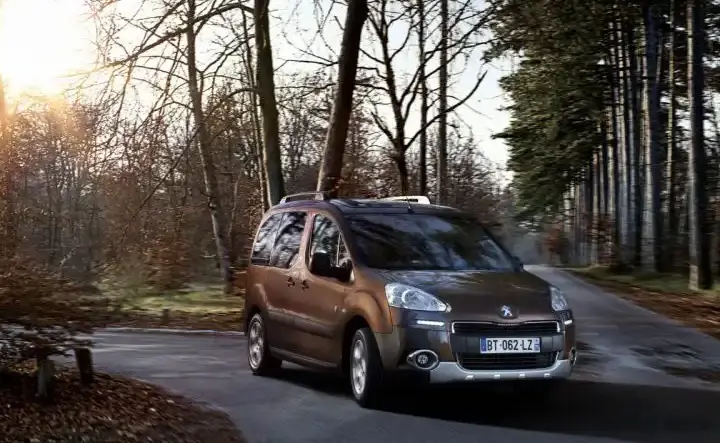
The Peugeot Partner II Tepee, specifically the Phase II model produced from 2012 to 2018, represented a significant evolution of Peugeot’s popular leisure activity vehicle (LAV). This variant, equipped with the 1.6 HDi 90 horsepower diesel engine and a five-speed manual transmission, occupied a crucial position in the Partner Tepee lineup as an entry-level to mid-range offering. Designed to appeal to families and those requiring a versatile, practical vehicle, the 1.6 HDi 90 offered a balance between fuel efficiency, affordability, and usability. It was primarily marketed in Europe, where compact MPVs were in high demand, offering a compelling alternative to larger, more expensive people carriers.
Powertrain & Engine Architecture
The heart of this Partner Tepee variant is the 1.6 HDi (High-Pressure Diesel Injection) engine, specifically the 9HF (DV6DTED) variant. This engine is a four-cylinder, inline diesel utilizing a common rail direct injection system. The DV6 engine family, developed by PSA Peugeot Citroën, is known for its robust design and relatively simple mechanics. The 9HF version produces 90 horsepower at 4000 rpm and 230 Nm (169.64 lb-ft) of torque at 1750 rpm. A turbocharger with an intercooler is employed to boost power and efficiency. The engine features two valves per cylinder and operates with a compression ratio of approximately 16.5:1. The five-speed manual transmission provides a relatively conventional gear selection, prioritizing fuel economy over outright performance. The gear ratios are tuned for everyday driving, with a focus on maximizing torque in the lower gears for ease of use and load-carrying capability.
Driving Characteristics
The 1.6 HDi 90 hp engine, paired with the five-speed manual transmission, delivers a driving experience geared towards practicality and economy. Acceleration is modest, taking around 14.3 seconds to reach 62 mph (100 km/h). The engine feels most comfortable in the mid-range, providing sufficient torque for everyday overtaking and hill climbing. Compared to higher-output versions of the Partner Tepee, such as those with the 110 hp or 130 hp engines, this variant feels noticeably slower. However, the lower power output translates to improved fuel economy. The manual transmission allows for greater driver control, but the gear ratios are spaced to prioritize fuel efficiency rather than sporty performance. The clutch is relatively light, making it easy to operate in urban environments.
Equipment & Trim Levels
The 1.6 HDi 90 version of the Partner Tepee Phase II typically came equipped with a reasonable level of standard features. These generally included power steering, central locking, electric front windows, and an adjustable steering column. Safety features such as ABS (Anti-lock Braking System) and driver/passenger airbags were also standard. Interior upholstery was typically cloth, with a durable and practical design. Optional extras included air conditioning, rear parking sensors, a CD player with MP3 compatibility, and alloy wheels. Higher trim levels, available at an additional cost, offered features like upgraded upholstery, a trip computer, and more comprehensive audio systems.
Chassis & Braking
The Partner Tepee utilizes a McPherson strut front suspension setup with a coil spring and anti-roll bar, providing a comfortable ride quality. The rear suspension employs an independent coil spring arrangement. The braking system consists of ventilated discs on the front wheels and solid discs on the rear. While adequate for the vehicle’s weight and performance, the braking system isn’t particularly sporty. The steering is a rack and pinion system, offering reasonable precision and feedback. The vehicle rides on 205/65 R15 tires, mounted on 15-inch steel or alloy wheels.
Market Reception & Comparison
The Peugeot Partner Tepee 1.6 HDi 90 was generally well-received by critics as a practical and economical choice in the compact MPV segment. It was praised for its fuel efficiency, spacious interior, and versatility. However, some reviewers noted that the engine could feel underpowered when fully loaded or when tackling steep hills. Compared to other trims in the Partner Tepee lineup, the 1.6 HDi 90 offered the most affordable entry point, making it attractive to budget-conscious buyers. Its fuel economy was superior to the higher-powered petrol variants, but its performance lagged behind the more powerful diesel options.
Legacy
The 1.6 HDi engine, in its various iterations, proved to be a reliable and durable powertrain. While not without its potential issues (such as diesel particulate filter clogging and occasional turbocharger problems), the engine is generally considered to be robust when properly maintained. In the used car market, the Partner Tepee 1.6 HDi 90 remains a popular choice due to its affordability and practicality. Its relatively simple mechanicals make it easier and cheaper to maintain compared to more complex modern vehicles. However, potential buyers should be aware of the age-related wear and tear common to vehicles of this era, and a thorough inspection is recommended before purchase.