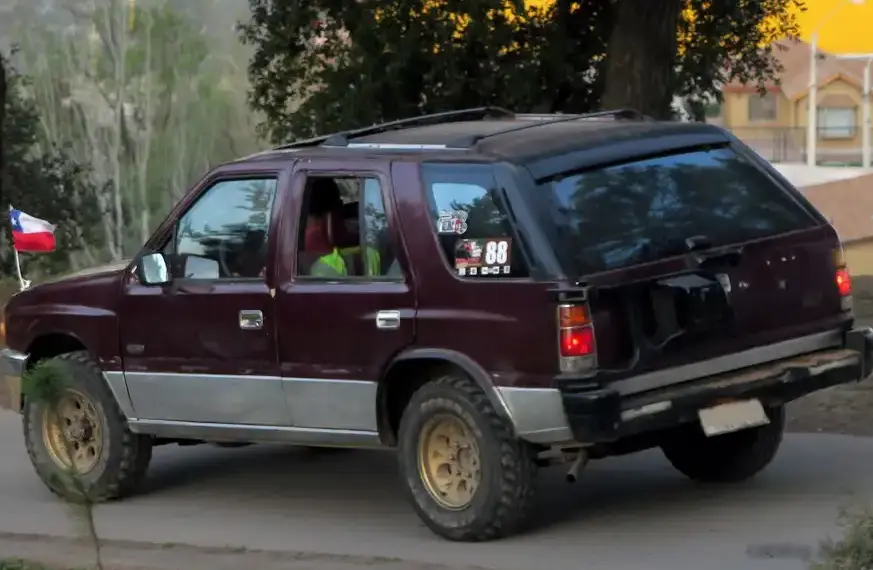
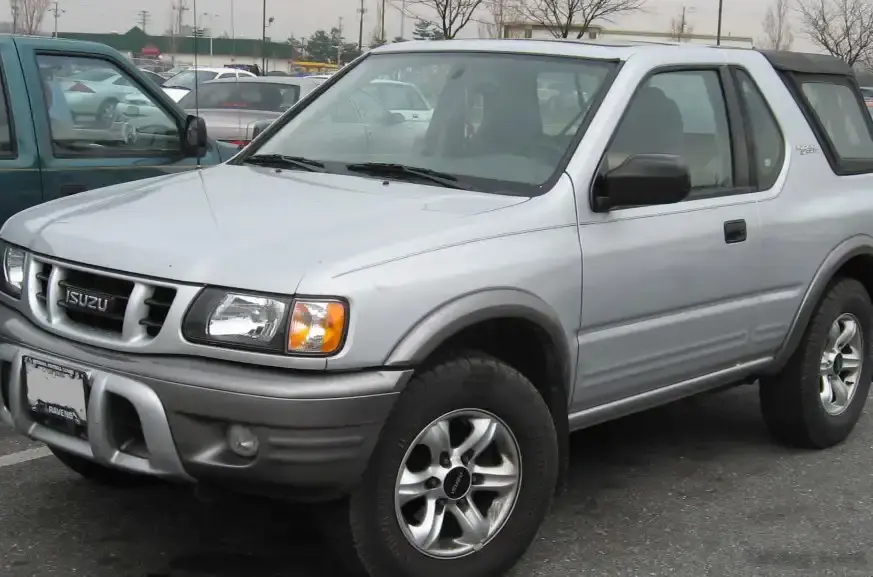
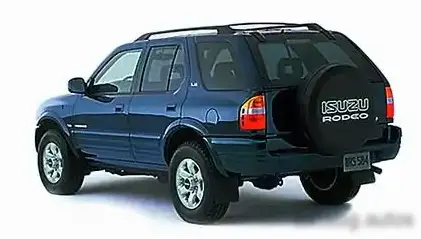
The Isuzu Rodeo Sport (UTS-145) 3.2 i V6 24V 2WD, produced from 1998 to 2004, represented a distinct offering within the second-generation Isuzu Rodeo lineup. Positioned as a more sporty and compact variant, the Rodeo Sport, with its three-door configuration, aimed to appeal to buyers seeking a blend of utility and a more engaging driving experience compared to the standard five-door Rodeo. It was primarily marketed in North America and select international markets, offering an alternative to larger, more traditional SUVs. This particular configuration, featuring the 3.2-liter V6 engine paired with a four-speed automatic transmission and rear-wheel drive, occupied a mid-range position within the Rodeo Sport’s trim levels, balancing performance with relative affordability.
Technical Specifications
| Brand | Isuzu |
| Model | Rodeo |
| Generation | Rodeo Sport (UTS-145) |
| Type (Engine) | 3.2 i V6 24V 2WD (208 Hp) |
| Start of production | 1998 |
| End of production | 2004 |
| Powertrain Architecture | Internal Combustion engine |
| Body type | SUV |
| Seats | 5 |
| Doors | 3 |
| Fuel consumption (urban) | 13.9 l/100 km (16.9 US mpg) |
| Fuel consumption (extra urban) | 10.1 l/100 km (23.3 US mpg) |
| Fuel Type | Petrol (Gasoline) |
| Maximum speed | 180 km/h (111.85 mph) |
| Weight-to-power ratio | 7.8 kg/Hp |
| Weight-to-torque ratio | 5.6 kg/Nm |
| Power | 208 Hp @ 5400 rpm |
| Power per litre | 65.7 Hp/l |
| Torque | 290 Nm @ 3000 rpm (213.89 lb.-ft. @ 3000 rpm) |
| Engine layout | Front, Longitudinal |
| Engine Model/Code | 6VD1-W |
| Engine displacement | 3165 cm3 (193.14 cu. in.) |
| Number of cylinders | 6 |
| Engine configuration | V-engine |
| Cylinder Bore | 93.4 mm (3.68 in.) |
| Piston Stroke | 77 mm (3.03 in.) |
| Compression ratio | 9.1:1 |
| Number of valves per cylinder | 4 |
| Fuel injection system | Multi-port manifold injection |
| Engine aspiration | Naturally aspirated engine |
| Engine oil capacity | 4.7 l (4.97 US qt | 4.14 UK qt) |
| Coolant capacity | 11 l (11.62 US qt | 9.68 UK qt) |
| Kerb Weight | 1615 kg (3560.47 lbs.) |
| Max. weight | 2110 kg (4651.75 lbs.) |
| Max load | 495 kg (1091.29 lbs.) |
| Trunk (boot) space – minimum | 595 l (21.01 cu. ft.) |
| Fuel tank capacity | 67 l (17.7 US gal | 14.74 UK gal) |
| Length | 4267 mm (167.99 in.) |
| Width | 1814 mm (71.42 in.) |
| Height | 1702 mm (67.01 in.) |
| Wheelbase | 2462 mm (96.93 in.) |
| Front track | 1514 mm (59.61 in.) |
| Rear track | 1519 mm (59.8 in.) |
| Drivetrain Architecture | Rear wheel drive |
| Number of gears | 4 |
| Gearbox type | Automatic transmission |
| Front suspension | Torsion |
| Rear suspension | Coil spring |
| Front brakes | Ventilated discs |
| Rear brakes | Disc |
| Assisting systems | ABS (Anti-lock braking system) |
| Power steering | Hydraulic Steering |
| Tires size | 235/55 R15 |
Powertrain & Engine Architecture
The heart of the Rodeo Sport 3.2 i V6 was the 6VD1-W engine, a 3.2-liter, 24-valve V6. This engine, a staple in Isuzu’s lineup during the late 1990s and early 2000s, featured a cast-iron block and aluminum cylinder heads. It employed a multi-port fuel injection system, delivering fuel directly to each intake port for optimized combustion. The engine’s valvetrain utilized double overhead camshafts (DOHC), contributing to its relatively high output for its displacement. The four-speed automatic transmission, while providing convenience, was a somewhat dated design by the early 2000s, lacking the efficiency and smoothness of newer transmissions with more gears. It was chosen for its robustness and cost-effectiveness. The engine’s longitudinal mounting allowed for a more balanced weight distribution, contributing to improved handling characteristics.
Driving Characteristics
The 208 horsepower and 290 Nm (213.89 lb-ft) of torque delivered by the 3.2-liter V6, when coupled with the four-speed automatic, provided adequate, though not exhilarating, performance. Acceleration was reasonable for its class, but the automatic transmission’s gear ratios weren’t optimized for maximizing fuel efficiency or providing particularly sporty acceleration. Compared to the five-speed manual transmission option available on other Rodeo Sport models, the automatic felt less responsive. The rear-wheel-drive configuration offered a more traditional SUV driving experience, with a focus on stability and predictable handling. However, it lacked the all-weather capability of four-wheel-drive variants. The Rodeo Sport’s shorter wheelbase, compared to the standard Rodeo, contributed to a slightly more nimble feel, making it more enjoyable on winding roads.
Equipment & Trim Levels
The Rodeo Sport 3.2 i V6 2WD typically came standard with features such as air conditioning, power windows and locks, and an AM/FM stereo. Interior upholstery was generally cloth, with optional leather available as an upgrade. Depending on the year and specific package, features like cruise control, a sunroof, and upgraded sound systems could also be included. The dashboard layout was functional and straightforward, prioritizing usability over aesthetic flair. The three-door body style meant rear seat access was less convenient than in the five-door Rodeo, and rear passenger space was somewhat limited.
Chassis & Braking
The Rodeo Sport utilized a body-on-frame construction, typical of SUVs of that era. The front suspension employed torsion bars, while the rear suspension featured coil springs. This setup provided a comfortable ride, but wasn’t particularly sophisticated in terms of handling precision. The braking system consisted of ventilated discs at the front and solid discs at the rear. Anti-lock brakes (ABS) were standard, enhancing safety by preventing wheel lockup during hard braking. The Rodeo Sport’s relatively light weight, compared to larger SUVs, helped to compensate for the somewhat basic braking system.
Market Reception & Comparison
The Isuzu Rodeo Sport 3.2 i V6 2WD received mixed reviews. Critics generally praised its sporty styling and V6 engine, but noted the automatic transmission’s lack of refinement and the rear-wheel-drive configuration’s limitations in inclement weather. Compared to the 2.2-liter four-cylinder Rodeo Sport models, the 3.2 V6 offered significantly more power and a more enjoyable driving experience, but at the cost of slightly lower fuel economy. The V6 version also commanded a higher price. Against competitors like the Toyota 4Runner and Jeep Cherokee, the Rodeo Sport offered a more affordable alternative, but lacked the brand recognition and established reputation of those models.
Legacy
The Isuzu Rodeo Sport 3.2 i V6 2WD, while not a sales juggernaut, has developed a modest following among enthusiasts. The 6VD1-W engine is generally considered to be a reliable powerplant, provided it receives regular maintenance. However, the four-speed automatic transmission can be prone to wear and tear over time. Today, these Rodeo Sports can be found on the used car market at relatively affordable prices. They appeal to buyers seeking a unique and capable SUV with a V6 engine, but potential buyers should be aware of the age-related maintenance issues common to vehicles of this era. The Rodeo Sport represents a unique chapter in Isuzu’s history, offering a blend of style, utility, and affordability that resonated with a specific segment of the SUV market.