
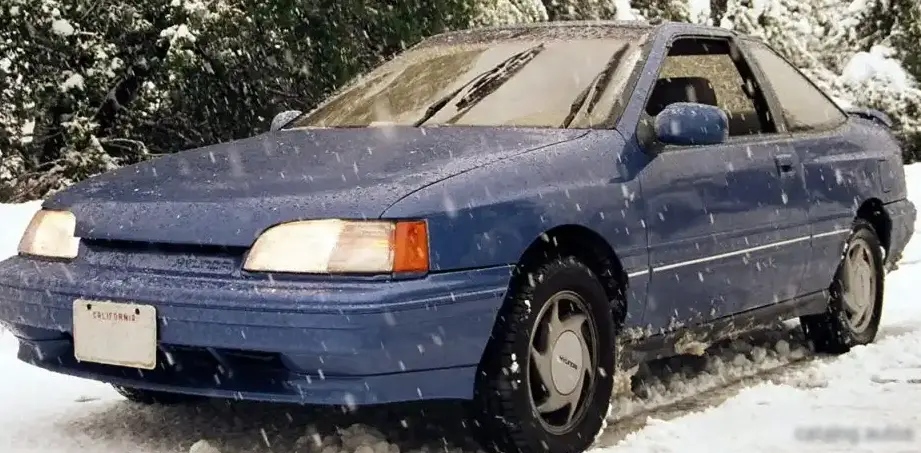
The Hyundai S-Coupe, internally designated SLC, marked Hyundai’s initial venture into the affordable coupe segment during the early 1990s. Production spanned from 1993 to 1996, with a primary focus on the European market. It aimed to provide a stylish and cost-effective alternative to established European and Japanese competitors. The 1.5 i variant, featuring a 90 horsepower engine coupled with a four-speed automatic transmission, served as the entry-level model, prioritizing fuel efficiency and ease of driving over outright performance. It occupied the lowest tier within the S-Coupe lineup, positioned below the more potent 1.6 and 2.0-liter engine options.
Technical Specifications
| Brand | Hyundai |
| Model | S-Coupe |
| Generation | S-Coupe (SLC) |
| Type (Engine) | 1.5 i (90 Hp) Automatic |
| Start of production | 1993 |
| End of production | 1996 |
| Powertrain Architecture | Internal Combustion engine |
| Body type | Coupe |
| Seats | 4 |
| Doors | 2 |
| Fuel Type | Petrol (Gasoline) |
| Acceleration 0 – 100 km/h | 11.4 sec |
| Acceleration 0 – 62 mph | 11.4 sec |
| Acceleration 0 – 60 mph | 10.8 sec |
| Maximum speed | 178 km/h (110.6 mph) |
| Weight-to-power ratio | 10.8 kg/Hp, 92.3 Hp/tonne |
| Weight-to-torque ratio | 7.5 kg/Nm, 133.3 Nm/tonne |
| Power | 90 Hp @ 5600 rpm |
| Power per litre | 60.2 Hp/l |
| Torque | 130 Nm @ 3050 rpm (95.88 lb.-ft. @ 3050 rpm) |
| Engine layout | Front, Transverse |
| Engine displacement | 1495 cm3 (91.23 cu. in.) |
| Number of cylinders | 4 |
| Engine configuration | Inline |
| Cylinder Bore | 75.5 mm (2.97 in.) |
| Piston Stroke | 83.5 mm (3.29 in.) |
| Compression ratio | 10:1 |
| Number of valves per cylinder | 3 |
| Fuel injection system | Multi-port manifold injection |
| Engine aspiration | Naturally aspirated engine |
| Valvetrain | OHC |
| Kerb Weight | 975 kg (2149.51 lbs.) |
| Max. weight | 1440 kg (3174.66 lbs.) |
| Max load | 465 kg (1025.15 lbs.) |
| Trunk (boot) space – maximum | 262 l (9.25 cu. ft.) |
| Fuel tank capacity | 45 l (11.89 US gal | 9.9 UK gal) |
| Length | 4215 mm (165.94 in.) |
| Width | 1640 mm (64.57 in.) |
| Height | 1328 mm (52.28 in.) |
| Wheelbase | 2383 mm (93.82 in.) |
| Front track | 1390 mm (54.72 in.) |
| Rear (Back) track | 1343 mm (52.87 in.) |
| Drivetrain Architecture | The Internal combustion engine (ICE) drives the front wheels of the vehicle. |
| Drive wheel | Front wheel drive |
| Number of gears and type of gearbox | 4 gears, automatic transmission |
| Front suspension | Spring Strut |
| Rear suspension | Transverse stabilizer |
| Front brakes | Disc |
| Rear brakes | Drum |
| Assisting systems | ABS (Anti-lock braking system) |
| Steering type | Steering rack and pinion |
| Power steering | Hydraulic Steering |
| Tires size | 185/60 R14 |
| Wheel rims size | 14 |
Powertrain & Engine Architecture
The S-Coupe 1.5 i’s engine is the Hyundai G4CR, a 1.5-liter inline-four cylinder gasoline engine. It employs a single overhead camshaft (OHC) design with three valves per cylinder – two intake and one exhaust. A multi-port fuel injection system manages fuel delivery, balancing efficiency and performance. The engine generates 90 horsepower at 5,600 rpm and 130 Nm (95.88 lb-ft) of torque at 3,050 rpm. This output was typical for entry-level cars of the period, prioritizing fuel economy and affordability. The engine is paired with a four-speed automatic transmission, designed for smooth and effortless driving. While lacking the sporty feel of a manual gearbox, it catered to drivers valuing convenience and ease of use.
Driving Characteristics
The combination of the 1.5-liter engine and automatic transmission resulted in a driving experience centered on comfort and practicality. Acceleration was sufficient for daily commutes, achieving 0-60 mph in approximately 10.8 seconds, but wasn’t particularly quick. The automatic transmission’s gear ratios were optimized for fuel efficiency, often causing the engine to feel strained during rapid acceleration or uphill climbs. Compared to the 1.6 and 2.0-liter S-Coupe models, the 1.5 i offered considerably less power and a less engaging driving experience. However, it performed well in urban settings, providing smooth and predictable performance. The front-wheel-drive layout offered predictable handling, though it lacked the dynamic capabilities of rear-wheel-drive competitors.
Equipment & Trim Levels
The S-Coupe 1.5 i generally came with a basic, yet functional, set of features. Standard equipment typically included power steering, central locking, and an AM/FM radio. Interior upholstery was usually cloth, featuring a simple and durable design. Optional extras, depending on the market, could include air conditioning, electric windows, and alloy wheels. This trim level was considered the base model, offering a no-frills approach to coupe ownership. The interior design prioritized ergonomics and ease of use over luxury or stylistic flourishes.
Chassis & Braking
The S-Coupe utilized a front-wheel-drive chassis with a MacPherson strut suspension at the front and a torsion beam suspension in the rear. Disc brakes were used on the front wheels, providing adequate stopping power, while the rear brakes were drums – a cost-saving measure common in this vehicle class. A transverse stabilizer bar was incorporated into the rear suspension to minimize body roll during cornering. The suspension was tuned for comfort, delivering a relatively smooth ride over uneven road surfaces. The curb weight of around 975 kg (2149.51 lbs) contributed to the car’s manageable handling.
Market Reception & Comparison
The S-Coupe 1.5 i was generally well-received as an affordable and stylish coupe. Reviewers praised its attractive design and competitive price. However, the 1.5-liter engine often drew criticism for its lack of power, especially when compared to larger-engined rivals. Fuel economy was a significant strength, making it appealing to budget-conscious buyers. Compared to the higher-spec S-Coupe models, the 1.5 i provided a more economical entry point, but at the cost of performance and refinement. It competed with other small coupes like the Opel Astra Coupe and the Ford Escort Coupe, offering a similar balance of style and affordability.
Legacy
The Hyundai S-Coupe, particularly the 1.5 i variant, has garnered a modest following among car enthusiasts. The G4CR engine is known for its reliability, though consistent maintenance is crucial to prevent potential issues. The automatic transmission, while not highly advanced, is generally durable. In the used car market, the S-Coupe 1.5 i remains an affordable and accessible classic. Its straightforward mechanicals make it relatively easy to maintain and repair. While not a performance icon, the S-Coupe 1.5 i represents a pivotal moment in Hyundai’s history, demonstrating the company’s ambition to compete in the European automotive landscape. Locating well-preserved examples can be challenging, but the S-Coupe 1.5 i offers a unique and affordable entry point into the world of classic coupes.
