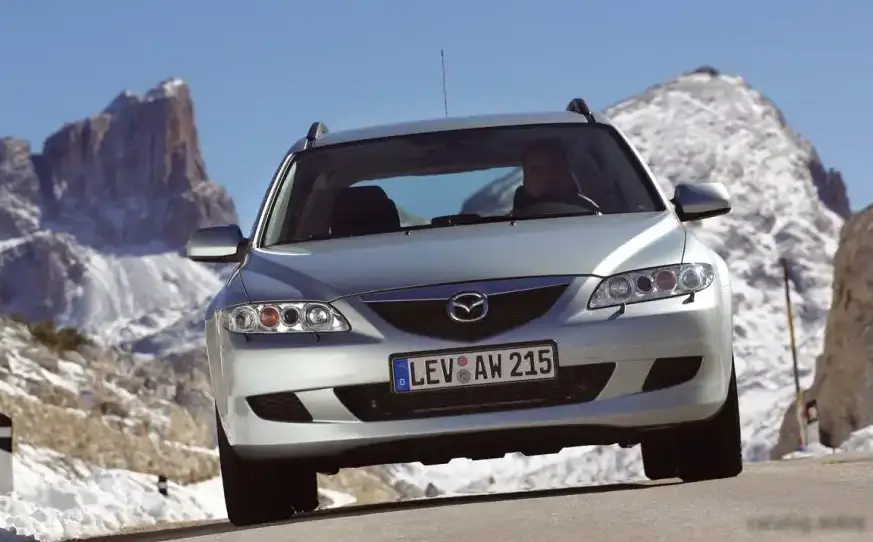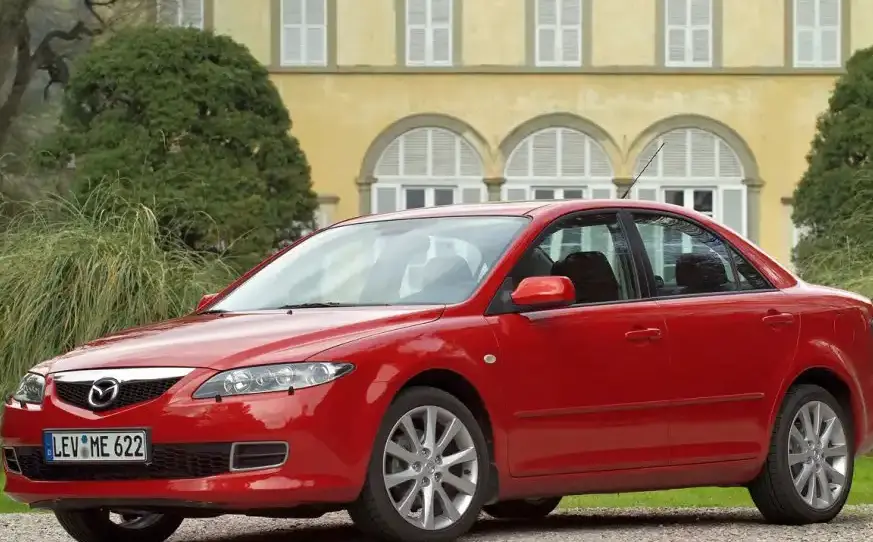
The Mazda 6, known internally as the GG/GY/GG1 generation, underwent a significant facelift in 2005, bringing revised styling and mechanical updates. Among the engine options available, the 3.0-liter V6 producing 215 horsepower represented the top-of-the-line performance offering for the sedan body style. Produced from September 2005 through 2006, this variant aimed to provide a more engaging driving experience and a premium feel compared to the four-cylinder models, primarily targeting buyers in North America and select European markets where larger displacement engines were favored. This model occupied the premium segment of the Mazda 6 lineup, positioned above the 2.3-liter inline-four and offering a substantial power increase.
Technical Specifications
| Brand | Mazda |
| Model | 6 |
| Generation | 6 I Sedan (Typ GG/GY/GG1 facelift 2005) |
| Type (Engine) | 3.0 V6 (215 Hp) |
| Start of production | September, 2005 |
| End of production | 2006 |
| Powertrain Architecture | Internal Combustion engine |
| Body type | Sedan |
| Seats | 5 |
| Doors | 4 |
| Fuel consumption (urban) | 12.4 l/100 km (19 US mpg) |
| Fuel consumption (extra urban) | 8.7 l/100 km (27 US mpg) |
| Fuel Type | Petrol (Gasoline) |
| Weight-to-power ratio | 7 kg/Hp |
| Weight-to-torque ratio | 5.6 kg/Nm |
| Power | 215 Hp @ 6000 rpm |
| Power per litre | 72.5 Hp/l |
| Torque | 270 Nm @ 5000 rpm (199.14 lb.-ft. @ 5000 rpm) |
| Maximum engine speed | 6500 rpm |
| Engine layout | Front, Transverse |
| Engine Model/Code | AJ0N |
| Engine displacement | 2967 cm3 (181.06 cu. in.) |
| Number of cylinders | 6 |
| Engine configuration | V-engine |
| Cylinder Bore | 89 mm (3.5 in.) |
| Piston Stroke | 79.5 mm (3.13 in.) |
| Compression ratio | 10:1 |
| Number of valves per cylinder | 4 |
| Fuel injection system | Multi-port manifold injection |
| Engine aspiration | Naturally aspirated engine |
| Valvetrain | DOHC, VVT |
| Engine oil capacity | 5.7 l (6.02 US qt | 5.02 UK qt) |
| Coolant capacity | 8.5 l (8.98 US qt | 7.48 UK qt) |
| Kerb Weight | 1506 kg (3320.16 lbs.) |
| Max. weight | 1956 kg (4312.24 lbs.) |
| Max load | 450 kg (992.08 lbs.) |
| Trunk (boot) space | 430 l (15.19 cu. ft.) |
| Fuel tank capacity | 68 l (17.96 US gal | 14.96 UK gal) |
| Length | 4745 mm (186.81 in.) |
| Width | 1780 mm (70.08 in.) |
| Height | 1440 mm (56.69 in.) |
| Wheelbase | 2675 mm (105.31 in.) |
| Front track | 1530 mm (60.24 in.) |
| Rear track | 1530 mm (60.24 in.) |
| Ride height | 130 mm (5.12 in.) |
| Minimum turning circle | 11.8 m (38.71 ft.) |
| Drivetrain Architecture | Front wheel drive |
| Number of gears | 5 |
| Gearbox type | Manual transmission |
| Front suspension | Double wishbone, Transverse stabilizer |
| Rear suspension | Independent multi-link spring suspension with stabilizer |
| Front brakes | Ventilated discs, 300×25 mm |
| Rear brakes | Disc, 280×10 mm |
| Assisting systems | ABS (Anti-lock braking system) |
| Steering type | Steering rack and pinion |
| Power steering | Hydraulic Steering |
| Tires size | 215/50 R17; 215/45 R18 |
| Wheel rims size | 7J x 17; 7J x 18 |
Powertrain & Engine Architecture
The heart of this Mazda 6 variant is the AJ0N engine, a 3.0-liter (2967 cc) DOHC 24-valve V6. This engine utilizes a 60-degree V-angle, contributing to a smoother power delivery and reduced vibrations. It features multi-port fuel injection and variable valve timing (VVT) on both intake and exhaust camshafts, optimizing performance and fuel efficiency across the rev range. The engine’s architecture prioritized a balance between power and refinement, avoiding the more aggressive tuning found in some sports-oriented V6 engines. The 5-speed manual transmission was the only transmission option available with this engine, offering a direct connection to the engine’s power. The transmission was chosen to complement the V6’s characteristics, providing precise shifts and enhancing the driving experience.
Driving Characteristics
The 3.0-liter V6 Mazda 6 offered a noticeable performance upgrade over the four-cylinder models. Acceleration was brisk, with the engine delivering strong torque throughout the mid-range. The manual transmission allowed for greater driver control, and the gear ratios were well-matched to the engine’s powerband. While not a dedicated sports sedan, the V6 model provided a confident and enjoyable driving experience, particularly on open roads. Compared to the automatic transmissions offered with the 2.3L engine, the manual transmission in the V6 model provided a more engaging and responsive feel. The weight distribution, while front-heavy, was well-managed by the suspension system, resulting in predictable handling characteristics.
Equipment & Trim Levels
The 3.0-liter V6 model typically came equipped with a higher level of standard features than the base Mazda 6 trims. These often included alloy wheels, a premium audio system, power-adjustable driver’s seat, and automatic climate control. Leather upholstery and a sunroof were frequently available as optional extras. The interior design focused on providing a comfortable and refined environment, with a focus on quality materials and ergonomic design. Trim levels varied slightly depending on the market, but generally, the V6 model represented the highest level of luxury and convenience within the Mazda 6 range.
Chassis & Braking
The Mazda 6’s chassis featured a double wishbone front suspension and an independent multi-link rear suspension, providing a comfortable ride and responsive handling. Stabilizer bars were fitted to both axles to reduce body roll during cornering. The braking system consisted of ventilated discs at the front and solid discs at the rear, providing adequate stopping power for the vehicle’s weight and performance. ABS (Anti-lock Braking System) was standard, enhancing safety and control in emergency braking situations. The suspension tuning was geared towards providing a balance between comfort and handling, making it suitable for both daily commuting and spirited driving.
Market Reception & Comparison
The 3.0-liter V6 Mazda 6 received generally positive reviews from automotive critics. It was praised for its smooth engine, responsive handling, and comfortable interior. However, some reviewers noted that the fuel economy was relatively low compared to the four-cylinder models. Compared to competitors like the Honda Accord V6 and Toyota Camry V6, the Mazda 6 offered a more engaging driving experience and a more stylish design. The V6 Mazda 6 was often seen as a more premium alternative to the mainstream family sedans, appealing to buyers who prioritized performance and refinement.
Legacy
The AJ0N V6 engine, while not without its quirks, proved to be a relatively reliable powertrain when properly maintained. Common issues included oil consumption and occasional sensor failures, but these were generally not major concerns. Today, the 2005-2006 Mazda 6 3.0 V6 holds a modest following among enthusiasts who appreciate its unique combination of performance, style, and value. Finding well-maintained examples can be challenging, but these cars offer a compelling alternative to more common family sedans, providing a taste of Mazda’s sporty heritage.