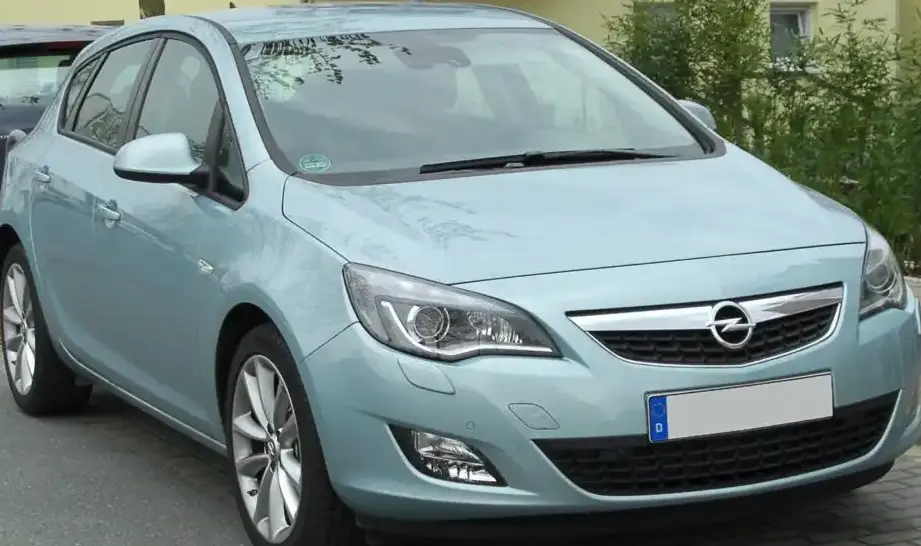
The Opel Astra J 1.3 CDTI (95 hp) ecoFLEX Start/Stop, produced between 2009 and 2012, represented an entry-level offering within the broader Astra J range (2009-2015). Positioned as a fuel-efficient option, it targeted buyers prioritizing economy over outright performance. This variant was a key component of Opel’s strategy to offer a diverse lineup catering to various customer needs within the competitive C-segment hatchback market in Europe. The Astra J itself was built on the GM Delta II platform, also known internally as the 1HX0/A3 platform, and represented a significant step forward in design and technology compared to its predecessor, the Astra H.
Technical Specifications
| Brand | Opel |
| Model | Astra |
| Generation | Astra J |
| Type (Engine) | 1.3 CDTI (95 Hp) ecoFLEX Start/Stop |
| Start of production | 2009 |
| End of production | 2012 |
| Powertrain Architecture | Internal Combustion engine |
| Body type | Hatchback |
| Seats | 5 |
| Doors | 5 |
| Fuel consumption (urban) | 4.6 l/100 km (51.1 US mpg, 61.4 UK mpg, 21.7 km/l) |
| Fuel consumption (extra urban) | 3.6 l/100 km (65.3 US mpg, 78.5 UK mpg, 27.8 km/l) |
| Fuel consumption (combined) | 3.9 l/100 km (60.3 US mpg, 72.4 UK mpg, 25.6 km/l) |
| CO2 emissions | 104 g/km |
| Fuel Type | Diesel |
| Acceleration 0 – 100 km/h | 14.7 sec |
| Acceleration 0 – 62 mph | 14.7 sec |
| Acceleration 0 – 60 mph | 14 sec |
| Emission standard | Euro 5 |
| Weight-to-power ratio | 15.9 kg/Hp, 62.7 Hp/tonne |
| Weight-to-torque ratio | 8 kg/Nm, 125.4 Nm/tonne |
| Power | 95 Hp @ 4000 rpm |
| Power per litre | 76.1 Hp/l |
| Torque | 190 Nm @ 1750-3250 rpm (140.14 lb.-ft. @ 1750-3250 rpm) |
| Engine layout | Front, Transverse |
| Engine Model/Code | A13DTE |
| Engine displacement | 1248 cm3 (76.16 cu. in.) |
| Number of cylinders | 4 |
| Engine configuration | Inline |
| Cylinder Bore | 69.6 mm (2.74 in.) |
| Piston Stroke | 82 mm (3.23 in.) |
| Compression ratio | 16.8:1 |
| Number of valves per cylinder | 4 |
| Fuel injection system | Diesel Commonrail |
| Engine aspiration | Turbocharger, Intercooler |
| Engine oil capacity | 3.5 l (3.7 US qt | 3.08 UK qt) |
| Coolant capacity | 6.8 l (7.19 US qt | 5.98 UK qt) |
| Kerb Weight | 1515 kg (3340 lbs.) |
| Max. weight | 2065 kg (4552.55 lbs.) |
| Max load | 550 kg (1212.54 lbs.) |
| Trunk (boot) space – minimum | 370 l (13.07 cu. ft.) |
| Trunk (boot) space – maximum | 1235 l (43.61 cu. ft.) |
| Fuel tank capacity | 56 l (14.79 US gal | 12.32 UK gal) |
| Length | 4419 mm (173.98 in.) |
| Width | 1814 mm (71.42 in.) |
| Width including mirrors | 2013 mm (79.25 in.) |
| Height | 1510 mm (59.45 in.) |
| Wheelbase | 2685 mm (105.71 in.) |
| Front track | 1541 mm (60.67 in.) |
| Rear (Back) track | 1551 mm (61.06 in.) |
| Ride height (ground clearance) | 160 mm (6.3 in.) |
| Drag coefficient (Cd) | 0.31 |
| Minimum turning circle | 11.4 m (37.4 ft.) |
| Drivetrain Architecture | Front wheel drive |
| Number of gears | 5 |
| Gearbox type | Manual transmission |
Powertrain & Engine Architecture
The heart of this Astra J variant is the A13DTE engine, a 1.3-liter inline-four cylinder diesel. This engine is part of Opel/Fiat’s family of small-displacement diesel engines, developed jointly. It features a common rail direct injection system, delivering fuel at extremely high pressure for optimized combustion. A turbocharger with an intercooler is employed to boost power output and improve torque across a wider rev range. The engine utilizes four valves per cylinder and a single overhead camshaft. The Start/Stop system, a key component of the ‘ecoFLEX’ designation, automatically shuts off the engine when the vehicle is stationary (e.g., at traffic lights) to reduce fuel consumption and emissions. The engine is transversely mounted, driving the front wheels. The five-speed manual transmission was the standard offering for this trim, chosen for its efficiency and cost-effectiveness.
Driving Characteristics
The 1.3 CDTI 95 hp engine, paired with the five-speed manual gearbox, provided adequate, but not exhilarating, performance. Acceleration from 0-100 km/h (0-62 mph) took approximately 14.7 seconds. The engine’s peak torque of 190 Nm (140 lb-ft) was available from 1750-3250 rpm, providing reasonable pulling power for everyday driving situations. However, it required frequent gear changes to maintain momentum, especially when overtaking or climbing hills. Compared to the more powerful 1.7 CDTI or petrol variants, this engine felt noticeably less responsive. The gear ratios were optimized for fuel economy rather than outright speed. The driving experience was generally comfortable, but lacked the punch of higher-spec Astra J models.
Equipment & Trim Levels
The 1.3 CDTI ecoFLEX Start/Stop typically represented the entry point to the Astra J range. Standard equipment generally included air conditioning, power steering, electric front windows, a basic audio system with MP3 compatibility, and ABS brakes. Safety features such as driver and passenger airbags were also standard. Interior upholstery was typically cloth, and the dashboard featured a functional, if somewhat basic, design. Optional extras included alloy wheels, upgraded audio systems, parking sensors, and cruise control. Trim levels varied slightly depending on the market, but generally focused on adding convenience and aesthetic enhancements.
Chassis & Braking
The Astra J 1.3 CDTI utilized a MacPherson strut front suspension and a torsion beam rear suspension. This setup provided a good balance between ride comfort and handling. The front brakes were typically ventilated discs, while the rear brakes were drum brakes – a cost-saving measure common in entry-level models. Anti-lock Braking System (ABS) was standard. The steering was rack and pinion, providing precise and responsive control. Stabilizer bars were fitted to both the front and rear axles to reduce body roll during cornering.
Market Reception & Comparison
The Astra J 1.3 CDTI ecoFLEX Start/Stop was well-received by critics for its exceptional fuel economy. Its combined fuel consumption of 3.9 l/100 km (60.3 US mpg) was among the best in its class. However, its performance was often criticized as being underpowered, particularly when fully loaded or on inclines. Compared to the 1.7 CDTI variant, the 1.3 offered significantly better fuel economy but at the cost of noticeable performance. The 1.7 CDTI provided a more refined driving experience and was better suited for long-distance journeys. Reliability was generally good, although the diesel particulate filter (DPF) required periodic maintenance, especially for drivers who primarily undertook short trips.
Legacy
The A13DTE engine, while not known for its blistering performance, proved to be a relatively reliable unit when properly maintained. The Astra J 1.3 CDTI ecoFLEX Start/Stop remains a popular choice in the used car market for buyers seeking an economical and practical hatchback. The Start/Stop technology, while initially met with some skepticism, has become increasingly common in modern vehicles. The Astra J, as a whole, established Opel as a strong contender in the C-segment, and the 1.3 CDTI variant played a crucial role in attracting budget-conscious buyers.