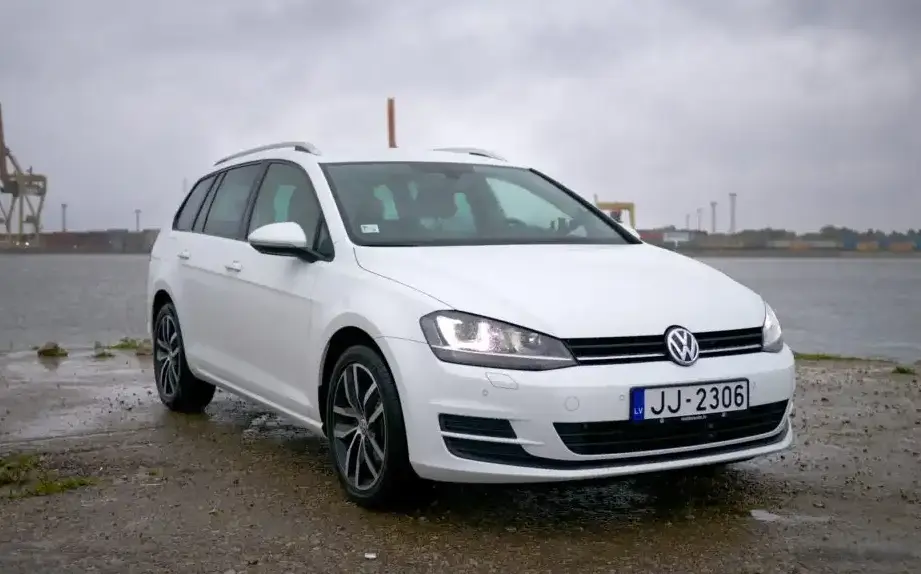
The Volkswagen Golf VII Variant 1.6 TDI (110 hp) 4MOTION was a station wagon (estate) model produced between June 2013 and April 2017. Positioned as a practical and efficient option within the seventh-generation Golf lineup (the 5G platform), it offered all-wheel drive capability combined with a fuel-efficient diesel engine. This variant aimed to appeal to buyers needing space and all-weather traction, particularly in European markets where compact wagons are highly popular. It represented a middle-ground offering, slotting below the more powerful diesel variants and petrol models, and above the base-level Golf trims.
Technical Specifications
| Brand | Volkswagen |
| Model | Golf |
| Generation | Golf VII Variant |
| Type (Engine) | 1.6 TDI (110 Hp) 4MOTION |
| Start of production | June, 2013 |
| End of production | April, 2017 |
| Powertrain Architecture | Internal Combustion engine |
| Body type | Station wagon (estate) |
| Seats | 5 |
| Doors | 5 |
| Fuel consumption (urban) | 5.6 – 5.5 l/100 km (42 – 42.8 US mpg) |
| Fuel consumption (extra urban) | 4.1 – 4.0 l/100 km (57.4 – 58.8 US mpg) |
| Fuel consumption (combined) | 4.6 – 4.5 l/100 km (51.1 – 52.3 US mpg) |
| CO2 emissions | 121 – 119 g/km |
| Fuel Type | Diesel |
| Acceleration 0 – 100 km/h | 11.7 sec |
| Acceleration 0 – 62 mph | 11.7 sec |
| Acceleration 0 – 60 mph | 11.1 sec |
| Maximum speed | 192 km/h (119.3 mph) |
| Emission standard | Euro 6 |
| Weight-to-power ratio | 12.9 kg/Hp, 77.5 Hp/tonne |
| Weight-to-torque ratio | 5.7 kg/Nm, 176.2 Nm/tonne |
| Power | 110 Hp @ 3200-4000 rpm |
| Power per litre | 68.8 Hp/l |
| Torque | 250 Nm @ 1500-3000 rpm (184.39 lb.-ft. @ 1500-3000 rpm) |
| Engine layout | Front, Transverse |
| Engine Model/Code | CRKB, CXXB |
| Engine displacement | 1598 cm3 (97.52 cu. in.) |
| Number of cylinders | 4 |
| Engine configuration | Inline |
| Number of valves per cylinder | 4 |
| Fuel injection system | Diesel Commonrail |
| Engine aspiration | Turbocharger, Intercooler |
| Engine oil capacity | 4.7 l (4.97 US qt | 4.14 UK qt) |
| Kerb Weight | 1419 kg (3128.36 lbs) |
| Max. weight | 2030 kg (4475.38 lbs) |
| Max load | 611 kg (1347.02 lbs) |
| Trunk (boot) space – minimum | 605 l (21.37 cu. ft.) |
| Trunk (boot) space – maximum | 1620 l (57.21 cu. ft.) |
| Fuel tank capacity | 50 l (13.21 US gal | 11 UK gal) |
| Max. roof load | 75 kg (165.35 lbs) |
| Permitted trailer load with brakes (8%) | 1900 kg (4188.78 lbs) |
| Permitted trailer load with brakes (12%) | 1700 kg (3747.86 lbs) |
| Permitted trailer load without brakes | 740 kg (1631.42 lbs) |
| Permitted towbar download | 80 kg (176.37 lbs) |
| Length | 4562 mm (179.61 in) |
| Width | 1799 mm (70.83 in) |
| Width including mirrors | 2027 mm (79.8 in) |
| Height | 1481 mm (58.31 in) |
| Wheelbase | 2635 mm (103.74 in) |
| Front track | 1549 mm (60.98 in) |
| Rear (Back) track | 1520 mm (59.84 in) |
| Ride height (ground clearance) | 140 mm (5.51 in) |
| Minimum turning circle (turning diameter) | 10.9 m (35.76 ft) |
| Drive wheel | All wheel drive (4×4) |
| Number of gears and type of gearbox | 6 gears, manual transmission |
| Front brakes | Ventilated discs |
| Rear brakes | Disc |
INTRODUCTION
The Volkswagen Golf VII Variant 1.6 TDI 4MOTION, launched in mid-2013, was a key component of Volkswagen’s strategy to offer a versatile and practical compact wagon. Built on the MQB (Modular Transverse Matrix) platform – specifically the A5 variant – it shared its underpinnings with several other Volkswagen Group vehicles, including the Audi A3 and SEAT Leon ST. The “Variant” designation signified the estate (wagon) body style, offering increased cargo capacity compared to the standard Golf hatchback. The 1.6 TDI engine, coupled with the 4MOTION all-wheel-drive system, aimed to provide a balance of fuel efficiency, reasonable performance, and enhanced stability in varying road conditions.
Powertrain & Engine Architecture
The heart of this Golf Variant was the 1.6-liter, four-cylinder diesel engine, identified by engine codes CRKB and CXXB. This engine was a common rail direct injection (CRDI) unit, utilizing piezo injectors for precise fuel delivery. The engine featured a turbocharger with an intercooler to boost power and efficiency. The valvetrain employed four valves per cylinder, contributing to improved breathing and power output. The 4MOTION system was a Haldex all-wheel-drive system, primarily front-wheel drive but capable of automatically engaging the rear wheels when traction was lost. The transmission was a six-speed manual gearbox, chosen for its efficiency and driver engagement. While a dual-clutch DSG transmission was available on other Golf VII variants, it wasn’t offered with this specific engine and 4MOTION combination.
Driving Characteristics
The 110 hp output and 250 Nm (184 lb-ft) of torque provided adequate, but not exhilarating, performance. Acceleration from 0-60 mph took around 11.1 seconds, and top speed was 119 mph. The engine felt most comfortable in the mid-range, with usable torque available from 1500-3000 rpm. The six-speed manual transmission was well-matched to the engine’s characteristics, allowing for efficient cruising on the highway. Compared to the more powerful 2.0 TDI variants, this 1.6 TDI felt noticeably slower, particularly when fully loaded or tackling steep inclines. However, it offered a smoother and more refined driving experience than the base petrol engines. The 4MOTION system provided enhanced grip and stability, especially on slippery surfaces, making it a confident performer in inclement weather.
Equipment & Trim Levels
The Golf VII Variant 1.6 TDI 4MOTION typically came with a reasonable level of standard equipment. This included air conditioning, electric windows, central locking, a touchscreen infotainment system, and alloy wheels. Safety features such as ABS, ESP (Electronic Stability Program), and multiple airbags were standard. Higher trim levels, such as Comfortline and Highline, added features like automatic climate control, parking sensors, cruise control, and upgraded upholstery. Optional extras included a panoramic sunroof, navigation system, and leather seats. Interior upholstery was typically cloth, with higher trims offering Alcantara or leather options. The dashboard layout was typical of the Golf VII, with a clean and functional design.
Chassis & Braking
The Golf VII Variant’s chassis featured independent suspension all around – MacPherson struts at the front and multi-link suspension at the rear. This setup provided a comfortable ride and good handling characteristics. The 4MOTION system added to the stability, particularly during cornering. Braking was handled by ventilated discs at the front and solid discs at the rear. ABS (Anti-lock Braking System) was standard, ensuring effective braking performance in emergency situations. Stabilizer bars were fitted to both the front and rear axles to reduce body roll.
Market Reception & Comparison
The Golf VII Variant 1.6 TDI 4MOTION was generally well-received by automotive critics. It was praised for its fuel efficiency, practicality, and all-weather capability. However, some reviewers noted that the engine lacked outright power, especially when compared to the more potent diesel options. Compared to the 2.0 TDI models, the 1.6 TDI offered lower running costs but compromised on performance. Against competitors like the Ford Focus Estate and Skoda Octavia Estate, the Golf offered a more premium feel and a more refined driving experience, but often at a higher price point. Fuel economy was a strong point, consistently achieving around 50 mpg in real-world driving.
Legacy
The 1.6 TDI engine, while generally reliable, has been subject to some scrutiny regarding emissions and potential issues with the diesel particulate filter (DPF). Proper maintenance, including regular DPF regeneration runs, is crucial to ensure long-term reliability. The 4MOTION system has proven to be robust and dependable. On the used car market, the Golf VII Variant 1.6 TDI 4MOTION represents a sensible and practical choice for buyers seeking a spacious, fuel-efficient, and all-weather capable estate car. Its relatively affordable price and proven reliability make it a popular option, although potential buyers should be aware of the potential DPF issues and ensure the vehicle has been well-maintained.