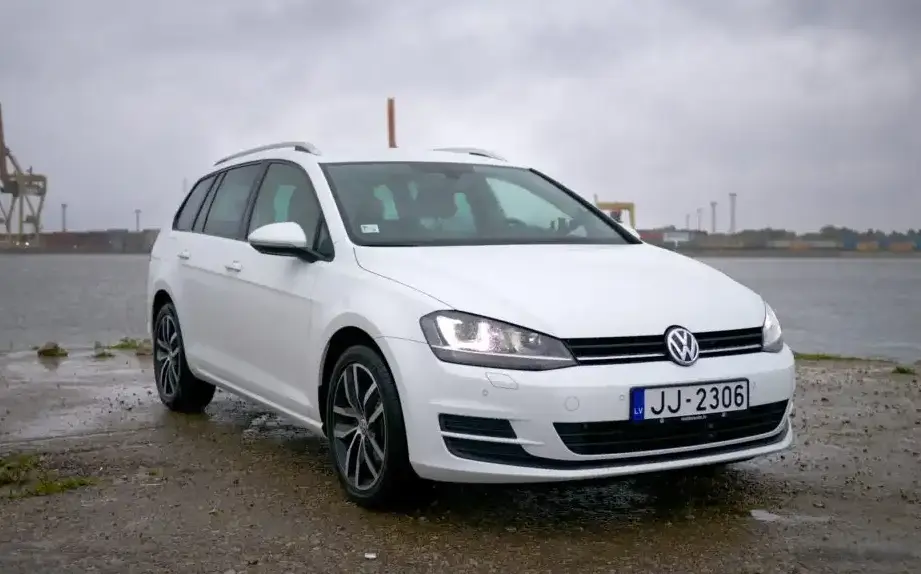
The Volkswagen Golf VII Variant 1.6 TDI (90 hp) was a popular entry-level trim of the seventh-generation Golf Estate, produced between April 2013 and 2017. Positioned as a fuel-efficient and practical option within the Golf VII range, it catered to buyers prioritizing economy and space over outright performance. This variant played a significant role in the European market, where compact wagons are highly sought after, offering a balance between family practicality and Volkswagen’s reputation for build quality. It was not officially sold in the North American market, where Volkswagen focused on hatchback and sedan body styles.
Technical Specifications
| Brand | Volkswagen |
| Model | Golf |
| Generation | Golf VII Variant |
| Type (Engine) | 1.6 TDI (90 Hp) |
| Start of production | April, 2013 |
| End of production | 2017 |
| Powertrain Architecture | Internal Combustion engine |
| Body type | Station wagon (estate) |
| Seats | 5 |
| Doors | 5 |
| Fuel consumption (urban) | 4.9 l/100 km (48 US mpg, 57.6 UK mpg, 20.4 km/l) |
| Fuel consumption (extra urban) | 3.3 l/100 km (71.3 US mpg, 85.6 UK mpg, 30.3 km/l) |
| Fuel consumption (combined) | 3.9 l/100 km (60.3 US mpg, 72.4 UK mpg, 25.6 km/l) |
| Fuel Type | Diesel |
| Acceleration 0 – 100 km/h | 12.9 sec |
| Acceleration 0 – 62 mph | 12.9 sec |
| Acceleration 0 – 60 mph | 12.3 sec |
| Maximum speed | 186 km/h (115.58 mph) |
| Weight-to-power ratio | 15.5 kg/Hp, 64.5 Hp/tonne |
| Weight-to-torque ratio | 6.1 kg/Nm, 164.9 Nm/tonne |
| Power | 90 Hp @ 2750-4800 rpm |
| Power per litre | 56.3 Hp/l |
| Torque | 230 Nm @ 1400-2700 rpm (169.64 lb.-ft. @ 1400-2700 rpm) |
| Engine layout | Front, Transverse |
| Engine Model/Code | CLHB, CRKA, CXXA, DDYB |
| Engine displacement | 1598 cm3 (97.52 cu. in.) |
| Number of cylinders | 4 |
| Engine configuration | Inline |
| Fuel injection system | Diesel Commonrail |
| Engine aspiration | Turbocharger, Intercooler |
| Engine oil capacity | 4.7 l (4.97 US qt | 4.14 UK qt) |
| Kerb Weight | 1395 kg (3075.45 lbs) |
| Max. weight | 1920 kg (4232.88 lbs) |
| Max load | 525 kg (1157.43 lbs) |
| Trunk (boot) space – minimum | 605 l (21.37 cu. ft.) |
| Trunk (boot) space – maximum | 1620 l (57.21 cu. ft.) |
| Fuel tank capacity | 50 l (13.21 US gal | 11 UK gal) |
| Length | 4562 mm (179.61 in) |
| Width | 1799 mm (70.83 in) |
| Height | 1481 mm (58.31 in) |
| Wheelbase | 2635 mm (103.74 in) |
| Front track | 1549 mm (60.98 in) |
| Rear (Back) track | 1520 mm (59.84 in) |
| Minimum turning circle | 10.9 m (35.76 ft) |
| Drivetrain Architecture | The Internal combustion engine (ICE) drives the front wheels of the vehicle. |
| Drive wheel | Front wheel drive |
| Number of gears and type of gearbox | 5 gears, manual transmission |
| Assisting systems | ABS (Anti-lock braking system) |
| Steering type | Steering rack and pinion |
Powertrain & Engine Architecture
The Golf VII Variant 1.6 TDI (90 hp) was powered by a 1.6-liter, four-cylinder diesel engine. Engine codes for this variant included CLHB, CRKA, CXXA, and DDYB, with minor variations depending on the specific production year and market. This engine utilized a common rail direct injection system, delivering fuel directly into the combustion chamber at extremely high pressure for improved efficiency and reduced emissions. A turbocharger with an intercooler was employed to boost power output, providing 90 horsepower at 2750-4800 rpm and 230 Nm (169.64 lb-ft) of torque between 1400-2700 rpm. The engine featured a cast iron block and an aluminum cylinder head, a common configuration for diesel engines of this era. The 5-speed manual transmission was standard, chosen for its simplicity and contribution to fuel economy. While a dual-clutch gearbox (DSG) was available on higher-spec Golfs, it was not offered with this particular engine and power output.
Driving Characteristics
The 1.6 TDI 90 hp variant offered a practical, if not particularly exciting, driving experience. Acceleration from 0-60 mph took around 12.3 seconds, and top speed was limited to 115.58 mph. The engine’s torque delivery was its strong suit, providing adequate pulling power for everyday driving and highway cruising. However, the relatively low horsepower meant that overtaking maneuvers required careful planning. The 5-speed manual transmission was well-matched to the engine’s characteristics, with gear ratios optimized for fuel efficiency. Compared to the more powerful 1.4 TSI or 2.0 TDI Golfs, the 1.6 TDI felt noticeably slower, but it offered a more relaxed and economical driving experience. The manual transmission also provided a more engaging driving experience than the DSG options available on other trims.
Equipment & Trim Levels
The 1.6 TDI 90 hp Golf VII Variant typically came with a base level of equipment, focusing on practicality and value. Standard features generally included air conditioning, power windows, central locking, a basic audio system with USB connectivity, and alloy wheels. Safety features such as ABS, ESP (Electronic Stability Program), and multiple airbags were also standard. Interior upholstery was typically cloth, and the dashboard featured a functional, if somewhat understated, design. Optional extras included features like parking sensors, a touchscreen infotainment system, cruise control, and upgraded interior trim. This trim level was designed to be an affordable entry point into the Golf VII Variant range, appealing to buyers who prioritized functionality and fuel economy over luxury features.
Chassis & Braking
The Golf VII Variant 1.6 TDI utilized a MacPherson strut front suspension and a multi-link rear suspension, providing a comfortable and controlled ride. The suspension was tuned for everyday use, prioritizing comfort over sporty handling. Braking systems varied slightly depending on the specific market and production year, but generally consisted of disc brakes on the front wheels and drum brakes on the rear. ABS (Anti-lock Braking System) was standard. The vehicle’s weight of approximately 1395 kg (3075.45 lbs) contributed to its stable handling characteristics. Stabilizer bars were fitted to both the front and rear axles to reduce body roll during cornering.
Market Reception & Comparison
The Golf VII Variant 1.6 TDI (90 hp) was well-received in Europe as a practical and economical family car. Critics praised its fuel efficiency, spacious interior, and build quality. However, some reviewers noted that the engine lacked outright power, particularly when fully loaded. Compared to the higher-output diesel variants, such as the 2.0 TDI, the 1.6 TDI offered significantly lower running costs but compromised on performance. Against competitors like the Ford Focus Estate and Opel Astra Sports Tourer, the Golf VII Variant 1.6 TDI held its own in terms of fuel economy and overall refinement. Its reputation for reliability and strong resale value also contributed to its popularity.
Legacy
The 1.6 TDI engine, while not known for being a powerhouse, proved to be relatively reliable in the Golf VII Variant. Common issues were generally related to the diesel particulate filter (DPF) and the dual-mass flywheel, particularly on vehicles that primarily saw short-trip urban driving. However, with regular maintenance and careful driving, these engines could provide many years of service. On the used car market, the Golf VII Variant 1.6 TDI (90 hp) remains a popular choice for buyers seeking an affordable and economical estate car. Its fuel efficiency and practicality continue to appeal to those prioritizing value and low running costs.