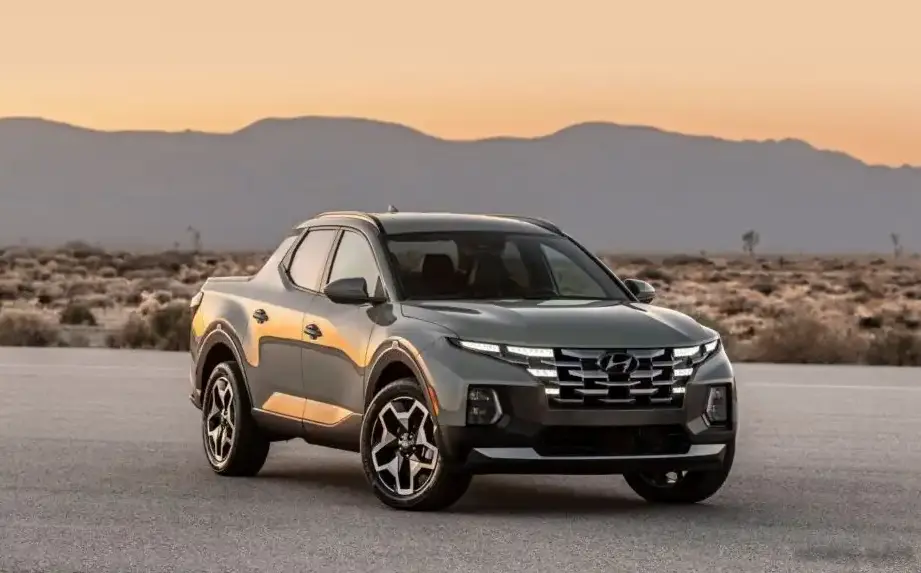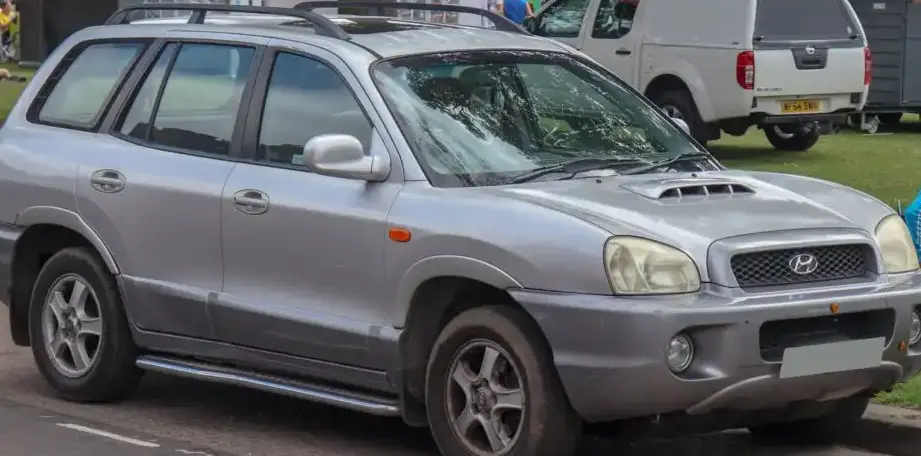
The Hyundai Santa Fe I (SM) 2.0 CRDi 4WD, produced between 2001 and 2006, represented Hyundai’s initial foray into the burgeoning compact SUV market. This variant, equipped with a 2.0-liter turbocharged diesel engine producing 113 horsepower, was a significant offering for the Korean automaker, particularly in European and Asian markets where diesel engines were – and continue to be – highly favored. It was positioned as a practical, all-weather capable vehicle aimed at families and individuals seeking a versatile and affordable SUV. The Santa Fe I (SM) was built on Hyundai’s D platform, shared with the Sonata sedan, and marked a departure from Hyundai’s traditionally budget-focused image, aiming for a more refined and contemporary vehicle.
Technical Specifications
| Brand | Hyundai |
| Model | Santa Fe |
| Generation | Santa Fe I (SM) |
| Type (Engine) | 2.0 CRDi 4WD (113 Hp) |
| Start of production | 2001 |
| End of production | 2006 |
| Powertrain Architecture | Internal Combustion engine |
| Body type | SUV |
| Seats | 5 |
| Doors | 5 |
| Fuel consumption (urban) | 9.5 l/100 km (24.8 US mpg) |
| Fuel consumption (extra urban) | 6.5 l/100 km (36.2 US mpg) |
| Fuel consumption (combined) | 7.6 l/100 km (30.9 US mpg) |
| Fuel Type | Diesel |
| Acceleration 0 – 100 km/h | 14.9 sec |
| Acceleration 0 – 62 mph | 14.9 sec |
| Acceleration 0 – 60 mph | 14.2 sec |
| Maximum speed | 166 km/h (103.15 mph) |
| Weight-to-power ratio | 16.3 kg/Hp |
| Weight-to-torque ratio | 7.9 kg/Nm |
| Power | 113 Hp @ 4000 rpm |
| Torque | 235 Nm @ 1800 rpm (173.33 lb.-ft. @ 1800 rpm) |
| Engine layout | Front, Transverse |
| Engine Model/Code | D / D4EA |
| Engine displacement | 1991 cm3 (121.5 cu. in.) |
| Number of cylinders | 4 |
| Engine configuration | Inline |
| Cylinder Bore | 83 mm (3.27 in.) |
| Piston Stroke | 92 mm (3.62 in.) |
| Compression ratio | 17.7:1 |
| Number of valves per cylinder | 4 |
| Fuel injection system | Diesel Commonrail |
| Engine aspiration | Turbocharger, Intercooler |
| Valvetrain | OHC |
| Engine oil capacity | 5.9 l (6.23 US qt | 5.19 UK qt) |
| Coolant capacity | 8.7 l (9.19 US qt | 7.65 UK qt) |
| Kerb Weight | 1845 kg (4067.53 lbs.) |
| Max. weight | 2380 kg (5247 lbs.) |
| Max load | 535 kg (1179.47 lbs.) |
| Trunk (boot) space – minimum | 850 l (30.02 cu. ft.) |
| Trunk (boot) space – maximum | 2100 l (74.16 cu. ft.) |
| Fuel tank capacity | 65 l (17.17 US gal | 14.3 UK gal) |
| Length | 4500 mm (177.17 in.) |
| Width | 1820 mm (71.65 in.) |
| Height | 1730 mm (68.11 in.) |
| Wheelbase | 2620 mm (103.15 in.) |
| Front track | 1540 mm (60.63 in.) |
| Rear track | 1540 mm (60.63 in.) |
| Drive wheel | All wheel drive (4×4) |
| Number of gears | 5 |
| Gearbox type | Manual transmission |
| Front suspension | Wishbone |
| Rear suspension | Coil spring |
| Front brakes | Ventilated discs |
| Rear brakes | Disc |
| Assisting systems | ABS (Anti-lock braking system) |
| Steering type | Steering rack and pinion |
| Power steering | Hydraulic Steering |
| Tires size | 225/70 R16 |
Powertrain & Engine Architecture
The heart of the Santa Fe 2.0 CRDi 4WD is the Hyundai D4EA engine, a 1991cc inline-four cylinder diesel. This engine utilizes a second-generation common rail direct injection system, delivering fuel at extremely high pressures for improved combustion efficiency and reduced emissions. The D4EA is equipped with a variable geometry turbocharger (VGT) and an intercooler, enhancing both low-end torque and overall power output. The engine’s overhead camshaft (OHC) configuration operates four valves per cylinder, optimizing airflow for increased performance. The 5-speed manual transmission was the standard offering for this variant, providing a balance between fuel economy and drivability. The engine code ‘D’ signifies the base version, while ‘D4EA’ denotes the enhanced version with the common rail injection system.
Driving Characteristics
The 113 horsepower and 235 Nm (173 lb-ft) of torque produced by the 2.0 CRDi engine provided adequate, though not exhilarating, performance for the Santa Fe. Acceleration from 0-60 mph took around 14.2 seconds, and top speed was limited to 166 km/h (103 mph). The engine’s strength lay in its low-end and mid-range torque, making it well-suited for everyday driving and hauling loads. Compared to the later 2.7L V6 gasoline engine option, the 2.0 CRDi offered significantly better fuel economy but lacked the V6’s outright power. The manual transmission, while offering more driver control, wasn’t particularly sporty, with relatively long throws. The all-wheel-drive system provided enhanced traction in inclement weather, making it a practical choice for regions with harsh winters or unpaved roads.
Equipment & Trim Levels
The Santa Fe 2.0 CRDi 4WD typically came with a reasonable level of standard equipment. This included air conditioning, power windows and locks, a basic audio system, and ABS brakes. Higher trim levels, often denoted by additional packages, added features such as alloy wheels, a sunroof, upgraded upholstery, and a more sophisticated audio system. Interior materials were generally durable and functional, reflecting the vehicle’s price point. The dashboard layout was straightforward and easy to use, prioritizing practicality over luxury.
Chassis & Braking
The Santa Fe I (SM) utilized a traditional body-on-frame construction, contributing to its robust feel. The front suspension employed independent wishbones, while the rear suspension featured a coil spring setup. This configuration provided a comfortable ride, although it wasn’t particularly sporty. Braking duties were handled by ventilated discs at the front and solid discs at the rear. The ABS system helped to maintain control during hard braking, particularly on slippery surfaces. The all-wheel-drive system was primarily reactive, engaging the rear wheels when front wheel slip was detected.
Market Reception & Comparison
The Hyundai Santa Fe I (SM) 2.0 CRDi 4WD was generally well-received by automotive critics as a competent and affordable SUV. Its fuel efficiency was a major selling point, particularly in Europe where diesel fuel was significantly cheaper than gasoline. However, some reviewers criticized its relatively slow acceleration and somewhat basic interior. Compared to competitors like the Honda CR-V and Toyota RAV4, the Santa Fe offered a more affordable price point but lacked the refinement and brand recognition of its Japanese rivals. The 2.0 CRDi variant was often seen as a more sensible choice than the more expensive V6 model, appealing to buyers who prioritized fuel economy and practicality.
Legacy
The Hyundai Santa Fe I (SM) 2.0 CRDi 4WD proved to be a reliable and durable vehicle, with many examples still on the road today. The D4EA engine, while not without its quirks, is generally considered to be a robust and long-lasting unit. Common issues include turbocharger wear and potential problems with the fuel injection system, but these are typically manageable with regular maintenance. In the used car market, the Santa Fe I (SM) 2.0 CRDi 4WD represents a good value proposition for buyers seeking an affordable and practical SUV. Its all-wheel-drive capability and fuel-efficient diesel engine continue to make it a popular choice for those seeking a versatile and dependable vehicle.