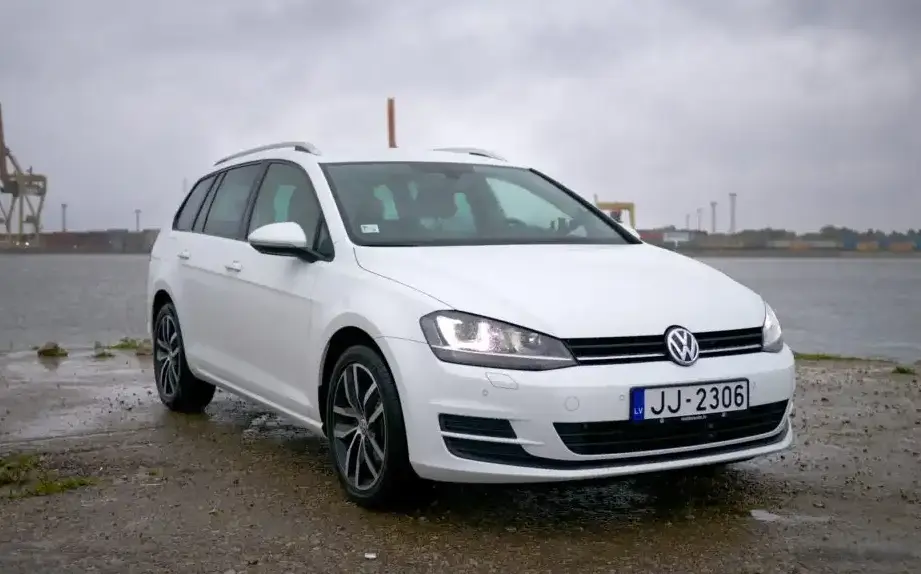
The Volkswagen Golf VII Variant 2.0 TDI (150 hp) DSG represents a compelling blend of practicality, efficiency, and performance within the seventh generation Golf lineup. Produced from May 2013 to April 2014, this variant occupied a mid-range position, offering a step up in power and refinement compared to lower-spec models while remaining more accessible than the range-topping trims. As a member of the Golf VII family (internally designated as the A7 platform), the Variant – Volkswagen’s designation for a station wagon or estate – aimed to provide increased cargo capacity and versatility without sacrificing the Golf’s renowned driving dynamics. This model was primarily marketed in Europe, where the station wagon body style remains highly popular, offering a practical alternative to compact SUVs.
Technical Specifications
| Brand | Volkswagen |
| Model | Golf |
| Generation | Golf VII Variant |
| Type (Engine) | 2.0 TDI (150 Hp) DSG |
| Start of production | May, 2013 |
| End of production | April, 2014 |
| Powertrain Architecture | Internal Combustion engine |
| Body type | Station wagon (estate) |
| Seats | 5 |
| Doors | 5 |
| Fuel consumption (urban) | 5.4 l/100 km (43.6 US mpg, 52.3 UK mpg, 18.5 km/l) |
| Fuel consumption (extra urban) | 4.1 l/100 km (57.4 US mpg, 68.9 UK mpg, 24.4 km/l) |
| Fuel consumption (combined) | 4.5 l/100 km (52.3 US mpg, 62.8 UK mpg, 22.2 km/l) |
| Fuel Type | Diesel |
| Acceleration 0 – 100 km/h | 8.9 sec |
| Acceleration 0 – 62 mph | 8.9 sec |
| Acceleration 0 – 60 mph | 8.5 sec |
| Maximum speed | 216 km/h (134.22 mph) |
| Weight-to-power ratio | 9.7 kg/Hp, 103.2 Hp/tonne |
| Weight-to-torque ratio | 4.5 kg/Nm, 220.1 Nm/tonne |
| Power | 150 Hp @ 3500-4000 rpm |
| Power per litre | 76.2 Hp/l |
| Torque | 320 Nm @ 1750-3000 rpm (236.02 lb.-ft. @ 1750-3000 rpm) |
| Engine layout | Front, Transverse |
| Engine Model/Code | CRBC, CRLB |
| Engine displacement | 1968 cm3 (120.09 cu. in.) |
| Number of cylinders | 4 |
| Engine configuration | Inline |
| Fuel injection system | Diesel Commonrail |
| Engine aspiration | Turbocharger, Intercooler |
| Engine oil capacity | 4.7 l (4.97 US qt | 4.14 UK qt) |
| Kerb Weight | 1454 kg (3205.52 lbs.) |
| Max. weight | 1990 kg (4387.2 lbs.) |
| Max load | 536 kg (1181.68 lbs.) |
| Trunk (boot) space – minimum | 605 l (21.37 cu. ft.) |
| Trunk (boot) space – maximum | 1620 l (57.21 cu. ft.) |
| Fuel tank capacity | 50 l (13.21 US gal | 11 UK gal) |
| Length | 4562 mm (179.61 in.) |
| Width | 1799 mm (70.83 in.) |
| Height | 1481 mm (58.31 in.) |
| Wheelbase | 2635 mm (103.74 in.) |
| Front track | 1549 mm (60.98 in.) |
| Rear (Back) track | 1520 mm (59.84 in.) |
| Minimum turning circle | 10.9 m (35.76 ft.) |
| Drivetrain Architecture | Front wheel drive |
| Number of gears and type of gearbox | 6 gears, automatic transmission |
| Assisting systems | ABS (Anti-lock braking system) |
| Steering type | Steering rack and pinion |
Powertrain & Engine Architecture
At the heart of the Golf VII Variant 2.0 TDI (150 hp) DSG lies the CRBC or CRLB engine code, a 2.0-liter four-cylinder diesel engine. This engine is a member of Volkswagen’s modular engine family, known for its compact dimensions and efficiency. The engine utilizes a common rail direct injection system, delivering fuel directly into the combustion chamber at extremely high pressure for optimized combustion. A turbocharger with an intercooler further enhances performance by forcing more air into the engine, increasing power output. The engine’s valvetrain features four valves per cylinder (DOHC), contributing to improved breathing and efficiency. The ‘DSG’ designation refers to Volkswagen’s dual-clutch transmission (Direct-Shift Gearbox), a six-speed automatic transmission known for its quick and smooth gear changes. This transmission offers both fully automatic operation and the ability for the driver to manually select gears via paddle shifters or the gear lever.
Driving Characteristics
The 150 hp output, coupled with the 320 Nm (236 lb-ft) of torque, provided a balanced driving experience. Acceleration from 0 to 60 mph took approximately 8.5 seconds, making it adequately quick for everyday driving and highway merging. The DSG transmission played a crucial role in maximizing the engine’s potential, providing seamless gear changes and contributing to a responsive feel. Compared to the lower-powered 1.6 TDI variants, the 2.0 TDI offered noticeably more punch, particularly during overtaking maneuvers. However, it didn’t possess the outright performance of the Golf GTD or the more powerful petrol engines. The DSG’s gear ratios were tuned for a blend of fuel efficiency and performance, with taller gears for relaxed cruising and shorter gears for quicker acceleration. The front-wheel-drive configuration provided predictable handling, although traction could be limited in slippery conditions.
Equipment & Trim Levels
The Golf VII Variant 2.0 TDI (150 hp) DSG typically came equipped with a respectable level of standard features. These included air conditioning, power windows, power mirrors, a multi-function steering wheel, and an infotainment system with a touchscreen display. Safety features such as ABS, electronic stability control, and multiple airbags were also standard. Interior upholstery was typically cloth, although leather options were available as upgrades. Higher trim levels offered additional features such as automatic climate control, parking sensors, a navigation system, and upgraded audio systems. Optional extras included panoramic sunroofs, adaptive cruise control, and various styling enhancements.
Chassis & Braking
The Golf VII Variant’s chassis was designed to provide a comfortable yet engaging driving experience. The suspension consisted of independent suspension at the front (typically MacPherson struts) and a multi-link rear suspension. Stabilizer bars were fitted to both axles to reduce body roll during cornering. The braking system featured disc brakes on the front wheels and typically drum brakes on the rear wheels, although some higher-spec models were equipped with rear disc brakes. The ABS system ensured optimal braking performance in emergency situations.
Market Reception & Comparison
The Golf VII Variant 2.0 TDI (150 hp) DSG was generally well-received by automotive critics. It was praised for its practicality, fuel efficiency, and refined driving experience. Compared to the lower-powered diesel variants, the 2.0 TDI offered a significant performance boost without a substantial increase in fuel consumption. However, some critics noted that the DSG transmission could occasionally feel jerky at low speeds. In terms of reliability, the 2.0 TDI engine proved to be generally robust, although regular maintenance was essential to prevent issues with the diesel particulate filter (DPF) and the dual-mass flywheel. Compared to petrol-powered Golfs, the diesel variant offered superior fuel economy, making it a popular choice for drivers who covered long distances.
Legacy
The Volkswagen Golf VII Variant 2.0 TDI (150 hp) DSG remains a popular choice in the used car market today. Its combination of practicality, efficiency, and reliability has ensured its enduring appeal. While the engine is generally durable, potential buyers should be aware of the maintenance requirements associated with diesel engines, such as DPF regeneration and regular oil changes. The DSG transmission, while offering smooth and quick gear changes, can be prone to issues if not properly maintained. Overall, this variant represents a well-rounded and capable estate car that continues to offer good value for money.