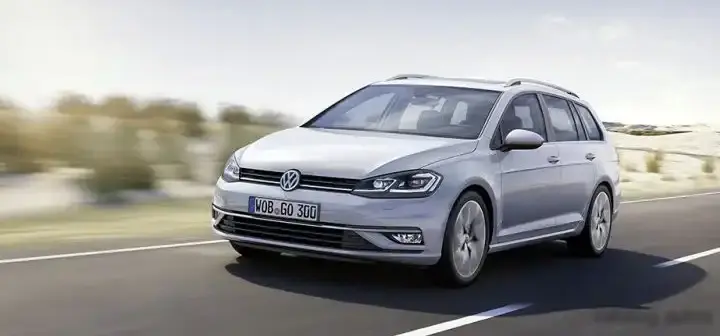
The Volkswagen Golf VII Variant 1.4 TGI BlueMotion, produced from 2017 to 2018, represents a unique offering within the seventh generation (Mk7) Golf lineup. This variant, a station wagon (estate) body style, was specifically designed to appeal to European markets increasingly focused on alternative fuel vehicles. It combined a 1.4-liter turbocharged gasoline engine with a Compressed Natural Gas (CNG) system, offering a blend of efficiency and practicality. Positioned as a mid-range option, it sat below the more powerful gasoline and diesel variants, targeting buyers seeking lower running costs and reduced emissions without sacrificing the Golf’s inherent versatility. The “facelift” designation refers to the cosmetic and technological updates applied to the Mk7 Golf in 2017, including revised front and rear styling, updated infotainment systems, and enhanced driver assistance features.
Technical Specifications
| Brand | Volkswagen |
| Model | Golf |
| Generation | Golf VII Variant (facelift 2017) |
| Type (Engine) | 1.4 TGI (110 Hp) BlueMotion |
| Start of production | 2017 |
| End of production | May, 2018 |
| Powertrain Architecture | Internal Combustion engine |
| Body type | Station wagon (estate) |
| Seats | 5 |
| Doors | 5 |
| Fuel consumption (economy) – urban | 7.3 l/100 km (32.2 US mpg, 38.7 UK mpg, 13.7 km/l) |
| Fuel consumption (economy) – urban (CNG) | 4.8 kg/100 km |
| Fuel consumption (economy) – extra urban | 4.6 l/100 km (51.1 US mpg, 61.4 UK mpg, 21.7 km/l) |
| Fuel consumption (economy) – extra urban (CNG) | 3.0 kg/100 km |
| Fuel consumption (economy) – combined | 5.6 l/100 km (42 US mpg, 50.4 UK mpg, 17.9 km/l) |
| Fuel consumption (economy) – combined (CNG) | 3.6 kg/100 km |
| CO2 emissions | 127 g/km |
| CO2 emissions (CNG) | 98 g/km |
| Fuel Type | Petrol / CNG |
| Acceleration 0 – 100 km/h | 10.9 sec |
| Acceleration 0 – 62 mph | 10.9 sec |
| Acceleration 0 – 60 mph | 10.4 sec |
| Maximum speed | 196 km/h (121.79 mph) |
| Emission standard | Euro 6 |
| Weight-to-power ratio | 11.7 kg/Hp, 85.4 Hp/tonne |
| Weight-to-torque ratio | 6.4 kg/Nm, 155.3 Nm/tonne |
| Power | 110 Hp @ 4800-6000 rpm |
| Power per litre | 78.9 Hp/l |
| Torque | 200 Nm @ 1500-3500 rpm (147.51 lb.-ft. @ 1500-3500 rpm) |
| Engine layout | Front, Transverse |
| Engine Model/Code | CPWA, CZBA |
| Engine displacement | 1395 cm3 (85.13 cu. in.) |
| Number of cylinders | 4 |
| Engine configuration | Inline |
| Number of valves per cylinder | 4 |
| Fuel injection system | Direct injection |
| Engine aspiration | Turbocharger |
| Engine oil capacity | 4 l (4.23 US qt | 3.52 UK qt) |
| Kerb Weight | 1288 kg (2839.55 lbs.) |
| Max. weight | 1860 kg (4100.6 lbs.) |
| Max load | 572 kg (1261.04 lbs.) |
| Trunk (boot) space – minimum | 605 l (21.37 cu. ft.) |
| Trunk (boot) space – maximum | 1620 l (57.21 cu. ft.) |
| Fuel tank capacity | 50 l (13.21 US gal | 11 UK gal) |
| CNG cylinder capacity | 15 kg |
| Max. roof load | 75 kg (165.35 lbs.) |
| Permitted trailer load with brakes (8%) | 1700 kg (3747.86 lbs.) |
| Permitted trailer load with brakes (12%) | 1400 kg (3086.47 lbs.) |
| Permitted trailer load without brakes | 680 kg (1499.14 lbs.) |
| Permitted towbar download | 80 kg (176.37 lbs.) |
| Length | 4567 mm (179.8 in.) |
| Width | 1799 mm (70.83 in.) |
| Width including mirrors | 2027 mm (79.8 in.) |
| Height | 1515 mm (59.65 in.) |
| Wheelbase | 2620 mm (103.15 in.) |
| Front track | 1549 mm (60.98 in.) |
| Rear (Back) track | 1520 mm (59.84 in.) |
| Ride height (ground clearance) | 140 mm (5.51 in.) |
| Minimum turning circle (turning diameter) | 10.9 m (35.76 ft.) |
| Drivetrain Architecture | The Internal combustion engine (ICE) drives the front wheels of the vehicle. |
| Drive wheel | Front wheel drive |
| Number of gears and type of gearbox | 6 gears, manual transmission |
| Front brakes | Ventilated discs |
| Rear brakes | Disc |
| Assisting systems | ABS (Anti-lock braking system) |
| Steering type | Steering rack and pinion |
| Power steering | Electric Steering |
| Tires size | 195/65 R15 |
| Wheel rims size | 6 J x 15 |
Powertrain & Engine Architecture
The heart of the Golf VII Variant 1.4 TGI BlueMotion is the 1.4-liter, four-cylinder, turbocharged gasoline engine, identified by engine codes CPWA or CZBA. This engine utilizes direct fuel injection, a technology that improves combustion efficiency and power output. The turbocharger provides forced induction, boosting power and torque despite the relatively small displacement. The key differentiating factor is the addition of a CNG (Compressed Natural Gas) system. This system allows the engine to run primarily on CNG, switching to gasoline automatically when the CNG tank is depleted. The CNG system includes a high-pressure fuel tank, a pressure regulator, and an injector system specifically designed for CNG. The engine management system seamlessly manages the transition between fuels. The engine produces 110 horsepower at 4800-6000 rpm and 200 Nm (147.51 lb-ft) of torque between 1500-3500 rpm. The engine is transversely mounted at the front of the vehicle, driving the front wheels. The transmission is a 6-speed manual gearbox, chosen for its efficiency and driver engagement.
Driving Characteristics
The 1.4 TGI BlueMotion offers a driving experience geared towards economy and practicality rather than outright performance. The 10.9-second 0-62 mph acceleration time reflects this. While not sluggish, it requires more planning when overtaking or merging onto highways compared to higher-powered Golf variants. The manual transmission provides a decent level of control, but the gear ratios are optimized for fuel efficiency, meaning the engine can feel strained at higher revs. When running on CNG, the engine delivers slightly less power than when running on gasoline, but the difference is generally not noticeable during everyday driving. The suspension is tuned for comfort, providing a reasonably smooth ride, although it may exhibit some body roll during cornering. The steering is precise and responsive, typical of the Golf lineage.
Equipment & Trim Levels
The 1.4 TGI BlueMotion trim typically included standard features such as air conditioning, power windows, central locking, and an infotainment system with a touchscreen display. Safety features included ABS, electronic stability control, and multiple airbags. Interior upholstery was generally cloth, with options for upgraded materials available. Common optional extras included parking sensors, a navigation system, and alloy wheels. The specific trim level could vary slightly depending on the market, but the focus remained on providing a well-equipped and practical vehicle at a competitive price point.
Chassis & Braking
The Golf VII Variant 1.4 TGI BlueMotion utilizes a MacPherson strut front suspension and a multi-link rear suspension, providing a good balance of ride comfort and handling. The front brakes are ventilated discs, while the rear brakes are solid discs. ABS (Anti-lock Braking System) is standard, enhancing braking performance and stability. The chassis is reinforced to accommodate the added weight of the CNG tank, ensuring structural integrity and safety. Stabilizer bars are fitted to both the front and rear axles to reduce body roll during cornering.
Market Reception & Comparison
The Golf VII Variant 1.4 TGI BlueMotion was generally well-received by critics for its fuel efficiency and low emissions. It offered a compelling alternative to traditional gasoline and diesel vehicles, particularly in countries with incentives for alternative fuel vehicles. Compared to the 1.6-liter TDI diesel variant, the 1.4 TGI offered similar fuel economy but with lower NOx emissions. However, the diesel variant typically provided more torque and slightly better acceleration. Compared to the 1.4 TSI gasoline variant, the TGI offered lower running costs due to the cheaper price of CNG, but the gasoline variant offered more power and a simpler powertrain.
Legacy
The 1.4 TGI BlueMotion powertrain has proven to be relatively reliable, with few widespread issues reported. The engine itself is known for its durability, and the CNG system is generally robust. However, the CNG system does require periodic inspection and maintenance to ensure safe operation. In the used car market, these models are often sought after by environmentally conscious buyers and those looking to reduce their fuel costs. The availability of CNG refueling stations remains a limiting factor in some regions, impacting the practicality of these vehicles. Despite this, the Golf VII Variant 1.4 TGI BlueMotion represents a significant step towards more sustainable transportation, showcasing Volkswagen’s commitment to alternative fuel technologies.