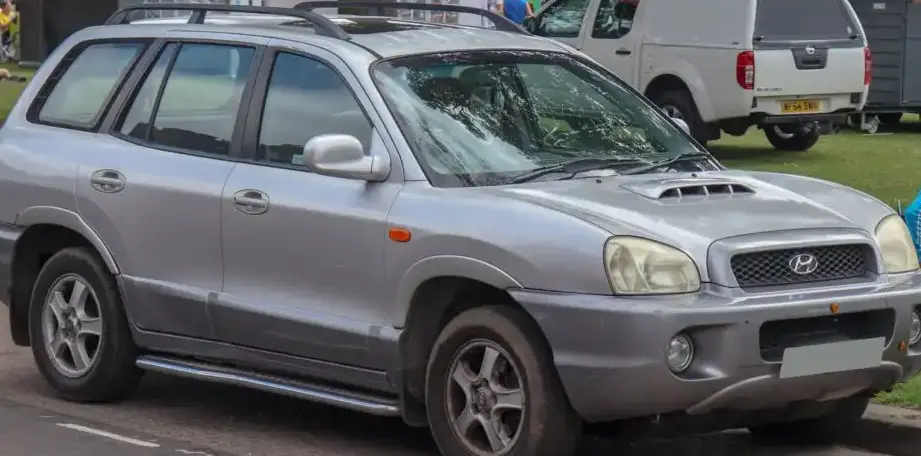
The Hyundai Santa Fe I (SM) 3.5 i V6 24V, produced from 2001 to 2006, represented Hyundai’s initial foray into the burgeoning compact SUV market. Positioned as the top-tier trim level within the first-generation Santa Fe (SM) lineup, this variant offered a significant step up in performance and refinement compared to the base 2.4L four-cylinder models. It was designed to appeal to buyers seeking a more powerful and capable SUV without the price premium of larger, more established competitors. The Santa Fe, built on the SM platform, was a crucial model for Hyundai, helping to establish the brand as a serious contender in the North American market and beyond.
Technical Specifications
| Brand | Hyundai |
| Model | Santa Fe |
| Generation | Santa Fe I (SM) |
| Type (Engine) | 3.5 i V6 24V (203 Hp) |
| Start of production | 2001 year |
| End of production | 2006 year |
| Powertrain Architecture | Internal Combustion engine |
| Body type | SUV |
| Seats | 5 |
| Doors | 5 |
| Fuel consumption (urban) | 13.9 l/100 km (16.9 US mpg) |
| Fuel consumption (extra urban) | 11.2 l/100 km (21 US mpg) |
| Fuel Type | Petrol (Gasoline) |
| Maximum speed | 180 km/h (111.85 mph) |
| Weight-to-power ratio | 8.8 kg/Hp |
| Weight-to-torque ratio | 6 kg/Nm |
| Power | 203 Hp @ 5500 rpm |
| Power per litre | 58 Hp/l |
| Torque | 297 Nm @ 3500 rpm (219.06 lb.-ft. @ 3500 rpm) |
| Engine layout | Front, Transverse |
| Engine Model/Code | Delta / G6CU |
| Engine displacement | 3497 cm3 (213.4 cu. in.) |
| Number of cylinders | 6 |
| Engine configuration | V-engine |
| Cylinder Bore | 93 mm (3.66 in.) |
| Piston Stroke | 85.8 mm (3.38 in.) |
| Compression ratio | 10:1 |
| Number of valves per cylinder | 4 |
| Fuel injection system | Multi-port manifold injection |
| Engine aspiration | Naturally aspirated engine |
| Engine oil capacity | 4.3 l (4.54 US qt | 3.78 UK qt) |
| Coolant | 8.2 l (8.66 US qt | 7.21 UK qt) |
| Kerb Weight | 1790 kg (3946.27 lbs.) |
| Trunk (boot) space – minimum | 850 l (30.02 cu. ft.) |
| Trunk (boot) space – maximum | 2100 l (74.16 cu. ft.) |
| Fuel tank capacity | 65 l (17.17 US gal | 14.3 UK gal) |
| Length | 4500 mm (177.17 in.) |
| Width | 1820 mm (71.65 in.) |
| Height | 1730 mm (68.11 in.) |
| Wheelbase | 2620 mm (103.15 in.) |
| Front track | 1540 mm (60.63 in.) |
| Rear (Back) track | 1540 mm (60.63 in.) |
| Drive wheel | All wheel drive (4×4) |
| Number of gears and type of gearbox | 4 gears, automatic transmission |
| Front suspension | Wishbone |
| Rear suspension | Coil spring |
| Front brakes | Ventilated discs |
| Rear brakes | Disc |
| Assisting systems | ABS (Anti-lock braking system) |
| Steering type | Steering rack and pinion |
| Power steering | Hydraulic Steering |
| Tires size | 225/70 R16 |
Powertrain & Engine Architecture
The heart of the Santa Fe 3.5 i V6 was the Hyundai Delta engine, specifically the G6CU variant. This 3.5-liter, naturally aspirated V6 engine featured a 60-degree V-angle and utilized a cast iron block with an aluminum cylinder head. The engine employed multi-port fuel injection (MPI) and a dual overhead camshaft (DOHC) valvetrain with four valves per cylinder. This configuration allowed for a relatively broad torque curve and a respectable 203 horsepower. The automatic transmission was a four-speed unit, designed to provide smooth shifts and adequate acceleration. While not the most advanced transmission available at the time, it was well-suited to the engine’s characteristics and the intended use of the vehicle.
Driving Characteristics
The 3.5L V6 and four-speed automatic combination delivered a noticeable performance advantage over the base four-cylinder Santa Fe. Acceleration was brisk, and the engine provided ample power for highway merging and passing maneuvers. However, the four-speed automatic transmission limited overall efficiency and didn’t offer the responsiveness of more modern transmissions with additional gears. The all-wheel-drive system provided enhanced traction in inclement weather, making the Santa Fe a capable all-season vehicle. Compared to a hypothetical manual transmission version, the automatic traded some responsiveness for ease of use, appealing to a broader range of drivers.
Equipment & Trim Levels
As the top-of-the-line trim, the 3.5 i V6 Santa Fe typically included features such as air conditioning, power windows and locks, a CD player, and alloy wheels. Leather upholstery and a sunroof were often optional extras. The interior design was functional and relatively spacious, offering comfortable seating for five passengers. The dashboard layout was straightforward and easy to use, prioritizing practicality over stylistic flair. Higher-end options could include upgraded sound systems and automatic climate control.
Chassis & Braking
The Santa Fe I utilized a traditional body-on-frame construction, which contributed to its robust feel. The front suspension featured independent wishbones, while the rear suspension employed a coil spring setup. Braking duties were handled by ventilated discs up front and solid discs at the rear. Anti-lock braking system (ABS) was standard, enhancing safety and control during hard braking. The suspension tuning prioritized ride comfort over sporty handling, making the Santa Fe a pleasant vehicle for long journeys.
Market Reception & Comparison
The Santa Fe 3.5 i V6 was generally well-received by automotive critics. It was praised for its spacious interior, comfortable ride, and strong engine performance. However, some reviewers noted the relatively dated four-speed automatic transmission and the somewhat unrefined driving experience compared to more established competitors like the Honda CR-V or Toyota RAV4. Fuel economy was also a point of criticism, as the V6 engine consumed significantly more fuel than the four-cylinder options. In terms of reliability, the Santa Fe proved to be a reasonably dependable vehicle, although some owners reported issues with the automatic transmission over the long term.
Legacy
The Hyundai Santa Fe I (SM) 3.5 i V6 24V played a significant role in establishing Hyundai as a viable competitor in the compact SUV segment. While the first-generation Santa Fe isn’t known for being a collector’s item, well-maintained examples with the 3.5L V6 engine can still be found on the used car market. The powertrain, while not particularly fuel-efficient by modern standards, is generally considered reliable if properly maintained. The Santa Fe’s success paved the way for subsequent generations of the model, which have continued to improve in terms of refinement, technology, and fuel economy. The G6CU engine, while superseded by newer designs, remains a relatively durable and straightforward powerplant.