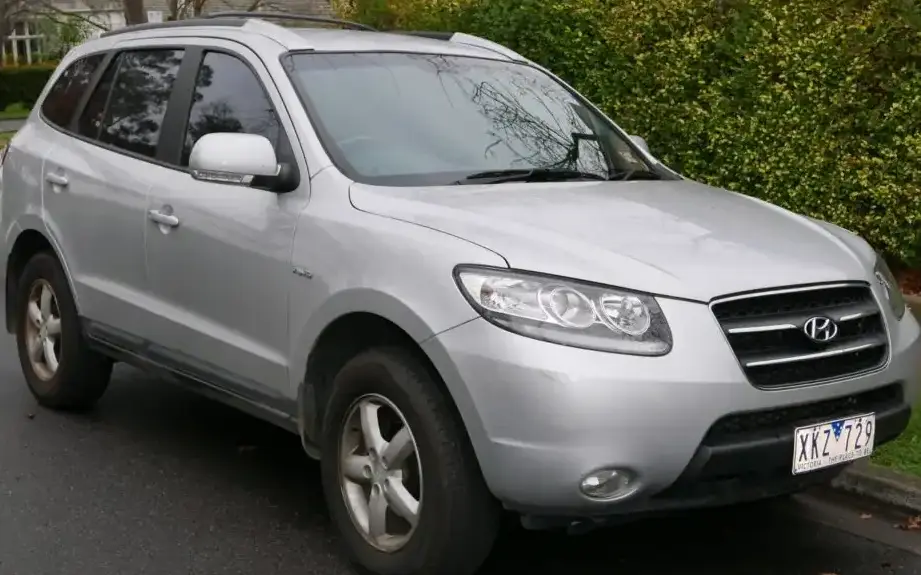
The Hyundai Santa Fe II (CM) 2.2 CRDi Automatic, produced between 2006 and 2009, represented a significant step forward for Hyundai in the mid-size SUV segment. Positioned as a comfortable and practical family vehicle, this variant utilized a 2.2-liter turbocharged diesel engine paired with a five-speed automatic transmission. It was a key offering within the CM generation, which itself was a substantial redesign of the original Santa Fe, moving to the 1HX0/A3 platform shared with the Kia Sorento. The 2.2 CRDi Automatic served as a mid-range option, offering a balance between performance, fuel economy, and convenience, appealing to buyers who preferred the ease of an automatic gearbox over a manual transmission.
Technical Specifications
| Brand | Hyundai |
| Model | Santa Fe |
| Generation | Santa Fe II (CM) |
| Type (Engine) | 2.2 CRDi (155 Hp) Automatic |
| Start of production | 2006 |
| End of production | 2009 |
| Powertrain Architecture | Internal Combustion engine |
| Body type | SUV |
| Seats | 5 |
| Doors | 5 |
| Fuel consumption (economy) – urban (NEDC) | 10.4 l/100 km (22.6 US mpg, 27.2 UK mpg, 9.6 km/l) |
| Fuel consumption (economy) – extra urban (NEDC) | 6.6 l/100 km (35.6 US mpg, 42.8 UK mpg, 15.2 km/l) |
| Fuel consumption (economy) – combined (NEDC) | 8 l/100 km (29.4 US mpg, 35.3 UK mpg, 12.5 km/l) |
| CO2 emissions (NEDC) | 211 g/km |
| Fuel Type | Diesel |
| Acceleration 0 – 100 km/h | 12.4 sec |
| Acceleration 0 – 62 mph | 12.4 sec |
| Acceleration 0 – 60 mph | 11.8 sec |
| Maximum speed | 179 km/h (111.23 mph) |
| Emission standard | Euro 4 |
| Weight-to-power ratio | 11.4 kg/Hp, 87.4 Hp/tonne |
| Weight-to-torque ratio | 5.2 kg/Nm, 193.5 Nm/tonne |
| Power | 155 Hp @ 4000 rpm |
| Power per litre | 70.8 Hp/l |
| Torque | 343 Nm @ 1800-2500 rpm (252.98 lb.-ft. @ 1800-2500 rpm) |
| Engine layout | Front, Transverse |
| Engine Model/Code | D4EB |
| Engine displacement | 2188 cm3 (133.52 cu. in.) |
| Number of cylinders | 4 |
| Engine configuration | Inline |
| Cylinder Bore | 87 mm (3.43 in.) |
| Piston Stroke | 92 mm (3.62 in.) |
| Compression ratio | 17.3:1 |
| Number of valves per cylinder | 4 |
| Fuel injection system | Diesel Commonrail |
| Engine aspiration | Turbocharger, Intercooler |
| Valvetrain | SOHC |
| Engine oil capacity | 5.9 l (6.23 US qt | 5.19 UK qt) |
| Coolant | 8.4 l (8.88 US qt | 7.39 UK qt) |
| Kerb Weight | 1773-1866 kg (3908.8 – 4113.83 lbs.) |
| Max. weight | 2520 kg (5555.65 lbs.) |
| Max load | 654-747 kg (1441.82 – 1646.85 lbs.) |
| Trunk (boot) space – minimum | 528 l (18.65 cu. ft.) |
| Fuel tank capacity | 75 l (19.81 US gal | 16.5 UK gal) |
| Max. roof load | 100 kg (220.46 lbs.) |
| Permitted trailer load with brakes (8%) | 2500 kg (5511.56 lbs.) |
| Permitted trailer load with brakes (12%) | 2000 kg (4409.25 lbs.) |
| Permitted trailer load without brakes | 750 kg (1653.47 lbs.) |
| Permitted towbar download | 80 kg (176.37 lbs.) |
| Length | 4675 mm (184.06 in.) |
| Width | 1890 mm (74.41 in.) |
| Height | 1795 mm (70.67 in.) |
| Wheelbase | 2700 mm (106.3 in.) |
| Front track | 1615 mm (63.58 in.) |
| Rear (Back) track | 1620 mm (63.78 in.) |
| Front overhang | 940 mm (37.01 in.) |
| Rear overhang | 1035 mm (40.75 in.) |
| Ride height (ground clearance) | 203 mm (7.99 in.) |
| Drag coefficient (Cd) | 0.38 |
| Minimum turning circle (turning diameter) | 10.9 m (35.76 ft.) |
| Drivetrain Architecture | The Internal combustion engine (ICE) drives the front wheels of the vehicle. |
| Drive wheel | Front wheel drive |
| Number of gears and type of gearbox | 5 gears, automatic transmission |
| Front suspension | Independent, type McPherson with coil spring and anti-roll bar |
| Rear suspension | Independent multi-link spring suspension with stabilizer |
| Front brakes | Ventilated discs |
| Rear brakes | Disc |
| Assisting systems | ABS (Anti-lock braking system) |
| Steering type | Steering rack and pinion |
| Power steering | Hydraulic Steering |
| Tires size | 235/65 R17; 235/60 R18 |
| Wheel rims size | 7J x 17; 8J x 18 |
Powertrain & Engine Architecture
The heart of this Santa Fe variant is the Hyundai D4EB 2.2-liter inline-four cylinder diesel engine. This engine utilizes a second-generation common rail direct injection system, delivering fuel at extremely high pressures for improved combustion efficiency and reduced emissions. The D4EB features a single overhead camshaft (SOHC) valvetrain operating four valves per cylinder. A turbocharger with an intercooler is employed to boost power output, providing 155 horsepower at 4,000 rpm and a substantial 343 Nm (253 lb-ft) of torque between 1800 and 2500 rpm. The five-speed automatic transmission, while providing convenience, was a conventional torque converter type, not a dual-clutch or continuously variable transmission (CVT) found in later models. It was designed to handle the engine’s torque output, but wasn’t known for particularly quick or sporty shifts.
Driving Characteristics
The 2.2 CRDi Automatic Santa Fe offered a comfortable and relaxed driving experience. Acceleration from 0-60 mph took around 11.8 to 12.4 seconds, which was adequate for everyday driving but not particularly brisk. The automatic transmission, while smooth, did contribute to some power loss compared to the available manual transmission versions. The gear ratios were tuned for fuel efficiency and cruising comfort rather than outright performance. The engine provided ample torque for merging onto highways and overtaking, but required a downshift or two for more urgent maneuvers. The front-wheel-drive configuration provided predictable handling, but lacked the all-weather capability of the optional four-wheel-drive system available on other Santa Fe trims.
Equipment & Trim Levels
The 2.2 CRDi Automatic typically came with a reasonable level of standard equipment. This included air conditioning, power windows and locks, a CD player with AM/FM radio, and basic safety features like ABS and dual front airbags. Higher trim levels offered upgrades such as leather upholstery, a sunroof, alloy wheels, and a more sophisticated audio system. Optional extras included a navigation system, heated front seats, and a rear parking sensor system. Interior materials were generally durable and practical, reflecting the Santa Fe’s focus on value and family usability.
Chassis & Braking
The Santa Fe II (CM) utilized an independent McPherson strut suspension in the front and an independent multi-link suspension in the rear. This setup provided a comfortable ride quality, absorbing bumps and irregularities in the road surface effectively. Stabilizer bars were fitted to both axles to reduce body roll during cornering. Braking duties were handled by ventilated discs at the front and solid discs at the rear. The ABS system provided enhanced braking control, particularly on slippery surfaces. The steering was a hydraulic rack-and-pinion system, offering reasonable precision and feedback.
Market Reception & Comparison
The Hyundai Santa Fe II (CM) 2.2 CRDi Automatic was generally well-received by automotive critics as a practical and well-equipped SUV. The diesel engine was praised for its fuel efficiency and torque, while the automatic transmission was seen as a convenient option for many buyers. However, some reviewers noted that the transmission could feel sluggish at times and that the overall driving experience wasn’t as engaging as some of its competitors. Compared to the gasoline-powered versions, the 2.2 CRDi offered significantly better fuel economy. Against rivals like the Honda CR-V and Toyota RAV4, the Santa Fe offered a more spacious interior and a lower price point, but lacked the established reputation for reliability of the Japanese brands.
Legacy
The Hyundai Santa Fe II (CM) 2.2 CRDi Automatic has proven to be a relatively reliable vehicle in the used car market. The D4EB engine, while not without its potential issues (such as potential turbocharger wear and common rail injector problems), is generally durable if properly maintained. The automatic transmission is also reasonably robust, although regular fluid changes are essential. Today, these Santa Fes represent a good value for buyers seeking an affordable and practical SUV. Their age means that maintenance costs are likely to increase, but their relatively simple mechanical design makes them easier and cheaper to repair than many more modern vehicles.