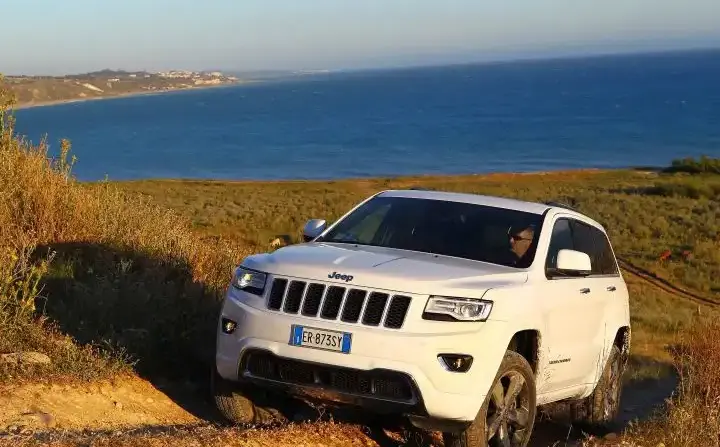
The Jeep Grand Cherokee IV (WK2), specifically the facelifted version produced from 2013 to 2017, offered a 3.0-liter CRD (Common Rail Diesel) engine producing 190 horsepower paired with an eight-speed automatic transmission and a four-wheel-drive system. This variant occupied a middle ground within the WK2 lineup, positioned as a more fuel-efficient alternative to the gasoline-powered V6 and V8 models, while offering a more refined experience than the base-level trims. It was primarily marketed in Europe and other regions where diesel engines were popular, offering a blend of capability, comfort, and economy expected of the Grand Cherokee nameplate.
Technical Specifications
| Brand | Jeep |
| Model | Grand Cherokee |
| Generation | Grand Cherokee IV (WK2, facelift 2013) |
| Type (Engine) | 3.0 CRD (190 Hp) 4×4 Automatic |
| Start of production | 2013 |
| End of production | 2017 |
| Powertrain Architecture | Internal Combustion engine |
| Body type | SUV |
| Seats | 5 |
| Doors | 5 |
| Fuel consumption (urban) | 9.3 l/100 km (25.3 US mpg, 30.4 UK mpg, 10.8 km/l) |
| Fuel consumption (extra urban) | 6.5 l/100 km (36.2 US mpg, 43.5 UK mpg, 15.4 km/l) |
| Fuel consumption (combined) | 7.5 l/100 km (31.4 US mpg, 37.7 UK mpg, 13.3 km/l) |
| CO2 emissions | 198 g/km |
| Fuel Type | Diesel |
| Acceleration 0 – 100 km/h | 10.2 sec |
| Acceleration 0 – 62 mph | 10.2 sec |
| Acceleration 0 – 60 mph | 9.7 sec |
| Maximum speed | 190 km/h (118.06 mph) |
| Emission standard | Euro 5 |
| Weight-to-power ratio | 12.6 kg/Hp, 79.1 Hp/tonne |
| Weight-to-torque ratio | 5.5 kg/Nm, 183.1 Nm/tonne |
| Power | 190 Hp @ 4000 rpm |
| Power per litre | 63.6 Hp/l |
| Torque | 440 Nm @ 1600-2800 rpm (324.53 lb.-ft. @ 1600-2800 rpm) |
| Engine layout | Front, Longitudinal |
| Engine Model/Code | EXN |
| Engine displacement | 2987 cm3 (182.28 cu. in.) |
| Number of cylinders | 6 |
| Engine configuration | V-engine |
| Cylinder Bore | 83 mm (3.27 in.) |
| Piston Stroke | 92 mm (3.62 in.) |
| Compression ratio | 15.5:1 |
| Number of valves per cylinder | 4 |
| Fuel injection system | Diesel Commonrail |
| Engine aspiration | Turbocharger, Intercooler |
| Valvetrain | DOHC |
| Engine oil capacity | 8.4 l (8.88 US qt | 7.39 UK qt) |
| Coolant | 13.2 l (13.95 US qt | 11.61 UK qt) |
| Kerb Weight | 2403-2522 kg (5297.71 – 5560.06 lbs.) |
| Max. weight | 2949 kg (6501.43 lbs.) |
| Max load | 427-546 kg (941.37 – 1203.72 lbs.) |
| Trunk (boot) space – minimum | 457 l (16.14 cu. ft.) |
| Trunk (boot) space – maximum | 1554 l (54.88 cu. ft.) |
| Fuel tank capacity | 93 l (24.57 US gal | 20.46 UK gal) |
| Permitted trailer load with brakes (12%) | 3500 kg (7716.18 lbs.) |
| Length | 4828 mm (190.08 in.) |
| Width | 1943 mm (76.5 in.) |
| Height | 1802 mm (70.94 in.) |
| Wheelbase | 2915 mm (114.76 in.) |
| Front track | 1628 mm (64.09 in.) |
| Rear (Back) track | 1634 mm (64.33 in.) |
| Ride height (ground clearance) | 218 mm (8.58 in.) |
| Drag coefficient (Cd) | 0.37 |
| Minimum turning circle (turning diameter) | 11.3 m (37.07 ft.) |
| Approach angle | 26.3° |
| Departure angle | 26.5° |
| Ramp-over (brakeover) angle | 18.8° |
| Drive wheel | All wheel drive (4×4) |
| Number of gears and type of gearbox | 8 gears, automatic transmission |
| Front suspension | Double wishbone |
| Rear suspension | Independent multi-link suspension |
| Front brakes | Ventilated discs |
| Rear brakes | Disc |
| Assisting systems | ABS (Anti-lock braking system) |
| Steering type | Steering rack and pinion |
| Power steering | Electric Steering |
| Tires size | 265/60 R18; 265/50 R20 |
| Wheel rims size | 8J x 18; 8J x 20 |
INTRODUCTION
The Jeep Grand Cherokee WK2, launched in 2010 and receiving a significant facelift in 2013, represented a substantial leap forward in refinement and capability for the iconic American SUV. The 3.0 CRD variant, introduced with the facelift, was specifically tailored for markets outside North America, where diesel engines held a strong preference. Production of this specific configuration ran from 2013 to 2017. Built on the 1HX0 platform (shared with the Mercedes-Benz ML-Class of the time, a result of DaimlerChrysler’s former partnership), the WK2 Grand Cherokee aimed to deliver a premium SUV experience with genuine off-road prowess. The 3.0 CRD model offered a balance between performance, fuel efficiency, and towing capacity, making it a popular choice for families and individuals seeking a versatile vehicle.
Powertrain & Engine Architecture
The heart of the 3.0 CRD Grand Cherokee is the EXN engine, a 2,987cc V6 diesel. This engine utilizes a common rail direct injection system, delivering fuel at extremely high pressure for optimized combustion. The EXN engine features a variable geometry turbocharger (VGT) and an intercooler to enhance power and efficiency. The engine’s valvetrain employs double overhead camshafts (DOHC) with four valves per cylinder, contributing to its smooth operation and power delivery. The eight-speed automatic transmission, sourced from ZF, was a key component of this powertrain. Its wide gear ratio spread allowed for both relaxed highway cruising and responsive acceleration. The transmission was programmed for smooth shifts and optimized fuel economy, but also provided manual shift control for drivers who preferred more engagement.
Driving Characteristics
The 190 horsepower and 440 Nm (324.53 lb-ft) of torque produced by the 3.0 CRD engine provided adequate, though not exhilarating, performance for the Grand Cherokee. Acceleration from 0-60 mph took around 9.7 seconds, and the top speed was limited to 190 km/h (118 mph). Compared to the gasoline-powered V6 or V8 models, the diesel offered less outright power, but its torque curve was broader and more accessible, making it feel strong in everyday driving situations. The eight-speed automatic transmission helped to keep the engine in its optimal power band, minimizing turbo lag and providing smooth, predictable acceleration. While not as sporty as some competitors, the 3.0 CRD Grand Cherokee offered a comfortable and capable driving experience, particularly on long journeys. The automatic transmission, while efficient, wasn’t known for particularly quick shifts compared to some performance-oriented automatics.
Equipment & Trim Levels
The 3.0 CRD Grand Cherokee typically came well-equipped, even in base trim levels. Standard features often included leather upholstery, dual-zone automatic climate control, a touchscreen infotainment system with navigation, and a rearview camera. Higher trim levels added features such as heated and ventilated front seats, a premium sound system, and advanced safety technologies like adaptive cruise control and blind-spot monitoring. Optional extras included a panoramic sunroof, rear-seat entertainment system, and various appearance packages. Interior color schemes varied depending on the trim level, with options ranging from dark shades of gray and black to lighter beige tones.
Chassis & Braking
The WK2 Grand Cherokee featured a robust chassis designed for both on-road comfort and off-road capability. The front suspension utilized a double wishbone design, while the rear employed an independent multi-link setup. This configuration provided a good balance between ride quality and handling. Braking duties were handled by ventilated discs at all four corners, providing ample stopping power. The 3.0 CRD models typically featured slightly smaller rear rotors compared to the V8-powered versions, reflecting the lower weight and power output. Anti-lock brakes (ABS) were standard, along with electronic stability control and traction control systems.
Market Reception & Comparison
The 3.0 CRD Grand Cherokee was generally well-received by automotive critics in Europe and other diesel-friendly markets. It was praised for its comfortable ride, spacious interior, and fuel efficiency. However, some reviewers noted that the engine lacked the outright power of its gasoline counterparts. Compared to rivals like the BMW X5 and Audi Q7, the Grand Cherokee offered a more rugged and American aesthetic, along with a more competitive price point. Fuel economy was a key selling point, with the 3.0 CRD achieving around 31.4 US mpg in combined driving, significantly better than the gasoline-powered models. Reliability was generally good, although some owners reported issues with the diesel particulate filter (DPF) system, a common concern with modern diesel engines.
Legacy
The 3.0 CRD Grand Cherokee (WK2) has established itself as a reliable and capable SUV in the used car market. The EXN engine, while not without its potential issues (such as DPF regeneration problems if not properly maintained), has proven to be relatively durable. These vehicles offer a good value proposition for buyers seeking a spacious, comfortable, and capable SUV with decent fuel economy. The eight-speed automatic transmission has also proven to be robust and reliable. Today, well-maintained examples of the 3.0 CRD Grand Cherokee continue to be sought after by those who appreciate its blend of American ruggedness and European refinement.