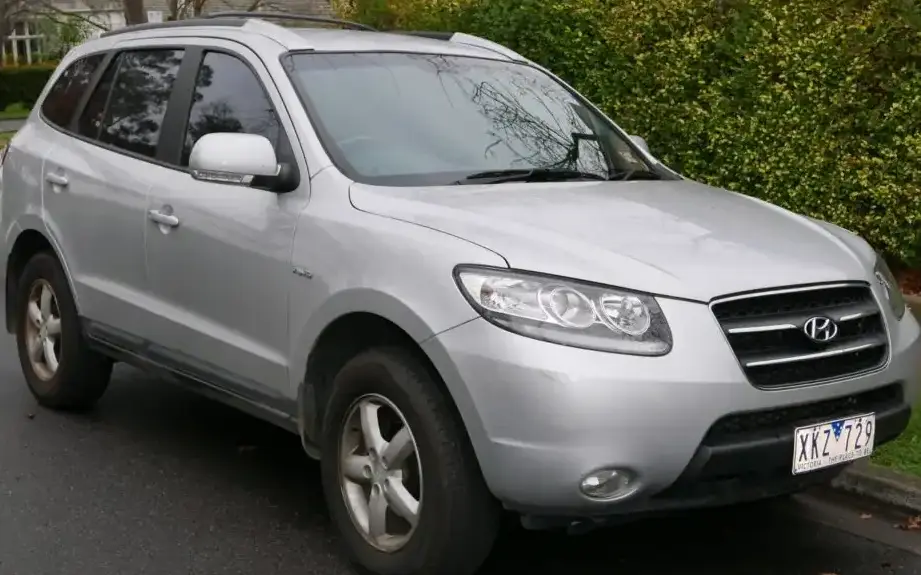
The Hyundai Santa Fe II (CM) 3.3 V6 Automatic, produced from 2006 to 2009, represented a significant step forward for Hyundai in the mid-size SUV segment. Positioned as the top-tier engine option within the CM generation Santa Fe lineup, it offered a substantial power upgrade over the 2.7L V6 and the available four-cylinder engines. This variant aimed to attract buyers seeking a comfortable, well-equipped SUV with robust performance for family transportation and light towing needs, primarily targeting the North American market where larger vehicles were favored. The CM Santa Fe itself was a crucial model for Hyundai, solidifying its reputation for value and reliability.
Technical Specifications
| Brand | Hyundai |
| Model | Santa Fe |
| Generation | Santa Fe II (CM) |
| Type (Engine) | 3.3 V6 (242 Hp) Automatic |
| Start of production | 2006 |
| End of production | 2009 |
| Powertrain Architecture | Internal Combustion engine |
| Body type | SUV |
| Seats | 5 |
| Doors | 5 |
| Fuel consumption (economy) – urban (EPA) | 13.8 l/100 km (17 US mpg, 20.5 UK mpg) |
| Fuel consumption (economy) – extra urban (EPA) | 9.8 l/100 km (24 US mpg, 28.8 UK mpg) |
| Fuel Type | Petrol (Gasoline) |
| Emission standard | ULEV |
| Weight-to-power ratio | 7.2 kg/Hp, 138.7 Hp/tonne |
| Weight-to-torque ratio | 5.7 kg/Nm, 175.4 Nm/tonne |
| Power | 242 Hp @ 6000 rpm |
| Power per litre | 72.4 Hp/l |
| Torque | 306 Nm @ 4500 rpm (225.69 lb.-ft. @ 4500 rpm) |
| Engine layout | Front, Transverse |
| Engine Model/Code | Lambda / G6DB |
| Engine displacement | 3342 cm3 (203.94 cu. in.) |
| Number of cylinders | 6 |
| Engine configuration | V-engine |
| Cylinder Bore | 92 mm (3.62 in.) |
| Piston Stroke | 83.8 mm (3.3 in.) |
| Compression ratio | 10.4:1 |
| Number of valves per cylinder | 4 |
| Fuel injection system | Multi-port manifold injection |
| Engine aspiration | Naturally aspirated engine |
| Valvetrain | DOHC, CVVT |
| Engine oil capacity | 5.5 l (5.81 US qt | 4.84 UK qt) |
| Coolant | 7 l (7.4 US qt | 6.16 UK qt) |
| Kerb Weight | 1745 kg (3847.07 lbs.) |
| Trunk (boot) space – minimum | 968 l (34.18 cu. ft.) |
| Trunk (boot) space – maximum | 2214 l (78.19 cu. ft.) |
| Fuel tank capacity | 75 l (19.81 US gal | 16.5 UK gal) |
| Permitted trailer load with brakes (12%) | 1588 kg (3500.94 lbs.) |
| Permitted trailer load without brakes | 748 kg (1649.06 lbs.) |
| Length | 4675 mm (184.06 in.) |
| Width | 1890 mm (74.41 in.) |
| Height | 1725 mm (67.91 in.) |
| Wheelbase | 2700 mm (106.3 in.) |
| Front track | 1615 mm (63.58 in.) |
| Rear (Back) track | 1620 mm (63.78 in.) |
| Ride height (ground clearance) | 206 mm (8.11 in.) |
| Minimum turning circle (turning diameter) | 10.9 m (35.76 ft.) |
| Drivetrain Architecture | The Internal combustion engine (ICE) drives the front wheels of the vehicle. |
| Drive wheel | Front wheel drive |
| Number of gears and type of gearbox | 5 gears, automatic transmission |
| Front suspension | Independent, type McPherson with coil spring and anti-roll bar |
| Rear suspension | Independent multi-link spring suspension with stabilizer |
| Front brakes | Ventilated discs |
| Rear brakes | Disc |
| Assisting systems | ABS (Anti-lock braking system) |
| Steering type | Steering rack and pinion |
| Power steering | Hydraulic Steering |
| Tires size | 235/60 R18 |
| Wheel rims size | 7J x 18 |
Powertrain & Engine Architecture
The heart of this Santa Fe variant is the Hyundai Lambda 3.3-liter V6 engine, designated as the G6DB. This engine is a naturally aspirated, 60-degree V6 featuring a cast iron block and an aluminum cylinder head. It utilizes multi-port fuel injection and Hyundai’s Continuously Variable Valve Timing (CVVT) technology on both intake and exhaust valves, optimizing performance and fuel efficiency across the rev range. The engine produces 242 horsepower at 6000 rpm and 306 Nm (225.69 lb-ft) of torque at 4500 rpm. The engine’s design prioritized smooth operation and adequate power for everyday driving rather than outright performance. Paired with the engine is a five-speed automatic transmission, providing relatively smooth shifts but lacking the responsiveness of a manual gearbox or more modern automatic transmissions. The transmission was chosen to appeal to the broader market seeking convenience and ease of use.
Driving Characteristics
The 3.3L V6 Automatic Santa Fe offered a noticeable improvement in acceleration and highway passing power compared to the lower-displacement engines. While not a sports SUV, it provided sufficient power for merging onto highways and maintaining speed on inclines. The automatic transmission, while smooth, could feel somewhat hesitant during quick acceleration, and the gear ratios were tuned for fuel economy rather than performance. Compared to a manual transmission equipped Santa Fe, the automatic version sacrificed some responsiveness and driver engagement. The weight of the vehicle, around 1745 kg (3847 lbs), meant that the 242 hp engine wasn’t delivering particularly brisk acceleration, but it was adequate for most drivers’ needs.
Equipment & Trim Levels
The 3.3L V6 Automatic typically came equipped as the highest trim level, often designated as the Limited or Signature trim. Standard features included air conditioning, power windows and locks, a CD player with an auxiliary input, and alloy wheels. Higher-end options included a sunroof, leather upholstery, heated front seats, and a premium sound system. Safety features such as ABS and front airbags were standard. The interior generally featured a comfortable and spacious cabin, although the materials used were not as luxurious as those found in some competing SUVs from European or Japanese manufacturers.
Chassis & Braking
The Santa Fe CM utilized a front-wheel-drive platform with an independent McPherson strut suspension in the front and an independent multi-link suspension in the rear. This setup provided a reasonably comfortable ride, absorbing bumps and imperfections in the road effectively. Stabilizer bars were included on both axles to reduce body roll during cornering. Braking duties were handled by ventilated discs in the front and solid discs in the rear, equipped with ABS. The braking system was adequate for everyday driving, but it wasn’t particularly powerful or sporty.
Market Reception & Comparison
The Hyundai Santa Fe II 3.3 V6 Automatic was generally well-received by critics as a competent and value-packed SUV. It offered a compelling combination of space, features, and performance at a competitive price point. However, some reviewers noted that the automatic transmission could be slow to respond and that the interior materials weren’t as refined as those found in some rivals. Compared to the 2.7L V6 version, the 3.3L offered a significant power boost, but at the cost of slightly lower fuel economy. Against competitors like the Honda CR-V and Toyota RAV4, the Santa Fe offered more interior space and a more powerful engine, but lacked the established reputation for reliability of the Japanese brands.
Legacy
The Hyundai Santa Fe II 3.3 V6 Automatic has proven to be a relatively reliable vehicle in the used car market. The Lambda engine, while not without its potential issues (such as oil consumption in some cases), is generally considered durable. The automatic transmission is also known to be fairly robust. Today, these vehicles are often found with relatively high mileage, and maintenance records are crucial when considering a purchase. The CM Santa Fe played a key role in establishing Hyundai as a serious contender in the SUV market, paving the way for the brand’s continued success in the segment.