Technical Specifications
| Brand | Hyundai |
| Model | Santa Fe |
| Generation | Santa Fe II (CM, facelift 2009) |
| Type (Engine) | 2.4 (174 Hp) 4WD |
| Start of production | 2009 |
| End of production | 2012 |
| Powertrain Architecture | Internal Combustion engine |
| Body type | SUV |
| Seats | 5 |
| Doors | 5 |
| Fuel consumption (economy) – urban (NEDC) | 11.7 l/100 km (20.1 US mpg, 24.1 UK mpg, 8.5 km/l) |
| Fuel consumption (economy) – extra urban (NEDC) | 6.9 l/100 km (34.1 US mpg, 40.9 UK mpg, 14.5 km/l) |
| Fuel consumption (economy) – combined (NEDC) | 8.7 l/100 km (27 US mpg, 32.5 UK mpg, 11.5 km/l) |
| CO2 emissions (NEDC) | 208 g/km |
| Fuel Type | Petrol (Gasoline) |
| Acceleration 0 – 100 km/h | 11.2 sec |
| Acceleration 0 – 62 mph | 11.2 sec |
| Acceleration 0 – 60 mph | 10.6 sec |
| Maximum speed | 190 km/h (118.06 mph) |
| Emission standard | Euro 5 |
| Weight-to-power ratio | 10 kg/Hp, 100.2 Hp/tonne |
| Weight-to-torque ratio | 7.7 kg/Nm, 130.1 Nm/tonne |
| Power | 174 Hp @ 6000 rpm |
| Power per litre | 73.8 Hp/l |
| Torque | 226 Nm @ 3750 rpm (166.69 lb.-ft. @ 3750 rpm) |
| Engine layout | Front, Transverse |
| Engine Model/Code | Theta II / G4KE |
| Engine displacement | 2359 cm3 (143.96 cu. in.) |
| Number of cylinders | 4 |
| Engine configuration | Inline |
| Cylinder Bore | 88 mm (3.46 in.) |
| Piston Stroke | 97 mm (3.82 in.) |
| Compression ratio | 10.5:1 |
| Number of valves per cylinder | 4 |
| Fuel injection system | Multi-port manifold injection |
| Engine aspiration | Naturally aspirated engine |
| Valvetrain | DOHC |
| Engine oil capacity | 4.6 l (4.86 US qt | 4.05 UK qt) |
| Coolant | 6.5 l (6.87 US qt | 5.72 UK qt) |
| Kerb Weight | 1737-1817 kg (3829.43 – 4005.8 lbs.) |
| Max. weight | 2505 kg (5522.58 lbs.) |
| Max load | 688-768 kg (1516.78 – 1693.15 lbs.) |
| Trunk (boot) space – minimum | 528 l (18.65 cu. ft.) |
| Fuel tank capacity | 75 l (19.81 US gal | 16.5 UK gal) |
| Max. roof load | 100 kg (220.46 lbs.) |
| Permitted trailer load with brakes (8%) | 2400 kg (5291.09 lbs.) |
| Permitted trailer load with brakes (12%) | 2000 kg (4409.25 lbs.) |
| Permitted trailer load without brakes | 750 kg (1653.47 lbs.) |
| Permitted towbar download | 80 kg (176.37 lbs.) |
| Length | 4660 mm (183.46 in.) |
| Width | 1890 mm (74.41 in.) |
| Height | 1760 mm (69.29 in.) |
| Wheelbase | 2700 mm (106.3 in.) |
| Front track | 1615 mm (63.58 in.) |
| Rear (Back) track | 1620 mm (63.78 in.) |
| Front overhang | 930 mm (36.61 in.) |
| Rear overhang | 1030 mm (40.55 in.) |
| Ride height (ground clearance) | 200 mm (7.87 in.) |
| Drag coefficient (Cd) | 0.38 |
| Minimum turning circle (turning diameter) | 10.9 m (35.76 ft.) |
| Approach angle | 24.6° |
| Departure angle | 21.6° |
| Ramp-over (brakeover) angle | 17.9° |
| Wading depth | 500 mm (19.69 in.) |
| Drivetrain Architecture | The Internal combustion engine (ICE) drives the front wheels permanently, and the rear wheels are driven through an electrically or mechanically operated clutch if necessary. |
| Drive wheel | All wheel drive (4×4) |
| Number of gears and type of gearbox | 6 gears, manual transmission |
| Front suspension | Independent, type McPherson with coil spring and anti-roll bar |
| Rear suspension | Independent multi-link spring suspension with stabilizer |
| Front brakes | Ventilated discs |
| Rear brakes | Disc |
| Assisting systems | ABS (Anti-lock braking system) |
| Steering type | Steering rack and pinion |
| Power steering | Hydraulic Steering |
| Tires size | 235/65 R17 |
| Wheel rims size | 7J x 17 |
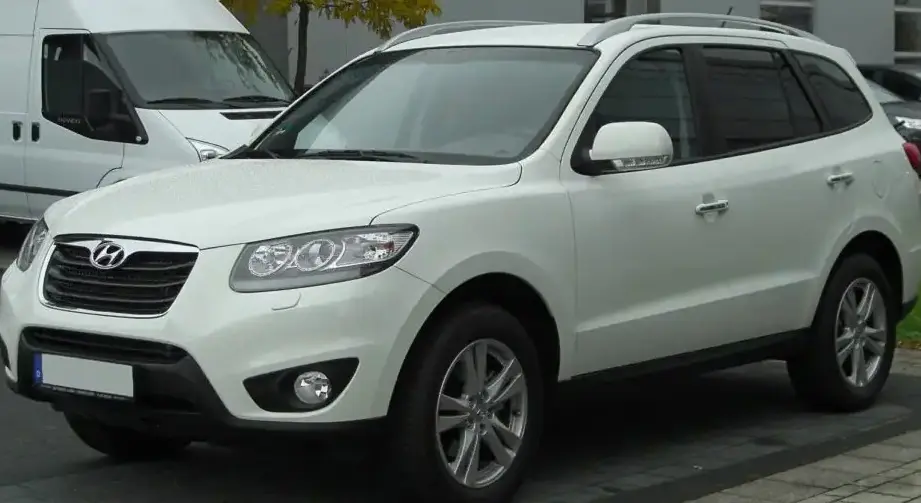
The Hyundai Santa Fe II (CM) facelift, launched in 2009, represented a significant refinement of Hyundai’s popular mid-size SUV. This updated model featured subtle styling changes, improved interior materials, and enhanced safety features. The 2.4-liter four-cylinder engine coupled with a six-speed manual transmission and all-wheel drive was a strategically important configuration, particularly in markets where fuel economy and all-weather capability were valued. It served as a more accessible entry point into the Santa Fe lineup, attracting buyers who didn’t require the added expense of the V6 models. This variant was crucial for Hyundai as they continued to expand their market share in the highly competitive North American and European SUV segments.
Powertrain & Engine Architecture
The core of this Santa Fe variant is the Hyundai Theta II 2.4-liter inline-four cylinder engine, internally designated G4KE. This engine employs multi-port fuel injection and a dual overhead camshaft (DOHC) valvetrain with four valves per cylinder. The Theta II series marked a substantial advancement over its predecessor, delivering increased power and improved efficiency. The engine generates 174 horsepower at 6000 rpm and 226 Nm (166.69 lb-ft) of torque at 3750 rpm. The six-speed manual transmission was selected for its balance of fuel efficiency and driver engagement. The all-wheel-drive system is a part-time system, automatically engaging the rear wheels when front wheel traction is compromised, enhancing stability in challenging road conditions.
Driving Characteristics
The 2.4-liter engine, while sufficient for everyday driving needs, wasn’t known for its exhilarating acceleration. A 0-60 mph time of approximately 10.6 seconds reflects this. The six-speed manual transmission allows drivers to maintain the engine within its optimal power band, but frequent shifting was often necessary, particularly when ascending inclines or executing overtaking maneuvers. Compared to the V6 models, the 2.4L felt noticeably less powerful, but it provided a more economical driving experience. The all-wheel-drive system instilled confidence in adverse weather conditions, making it a practical choice for regions prone to snow or rain. The gear ratios were calibrated to prioritize fuel economy and usability, rather than outright performance.
Equipment & Trim Levels
The 2.4L 4WD Santa Fe typically came standard with features such as air conditioning, power windows and locks, a CD player with an auxiliary input jack, and basic cloth upholstery. Safety features included anti-lock brakes (ABS), front airbags, and side curtain airbags. Optional extras included a sunroof, leather upholstery, a premium audio system, and alloy wheels. Trim levels varied depending on the market, but generally, the 2.4L 4WD was positioned as a mid-range offering, providing a good level of standard equipment without the luxury appointments found in the higher-end V6 models.
Chassis & Braking
The Santa Fe II featured an independent McPherson strut front suspension and an independent multi-link rear suspension. This suspension setup delivered a comfortable ride quality, effectively absorbing bumps and road imperfections. The 2.4L models typically utilized ventilated front disc brakes and solid rear discs, providing adequate stopping power for the vehicle’s weight. Anti-lock brakes (ABS) were standard equipment, enhancing safety during emergency braking situations. Stabilizer bars were incorporated into both the front and rear suspensions to minimize body roll during cornering maneuvers.
Market Reception & Comparison
Automotive critics generally lauded the Santa Fe II for its spacious interior, comfortable ride, and competitive pricing. However, the 2.4-liter engine frequently received criticism for feeling underpowered, especially when the vehicle was fully loaded or towing a trailer. Compared to the V6 models, the 2.4L offered significantly improved fuel economy, achieving around 27 mpg in combined driving conditions. Reliability was generally considered good, with the Theta II engine proving to be a durable and dependable powerplant. The 2.4L 4WD variant proved popular among buyers who prioritized fuel efficiency and all-weather capability over sheer performance.
Legacy
The Hyundai Santa Fe II (CM) facelift, and specifically the 2.4-liter 4WD variant, remains a relatively common vehicle on the used car market today. The Theta II engine has demonstrated reasonable reliability, although consistent maintenance is essential to prevent potential issues such as oil consumption. These Santa Fes represent a good value proposition for buyers seeking an affordable and practical SUV. While not the most dynamically engaging vehicle to drive, its combination of interior space, ride comfort, and all-weather capability makes it a sensible choice for families and individuals alike. The 2.4L engine, while not renowned for its power, has earned a reputation for longevity, making it a viable option for those seeking a dependable used SUV.