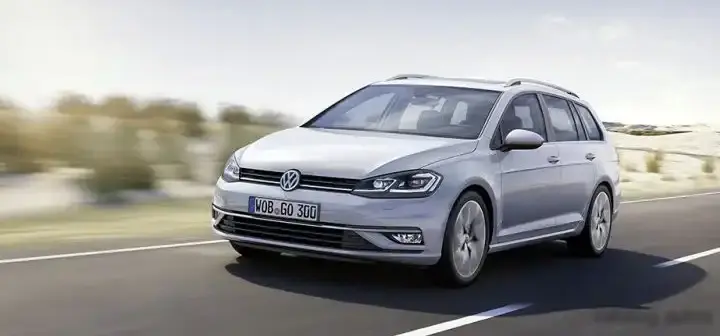
The Volkswagen Golf VII Variant, specifically the 2.0 TDI 150 hp 4MOTION model produced from 2017 to 2019, represents a compelling blend of practicality, efficiency, and all-weather capability within the seventh generation Golf lineup. This variant, part of the facelifted Golf VII range (often referred to as the 7.5), offered a station wagon (estate) body style combined with a potent turbocharged diesel engine and Volkswagen’s 4MOTION all-wheel-drive system. It occupied a mid-to-upper position in the Golf Variant range, appealing to buyers seeking a versatile family vehicle with enhanced performance and security in varied driving conditions.
Technical Specifications
| Brand | Volkswagen |
| Model | Golf |
| Generation | Golf VII Variant (facelift 2017) |
| Type (Engine) | 2.0 TDI (150 Hp) 4MOTION |
| Start of production | 2017 |
| End of production | 2019 |
| Powertrain Architecture | Internal Combustion engine |
| Body type | Station wagon (estate) |
| Seats | 5 |
| Doors | 5 |
| Fuel consumption (economy) – urban (NEDC) | 5.9-6.0 l/100 km (39.9 – 39.2 US mpg, 47.9 – 47.1 UK mpg, 16.9 – 16.7 km/l) |
| Fuel consumption (economy) – extra urban (NEDC) | 4.4-4.5 l/100 km (53.5 – 52.3 US mpg, 64.2 – 62.8 UK mpg, 22.7 – 22.2 km/l) |
| Fuel consumption (economy) – combined (NEDC) | 5.0-5.1 l/100 km (47 – 46.1 US mpg, 56.5 – 55.4 UK mpg, 20 – 19.6 km/l) |
| CO2 emissions (NEDC) | 130-132 g/km |
| Fuel Type | Diesel |
| Acceleration 0 – 100 km/h | 8.9 sec |
| Acceleration 0 – 62 mph | 8.9 sec |
| Acceleration 0 – 60 mph | 8.5 sec |
| Maximum speed | 214 km/h (132.97 mph) |
| Emission standard | Euro 6 |
| Weight-to-power ratio | 9.7 kg/Hp, 103.6 Hp/tonne |
| Weight-to-torque ratio | 4.3 kg/Nm, 234.8 Nm/tonne |
| Power | 150 Hp @ 3500-4000 rpm |
| Torque | 340 Nm @ 1750-3000 rpm (250.77 lb.-ft. @ 1750-3000 rpm) |
| Engine layout | Front, Transverse |
| Engine Model/Code | CRLB, DCYA, DEJA, DFGA |
| Engine displacement | 1968 cm3 (120.09 cu. in.) |
| Number of cylinders | 4 |
| Engine configuration | Inline |
| Cylinder Bore | 81 mm (3.19 in.) |
| Piston Stroke | 95.5 mm (3.76 in.) |
| Compression ratio | 16.2:1 |
| Number of valves per cylinder | 4 |
| Fuel injection system | Diesel Commonrail |
| Engine aspiration | Turbocharger, Intercooler |
| Valvetrain | DOHC |
| Engine oil capacity | 4.7 l (4.97 US qt | 4.14 UK qt) |
| Kerb Weight | 1448 kg (3192.29 lbs.) |
| Max. weight | 2050 kg (4519.48 lbs.) |
| Max load | 602 kg (1327.18 lbs.) |
| Trunk (boot) space – minimum | 605 l (21.37 cu. ft.) |
| Trunk (boot) space – maximum | 1620 l (57.21 cu. ft.) |
| Fuel tank capacity | 50 l (13.21 US gal | 11 UK gal) |
| Max. roof load | 75 kg (165.35 lbs.) |
| Permitted trailer load with brakes (8%) | 2000 kg (4409.25 lbs.) |
| Permitted trailer load with brakes (12%) | 2000 kg (4409.25 lbs.) |
| Permitted trailer load without brakes | 750 kg (1653.47 lbs.) |
| Permitted towbar download | 80 kg (176.37 lbs.) |
| Length | 4567 mm (179.8 in.) |
| Width | 1799 mm (70.83 in.) |
| Width including mirrors | 2027 mm (79.8 in.) |
| Height | 1515 mm (59.65 in.) |
| Wheelbase | 2620 mm (103.15 in.) |
| Front track | 1549 mm (60.98 in.) |
| Rear (Back) track | 1520 mm (59.84 in.) |
| Ride height (ground clearance) | 140 mm (5.51 in.) |
| Minimum turning circle (turning diameter) | 10.9 m (35.76 ft.) |
| Drivetrain Architecture | The Internal combustion engine (ICE) drives the front wheels permanently, and the rear wheels are driven through an electrically or mechanically operated clutch if necessary. |
| Drive wheel | All wheel drive (4×4) |
| Number of gears and type of gearbox | 6 gears, manual transmission |
| Front suspension | Independent, type McPherson with coil spring and anti-roll bar |
| Rear suspension | Independent multi-link spring suspension with stabilizer |
| Front brakes | Ventilated discs |
| Rear brakes | Disc |
| Assisting systems | ABS (Anti-lock braking system) |
| Steering type | Steering rack and pinion |
| Power steering | Electric Steering |
| Tires size | 205/55 R16 |
| Wheel rims size | 6.5J x 16 |
INTRODUCTION
The Golf VII Variant, launched in 2013 and facelifted in 2017, built upon the success of previous Golf generations, offering a more practical alternative to the hatchback while retaining the core Golf driving experience. The 2.0 TDI 150 hp 4MOTION variant, produced between 2017 and 2019, was a significant offering for European markets, where diesel engines and all-wheel drive were highly valued. It was positioned as a versatile, all-weather vehicle suitable for families and individuals needing extra cargo space and enhanced traction. This model utilized the Volkswagen Group’s MQB platform (specifically the A5 iteration), known for its modularity and efficiency.
Powertrain & Engine Architecture
At the heart of the Golf VII Variant 2.0 TDI 4MOTION lies the Volkswagen Group’s 2.0-liter four-cylinder diesel engine. Engine codes for this generation included CRLB, DCYA, DEJA, and DFGA, with minor variations depending on the specific market and year of production. This engine featured common-rail direct injection, delivering fuel directly into the combustion chamber at extremely high pressure for improved efficiency and reduced emissions. The engine employed a turbocharger with an intercooler to boost power output. The DOHC (Double Overhead Camshaft) valvetrain, with four valves per cylinder, optimized gas flow for enhanced performance. The 4MOTION system is a sophisticated all-wheel-drive system that normally operates as front-wheel drive, but can seamlessly engage the rear wheels via a multi-plate clutch when traction is lost. This system provides enhanced stability and control, particularly on slippery surfaces. The 6-speed manual transmission was standard, offering precise gear changes and a direct connection to the engine.
Driving Characteristics
The 150 hp 2.0 TDI engine, coupled with the 6-speed manual transmission, provided a balanced driving experience. While not overtly sporty, it delivered ample torque (340 Nm / 250.77 lb.-ft.) from 1750-3000 rpm, making it responsive in everyday driving situations. Acceleration from 0-100 km/h (0-62 mph) took approximately 8.9 seconds. The 4MOTION system significantly enhanced handling and stability, especially in adverse weather conditions. Compared to the lower-powered 1.6 TDI variants, the 2.0 TDI offered noticeably more performance and refinement. Compared to the petrol-powered Golf variants, the 2.0 TDI provided superior fuel economy and torque, but lacked the higher revving character of the gasoline engines. The manual transmission allowed for greater driver control, but some drivers preferred the convenience of the available DSG (Dual Clutch Gearbox) option.
Equipment & Trim Levels
The Golf VII Variant 2.0 TDI 4MOTION typically came well-equipped, even in base trim. Standard features often included air conditioning, power windows, power mirrors, a touchscreen infotainment system with Bluetooth connectivity, and a suite of safety features such as ABS, ESP (Electronic Stability Program), and multiple airbags. Higher trim levels added features like automatic climate control, heated seats, a larger touchscreen display with navigation, parking sensors, and adaptive cruise control. Interior upholstery was typically cloth, with leather options available as upgrades. Dashboard design followed the clean and functional aesthetic of the Golf VII, with a focus on ergonomics and ease of use.
Chassis & Braking
The Golf VII Variant featured an independent suspension system, with a McPherson strut setup at the front and a multi-link setup at the rear. This configuration provided a comfortable ride and good handling characteristics. Stabilizer bars were fitted to both axles to reduce body roll during cornering. Braking duties were handled by ventilated discs at the front and solid discs at the rear, providing ample stopping power. The ABS (Anti-lock Braking System) and ESP (Electronic Stability Program) worked in conjunction to enhance braking performance and stability, particularly in emergency situations.
Market Reception & Comparison
The Golf VII Variant 2.0 TDI 4MOTION was generally well-received by automotive critics. It was praised for its practicality, fuel efficiency, and all-weather capability. The combination of the diesel engine and all-wheel drive was seen as a particularly strong selling point in regions with harsh winters or challenging road conditions. Compared to other station wagons in its class, the Golf Variant offered a compelling blend of performance, economy, and refinement. The 2.0 TDI engine offered a good balance between power and fuel consumption, making it a popular choice for long-distance drivers. However, some critics noted that the ride could be slightly firm on rough roads.
Legacy
The 2.0 TDI engine, in various iterations, has proven to be a reliable and durable powertrain. While diesel engines have faced increased scrutiny in recent years due to emissions concerns, the Golf VII Variant 2.0 TDI 4MOTION remains a popular choice in the used car market. Regular maintenance, including timely oil changes and filter replacements, is crucial for ensuring long-term reliability. The 4MOTION system is generally robust and requires minimal maintenance. Today, these vehicles offer a practical and efficient option for buyers seeking a versatile and capable station wagon.