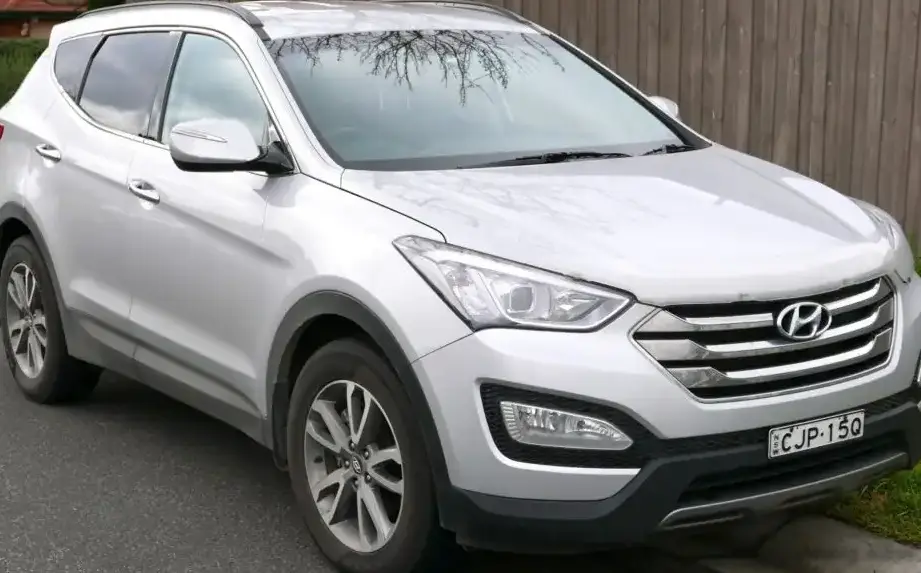
The Hyundai Santa Fe III (DM) 2.0 CRDi 4WD, produced from 2013 to 2015, represented a significant offering in the increasingly competitive mid-size SUV segment. Positioned as a versatile, family-oriented vehicle, this variant utilized a 2.0-liter turbocharged diesel engine paired with a six-speed manual transmission and a four-wheel-drive system. It served as a key model within the DM generation, offering a balance between fuel efficiency, practicality, and all-weather capability. The Santa Fe DM was Hyundai’s attempt to move further upmarket, offering a more refined experience than previous generations.
Technical Specifications
| Brand | Hyundai |
| Model | Santa Fe |
| Generation | Santa Fe III (DM) |
| Type (Engine) | 2.0 CRDi (150 Hp) 4WD |
| Start of production | 2013 |
| End of production | 2015 |
| Powertrain Architecture | Internal Combustion engine |
| Body type | SUV |
| Seats | 7 |
| Doors | 5 |
| Fuel consumption (urban) | 8.1 l/100 km (29 US mpg, 34.9 UK mpg, 12.3 km/l) |
| Fuel consumption (extra urban) | 4.9 l/100 km (48 US mpg, 57.6 UK mpg, 20.4 km/l) |
| Fuel consumption (combined) | 6.1 l/100 km (38.6 US mpg, 46.3 UK mpg, 16.4 km/l) |
| Fuel Type | Diesel |
| Acceleration 0 – 100 km/h | 11.3 sec |
| Acceleration 0 – 62 mph | 11.3 sec |
| Acceleration 0 – 60 mph | 10.7 sec |
| Maximum speed | 187 km/h (116.2 mph) |
| Emission standard | Euro 6 |
| Weight-to-power ratio | 11.8 kg/Hp, 84.8 Hp/tonne |
| Weight-to-torque ratio | 4.6 kg/Nm, 216.6 Nm/tonne |
| Power | 150 Hp @ 4000 rpm |
| Power per litre | 75.2 Hp/l |
| Torque | 383 Nm @ 1800-2500 rpm (282.49 lb.-ft. @ 1800-2500 rpm) |
| Engine layout | Front, Transverse |
| Engine Model/Code | R II / D4HA |
| Engine displacement | 1995 cm3 (121.74 cu. in.) |
| Number of cylinders | 4 |
| Engine configuration | Inline |
| Cylinder Bore | 84 mm (3.31 in.) |
| Piston Stroke | 90 mm (3.54 in.) |
| Compression ratio | 16.5:1 |
| Number of valves per cylinder | 4 |
| Fuel injection system | Diesel Commonrail |
| Engine aspiration | Turbocharger, Intercooler |
| Valvetrain | DOHC |
| Engine oil capacity | 6.7 l (7.08 US qt | 5.9 UK qt) |
| Coolant | 9.1 l (9.62 US qt | 8.01 UK qt) |
| Kerb Weight | 1768 kg (3897.77 lbs.) |
| Max. weight | 2510 kg (5533.6 lbs.) |
| Max load | 742 kg (1635.83 lbs.) |
| Trunk (boot) space – minimum | 585 l (20.66 cu. ft.) |
| Trunk (boot) space – maximum | 1570 l (55.44 cu. ft.) |
| Fuel tank capacity | 64 l (16.91 US gal | 14.08 UK gal) |
| Length | 4690 mm (184.65 in.) |
| Width | 1880 mm (74.02 in.) |
| Height | 1680 mm (66.14 in.) |
| Wheelbase | 2700 mm (106.3 in.) |
| Front track | 1633 mm (64.29 in.) |
| Rear (Back) track | 1644 mm (64.72 in.) |
| Minimum turning circle | 10.9 m (35.76 ft.) |
| Drive wheel | All wheel drive (4×4) |
| Number of gears | 6 gears, manual transmission |
| Front suspension | Independent type McPherson |
| Rear suspension | Independent coil spring |
| Front brakes | Ventilated discs |
| Rear brakes | Disc |
| Assisting systems | ABS (Anti-lock braking system) |
| Steering type | Steering rack and pinion |
| Power steering | Electric Steering |
| Tires size | 235/65 R17; 235/60 R18; 235/55 R19 |
| Wheel rims size | 7.0J x 17; 7.5J x 18; 7.5J x 19 |
Powertrain & Engine Architecture
At the heart of the Santa Fe 2.0 CRDi 4WD lies the Hyundai R II diesel engine, specifically the D4HA variant. This 1995cc inline-four cylinder engine utilizes a common-rail direct injection system, delivering fuel at extremely high pressures for optimized combustion. The engine features a single turbocharger with an intercooler, boosting power output to 150 horsepower at 4000 rpm and 383 Nm (282.49 lb-ft) of torque between 1800 and 2500 rpm. The engine employs a double overhead camshaft (DOHC) valvetrain with four valves per cylinder, enhancing breathing and overall efficiency. The six-speed manual transmission provides precise gear changes, while the four-wheel-drive system offers enhanced traction in various driving conditions.
Driving Characteristics
The 2.0 CRDi engine, while not the most powerful option in the Santa Fe lineup, provided adequate performance for everyday driving. Acceleration from 0 to 60 mph took approximately 10.7 seconds, and the vehicle reached a top speed of 116.2 mph. The engine’s strong low-end torque made it well-suited for hauling passengers and cargo, and the manual transmission allowed for greater driver control. Compared to the more powerful 2.2 CRDi variants, the 2.0 CRDi offered a more economical driving experience, but with a noticeable difference in outright acceleration. The six-speed gearbox was well-matched to the engine’s powerband, providing comfortable cruising at highway speeds.
Equipment & Trim Levels
The 2.0 CRDi 4WD trim typically included standard features such as air conditioning, power windows and locks, a basic audio system, and alloy wheels. Higher trim levels offered upgrades like leather upholstery, a sunroof, a navigation system, and parking sensors. Safety features included ABS, airbags, and stability control. The interior design was functional and spacious, with seating for up to seven passengers. The 2.0 CRDi was often positioned as the entry-level or mid-range trim, appealing to buyers seeking a practical and affordable SUV.
Chassis & Braking
The Santa Fe DM featured an independent McPherson strut suspension at the front and an independent coil spring suspension at the rear, providing a comfortable ride quality. Ventilated disc brakes were used at the front, while solid discs were fitted at the rear. The four-wheel-drive system distributed power to all four wheels as needed, enhancing stability and traction. The electric power steering provided light and precise steering feel. The chassis was designed to balance ride comfort with handling stability, making it suitable for both urban driving and longer journeys.
Market Reception & Comparison
The Hyundai Santa Fe 2.0 CRDi 4WD was generally well-received by automotive critics for its practicality, fuel efficiency, and value for money. It offered a compelling alternative to established competitors like the Kia Sorento and Nissan X-Trail. Fuel economy was a strong point, with combined fuel consumption figures of around 38.6 US mpg. However, some critics noted that the 2.0 CRDi engine lacked the refinement and power of its larger displacement counterparts. Reliability was generally good, with few reported issues.
Legacy
The Hyundai Santa Fe DM 2.0 CRDi 4WD has proven to be a relatively reliable and durable vehicle in the used car market. The R II diesel engine, while not without its potential maintenance needs (such as diesel particulate filter issues), has generally demonstrated good longevity. The availability of parts and relatively affordable repair costs contribute to its continued appeal. Today, these Santa Fes represent a practical and affordable option for buyers seeking a spacious, fuel-efficient, and capable SUV.