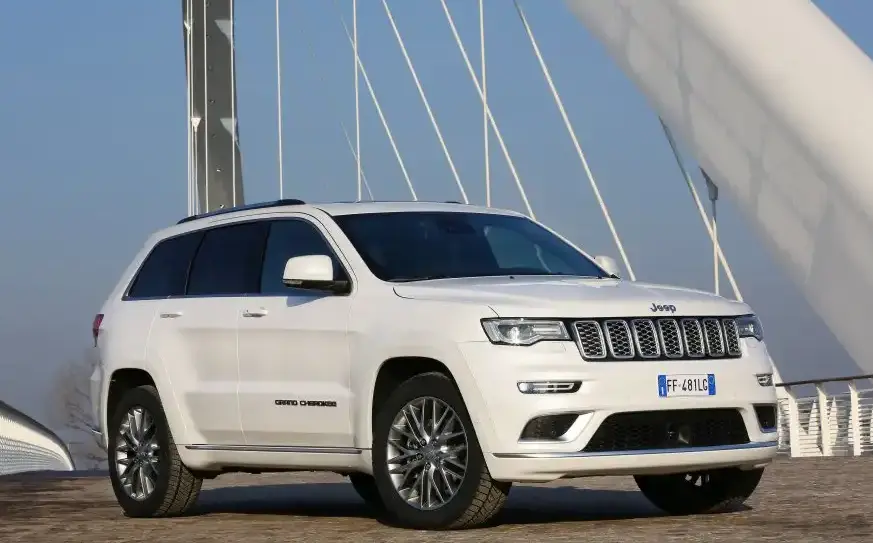
The Jeep Grand Cherokee IV (WK2), particularly the facelifted version introduced in 2017, represented a significant evolution of Jeep’s flagship SUV. Within the WK2 generation (2011-2021), the 3.0 V6 EcoDiesel Automatic variant, produced from 2017 to 2019, occupied a unique position, offering a blend of capability, fuel efficiency, and refinement. This model aimed to appeal to buyers seeking a full-size SUV with diesel torque for towing and improved highway mileage, without the higher price tag of the more powerful gasoline engines or the performance-oriented trims. It was positioned as a mid-range offering, bridging the gap between the base V6 and the high-performance SRT and Trackhawk models.
Technical Specifications
| Brand | Jeep |
| Model | Grand Cherokee |
| Generation | Grand Cherokee IV (WK2, facelift 2017) |
| Type (Engine) | 3.0 V6 EcoDiesel (240 Hp) Automatic |
| Start of production | 2017 |
| End of production | 2019 |
| Powertrain Architecture | Internal Combustion engine |
| Body type | SUV |
| Seats | 5 |
| Doors | 5 |
| Fuel consumption (economy) – urban (EPA) | 10.7 l/100 km (22 US mpg, 26.4 UK mpg, 9.3 km/l) |
| Fuel consumption (economy) – extra urban (EPA) | 7.8 l/100 km (30.2 US mpg, 36.2 UK mpg, 12.8 km/l) |
| Fuel consumption (economy) – combined (EPA) | 9.4 l/100 km (25 US mpg, 30.1 UK mpg, 10.6 km/l) |
| Fuel Type | Diesel |
| Weight-to-power ratio | 9.4 kg/Hp, 106.3 Hp/tonne |
| Weight-to-torque ratio | 4 kg/Nm, 252 Nm/tonne |
| Power | 240 Hp @ 3600 rpm |
| Power per litre | 80.3 Hp/l |
| Torque | 569 Nm @ 2000 rpm (419.67 lb.-ft. @ 2000 rpm) |
| Maximum engine speed | 4800 rpm |
| Engine layout | Front, Longitudinal |
| Engine Model/Code | EXN |
| Engine displacement | 2988 cm3 (182.34 cu. in.) |
| Number of cylinders | 6 |
| Engine configuration | V-engine |
| Cylinder Bore | 83 mm (3.27 in.) |
| Piston Stroke | 92 mm (3.62 in.) |
| Compression ratio | 16.5:1 |
| Number of valves per cylinder | 4 |
| Fuel injection system | Diesel Commonrail |
| Engine aspiration | Turbocharger, Intercooler |
| Valvetrain | DOHC |
| Engine oil capacity | 7.7 l (8.14 US qt | 6.78 UK qt) |
| Coolant | 11.4 l (12.05 US qt | 10.03 UK qt) |
| Kerb Weight | 2258-2338 kg (4978.04 – 5154.41 lbs.) |
| Max. weight | 2948 kg (6499.23 lbs.) |
| Max load | 610-690 kg (1344.82 – 1521.19 lbs.) |
| Trunk (boot) space – minimum | 1028 l (36.3 cu. ft.) |
| Trunk (boot) space – maximum | 1934 l (68.3 cu. ft.) |
| Fuel tank capacity | 93.1 l (24.59 US gal | 20.48 UK gal) |
| AdBlue tank | 30.3 l (8 US gal | 6.67 UK gal) |
| Permitted trailer load with brakes (12%) | 3400 kg (7495.72 lbs.) |
| Length | 4822 mm (189.84 in.) |
| Width | 1943 mm (76.5 in.) |
| Width including mirrors | 2154 mm (84.8 in.) |
| Height | 1761 mm (69.33 in.) |
| Wheelbase | 2914 mm (114.72 in.) |
| Front track | 1623 mm (63.9 in.) |
| Rear (Back) track | 1627 mm (64.06 in.) |
| Ride height (ground clearance) | 218-264 mm (8.58 – 10.39 in.) |
| Drag coefficient (Cd) | 0.371 |
| Minimum turning circle (turning diameter) | 11.6 m (38.06 ft.) |
| Approach angle | 26.2-36.1° |
| Departure angle | 24-27.1° |
| Ramp-over (brakeover) angle | 19-22.8° |
| Drivetrain Architecture | The Internal combustion engine (ICE) drives the rear wheels of the vehicle. |
| Drive wheel | Rear wheel drive |
| Number of gears and type of gearbox | 8 gears, automatic transmission |
| Front suspension | Coil spring, Double wishbone, Transverse stabilizer, Air Suspension – Optional |
| Rear suspension | Independent multi-link spring suspension with stabilizer, Air Suspension – Optional |
| Front brakes | Ventilated discs, 350×32 mm |
| Rear brakes | Ventilated discs, 330×22 mm |
| Assisting systems | ABS (Anti-lock braking system) |
| Steering type | Steering rack and pinion |
| Power steering | Electric Steering |
| Tires size | 265/60 R18; 265/50 R20 |
| Wheel rims size | 8J x 18; 8J x 20 |
INTRODUCTION
The Jeep Grand Cherokee IV (WK2) facelift, launched for the 2017 model year, brought refreshed styling, updated technology, and continued refinement to Jeep’s popular SUV. The 3.0L V6 EcoDiesel Automatic variant was a key component of the lineup, offering a compelling alternative to the standard 3.6L Pentastar V6 and the more potent 5.7L Hemi V8. This diesel engine, designated EXN, was designed to deliver strong low-end torque for towing and off-road capability, coupled with improved fuel economy for long-distance driving. The eight-speed automatic transmission was standard, providing smooth shifts and optimizing engine efficiency.
Powertrain & Engine Architecture
The heart of this Grand Cherokee is the EXN 3.0-liter V6 turbodiesel engine. This engine utilizes a common-rail direct injection system, delivering fuel at extremely high pressure for optimized combustion. The engine features a variable geometry turbocharger (VGT) with an intercooler, enhancing both power and efficiency. The VGT adjusts the turbine vanes to optimize airflow across a wide range of engine speeds. The engine also incorporates a diesel particulate filter (DPF) and a selective catalytic reduction (SCR) system, utilizing AdBlue (Diesel Exhaust Fluid) to reduce NOx emissions, meeting stringent emissions standards. The eight-speed 845RE automatic transmission, sourced from ZF, is a crucial part of the powertrain. It features a wide gear ratio spread, allowing for both strong acceleration and relaxed highway cruising. The transmission is electronically controlled and adapts to driving conditions for optimal performance.
Driving Characteristics
The 240 horsepower and 569 lb-ft of torque produced by the 3.0L EcoDiesel deliver a distinctly different driving experience compared to the gasoline-powered Grand Cherokees. While not as quick off the line as the V8 models, the diesel provides a robust surge of torque from low RPMs, making it ideal for towing and navigating challenging terrain. The eight-speed automatic transmission is well-tuned, providing smooth and timely shifts. However, the diesel engine is noticeably louder than the gasoline engines, particularly during cold starts and acceleration. The gear ratios are optimized for fuel efficiency and towing, meaning the engine doesn’t rev as high as the gasoline variants. This results in a more relaxed driving experience, but potentially less responsiveness when quick acceleration is needed.
Equipment & Trim Levels
The 3.0 V6 EcoDiesel was typically offered in the Limited and Trailhawk trim levels. The Limited trim included standard features such as leather upholstery, dual-zone automatic climate control, an 8.4-inch touchscreen infotainment system with Apple CarPlay and Android Auto compatibility, and a rearview camera. The Trailhawk trim added more off-road focused equipment, including a more aggressive front fascia for improved approach angle, skid plates, and a more capable four-wheel-drive system with a low-range gear. Optional extras included a panoramic sunroof, premium audio systems, advanced safety features like adaptive cruise control and lane departure warning, and various appearance packages.
Chassis & Braking
The WK2 Grand Cherokee features an independent front suspension with coil springs and a multi-link rear suspension. The Limited trim typically came with traditional coil springs, while the Trailhawk offered an optional air suspension system that allowed for adjustable ride height and improved off-road capability. Braking duties were handled by ventilated discs on all four wheels, providing ample stopping power. The front brakes measured 350x32mm, while the rear brakes were 330x22mm. An Anti-lock Braking System (ABS) was standard, enhancing safety and control during emergency braking situations.
Market Reception & Comparison
The 3.0L EcoDiesel Grand Cherokee was generally well-received by critics and consumers alike. It was praised for its fuel efficiency, strong towing capacity, and refined driving experience. Compared to the 3.6L V6, the diesel offered significantly more torque and better fuel economy, albeit at a higher initial cost. Compared to the 5.7L V8, the diesel provided comparable towing capacity with improved fuel efficiency, but lacked the V8’s outright power and acceleration. Reliability was generally good, although some owners reported issues with the diesel particulate filter (DPF) and emissions control systems.
Legacy
The 3.0L EcoDiesel engine proved to be a popular choice for Grand Cherokee buyers seeking a balance of capability and efficiency. While the diesel engine was discontinued in the Grand Cherokee lineup after 2019 due to emissions regulations and shifting market preferences, the WK2 EcoDiesel models remain sought after in the used car market. The powertrain is generally considered reliable, but potential buyers should be aware of the potential for DPF and emissions system issues, and ensure proper maintenance has been performed. The 3.0L EcoDiesel Grand Cherokee represents a unique and capable SUV that continues to offer a compelling value proposition for those seeking a diesel-powered full-size vehicle.