Technical Specifications
| Brand | Volkswagen |
| Model | Golf |
| Generation | Golf VII Variant (facelift 2017) |
| Type (Engine) | R 2.0 TSI (310 Hp) 4MOTION DSG |
| Start of production | February, 2017 |
| End of production | August, 2018 |
| Powertrain Architecture | Internal Combustion engine |
| Body type | Station wagon (estate) |
| Seats | 5 |
| Doors | 5 |
| Fuel consumption (urban) | 8.8-9 l/100 km (26.7 – 26.1 US mpg, 32.1 – 31.4 UK mpg, 11.4 – 11.1 km/l) |
| Fuel consumption (extra urban) | 6.1-6.3 l/100 km (38.6 – 37.3 US mpg, 46.3 – 44.8 UK mpg, 16.4 – 15.9 km/l) |
| Fuel consumption (combined) | 7.1-7.3 l/100 km (33.1 – 32.2 US mpg, 39.8 – 38.7 UK mpg, 14.1 – 13.7 km/l) |
| CO2 emissions | 161-166 g/km |
| Fuel Type | Petrol (Gasoline) |
| Acceleration 0 – 100 km/h | 4.8 sec |
| Acceleration 0 – 62 mph | 4.8 sec |
| Acceleration 0 – 60 mph | 4.6 sec |
| Maximum speed | 250 km/h (155.34 mph), Electronically limited |
| Emission standard | Euro 6 |
| Weight-to-power ratio | 4.9 kg/Hp, 204.2 Hp/tonne |
| Weight-to-torque ratio | 3.8 kg/Nm, 263.5 Nm/tonne |
| Power | 310 Hp @ 5500-6500 rpm |
| Power per litre | 156.3 Hp/l |
| Torque | 400 Nm @ 2000-5400 rpm (295.02 lb.-ft. @ 2000-5400 rpm) |
| Engine layout | Front, Transverse |
| Engine Model/Code | EA888 / DJHA |
| Engine displacement | 1984 cm3 (121.07 cu. in.) |
| Number of cylinders | 4 |
| Engine configuration | Inline |
| Cylinder Bore | 82.5 mm (3.25 in.) |
| Piston Stroke | 92.8 mm (3.65 in.) |
| Compression ratio | 9.3:1 |
| Number of valves per cylinder | 4 |
| Fuel injection system | Direct injection and Multi-port manifold injection |
| Engine aspiration | Turbocharger, Intercooler |
| Valvetrain | DOHC |
| Engine oil capacity | 5.7 l (6.02 US qt | 5.02 UK qt) |
| Kerb Weight | 1518 kg (3346.62 lbs.) |
| Max. weight | 2110 kg (4651.75 lbs.) |
| Max load | 592 kg (1305.14 lbs.) |
| Trunk (boot) space – minimum | 605 l (21.37 cu. ft.) |
| Trunk (boot) space – maximum | 1620 l (57.21 cu. ft.) |
| Fuel tank capacity | 55 l (14.53 US gal | 12.1 UK gal) |
| Max. roof load | 75 kg (165.35 lbs.) |
| Length | 4586 mm (180.55 in.) |
| Width | 1799 mm (70.83 in.) |
| Width including mirrors | 2027 mm (79.8 in.) |
| Height | 1515 mm (59.65 in.) |
| Wheelbase | 2620 mm (103.15 in.) |
| Front track | 1533-1549 mm (60.35 – 60.98 in.) |
| Rear (Back) track | 1504-1520 mm (59.21 – 59.84 in.) |
| Ride height (ground clearance) | 126 mm (4.96 in.) |
| Minimum turning circle | 10.9 m (35.76 ft.) |
| Drivetrain Architecture | All wheel drive (4×4). ICE drives front wheels, rear driven via clutch. |
| Number of gears | 7 |
| Gearbox type | Automatic transmission DSG |
| Front suspension | Independent, McPherson with coil spring and anti-roll bar |
| Rear suspension | Independent multi-link spring suspension with stabilizer |
| Front brakes | Ventilated discs |
| Rear brakes | Disc |
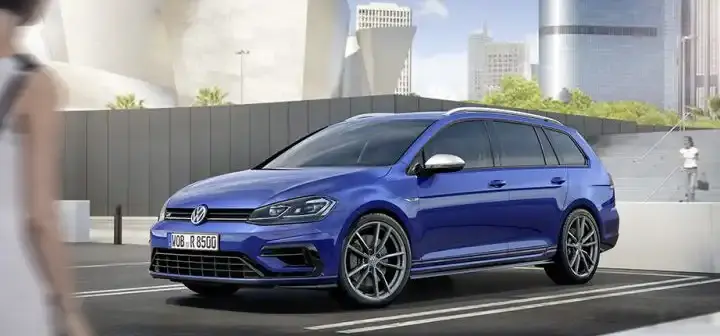
The Golf VII Variant R, launched in 2017 following the facelift of the Golf VII range, was a performance-oriented estate car designed to appeal to drivers seeking a practical yet engaging driving experience. Building upon the success of the Golf R hatchback, the Variant offered the same high-performance powertrain and all-wheel-drive system within a more spacious and versatile body style. It occupied the top position in the Golf Variant lineup, offering a significant performance upgrade over models like the 1.4 TSI and 1.6 TDI. The facelift brought subtle styling revisions, including redesigned bumpers, headlights, and taillights, along with updated infotainment systems.
Powertrain & Engine Architecture
At the heart of the Golf VII Variant R lies the EA888 2.0-liter turbocharged four-cylinder engine, specifically the DJHA engine code. This engine featured direct fuel injection combined with multi-point injection, optimizing both performance and efficiency. The engine produced 310 horsepower at 5500-6500 rpm and 400 Nm (295 lb-ft) of torque between 2000 and 5400 rpm. The turbocharger and intercooler were crucial components in delivering this level of performance. The engine’s DOHC (Dual Overhead Camshaft) valvetrain, with four valves per cylinder, further enhanced its breathing and power output. Power was delivered to all four wheels via Volkswagen’s 4MOTION all-wheel-drive system and a seven-speed dual-clutch DSG (Direct-Shift Gearbox) transmission. The DSG transmission offered rapid and seamless gear changes, contributing to the car’s impressive acceleration.
Driving Characteristics
The Golf VII Variant R delivered a noticeably more engaging driving experience compared to lower-powered Golf Variant models. The 310 hp engine and 4MOTION all-wheel-drive system provided strong acceleration and excellent grip in all weather conditions. The DSG transmission’s quick shifts complemented the engine’s power delivery, resulting in a responsive and dynamic feel. While the added weight of the estate body compared to the hatchback was noticeable, the R’s performance remained impressive, with a 0-60 mph time of around 4.6 seconds. The suspension was tuned to provide a balance between comfort and handling, offering a firm but controlled ride. The all-wheel-drive system intelligently distributed torque between the front and rear axles, maximizing traction and stability.
Equipment & Trim Levels
The Golf VII Variant R came generously equipped as standard. Key features included sport seats upholstered in cloth and Alcantara, stainless steel pedal caps, ambient lighting, and a Discover Pro infotainment system with an 8-inch touchscreen display. Standard safety features included adaptive cruise control, front and rear parking sensors, and automatic emergency braking. Optional extras included leather upholstery, a panoramic sunroof, and a premium sound system. The interior featured R-specific badging and trim details, further differentiating it from other Golf Variant models.
Chassis & Braking
The Golf VII Variant R featured a sports-tuned suspension with stiffer springs and dampers compared to standard Golf Variant models. The front suspension utilized a McPherson strut design, while the rear employed a multi-link setup. This configuration provided a good balance between ride comfort and handling precision. Braking duties were handled by ventilated discs on all four wheels, providing ample stopping power. The electronic stability control (ESC) system was specifically tuned for the R model, allowing for a degree of controlled wheel slip in Sport mode. The steering was precise and well-weighted, providing good feedback to the driver.
Market Reception & Comparison
The Golf VII Variant R was generally well-received by automotive critics, who praised its performance, handling, and practicality. It was often compared to other high-performance estates, such as the Audi S4 Avant and BMW 3 Series Touring. While the Audi offered a more luxurious interior, the Golf R Variant was often considered to be the more engaging and driver-focused option. Compared to lower-powered Golf Variant models, the R offered a significant performance upgrade, but at a higher price point. Fuel economy was respectable for a performance car, but naturally lower than that of more economical Golf variants.
Legacy
The Golf VII Variant R has established itself as a desirable used car, appreciated for its blend of performance, practicality, and build quality. The EA888 engine, while known for requiring regular maintenance, has proven to be relatively reliable when properly cared for. The DSG transmission, while capable, can be susceptible to issues if not serviced according to Volkswagen’s recommendations. Today, the Golf VII Variant R remains a popular choice for enthusiasts seeking a high-performance estate car that offers a rewarding driving experience and a spacious interior.