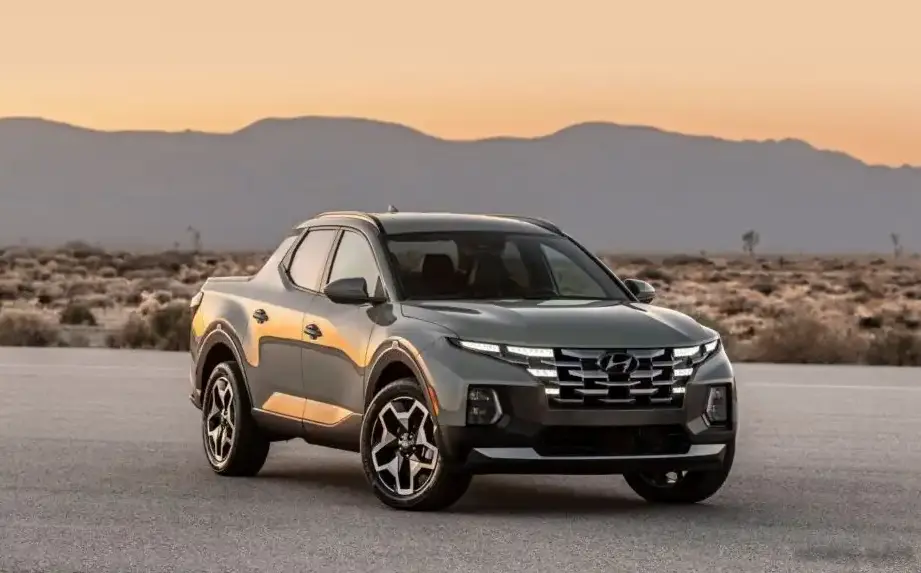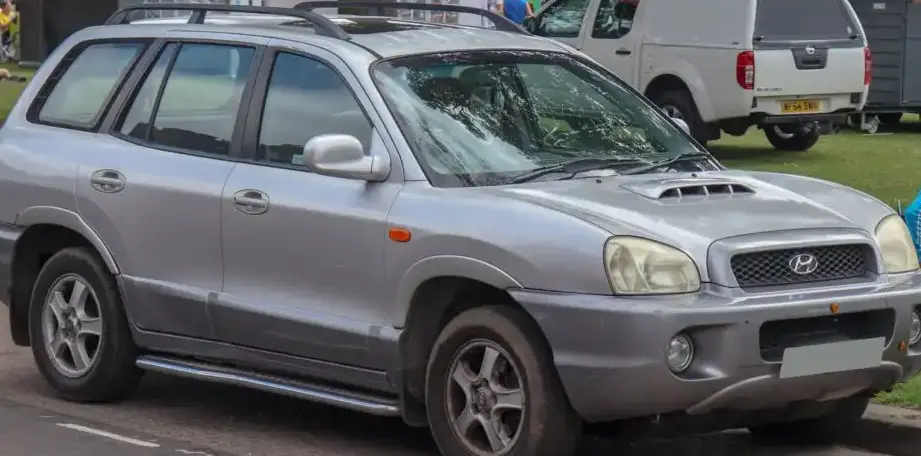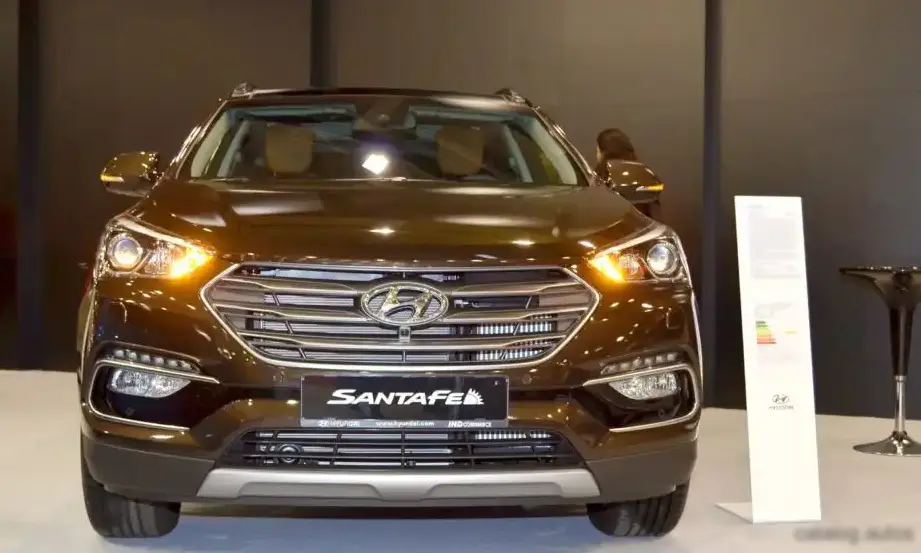
The Hyundai Santa Fe III (DM, facelift 2015) 2.0 CRDi 4WD 7-Seat represents a significant iteration of Hyundai’s popular mid-size SUV, produced from 2015 to 2018. This variant occupied a crucial position within the Santa Fe lineup, offering a balance between fuel efficiency, practicality with its seven-passenger capacity, and all-weather capability through its four-wheel-drive system. The facelift brought styling updates and refinements to the already well-received DM generation, solidifying the Santa Fe’s appeal in a competitive segment. It was primarily marketed towards families seeking a versatile and reliable vehicle with a focus on value.
Technical Specifications
| Brand | Hyundai |
| Model | Santa Fe |
| Generation | Santa Fe III (DM, facelift 2015) |
| Type | 2.0 CRDi (150 Hp) 4WD 7 Seat |
| Start of production | 2015 |
| End of production | 2018 |
| Powertrain Architecture | Internal Combustion engine |
| Body type | SUV |
| Seats | 7 |
| Doors | 5 |
| Fuel consumption (urban) | 7 l/100 km (33.6 US mpg, 40.4 UK mpg, 14.3 km/l) |
| Fuel consumption (extra urban) | 5.3 l/100 km (44.4 US mpg, 53.3 UK mpg, 18.9 km/l) |
| Fuel consumption (combined) | 6 l/100 km (39.2 US mpg, 47.1 UK mpg, 16.7 km/l) |
| CO2 emissions | 159 g/km |
| Fuel Type | Diesel |
| Acceleration 0 – 100 km/h | 11.2 sec |
| Acceleration 0 – 62 mph | 11.2 sec |
| Acceleration 0 – 60 mph | 10.6 sec |
| Maximum speed | 187 km/h (116.2 mph) |
| Emission standard | Euro 6 |
| Weight-to-power ratio | 12.9 kg/Hp, 77.4 Hp/tonne |
| Weight-to-torque ratio | 4.8 kg/Nm, 206.3 Nm/tonne |
| Power | 150 Hp @ 4000 rpm |
| Power per litre | 75.2 Hp/l |
| Torque | 400 Nm @ 1750-2500 rpm (295.02 lb.-ft. @ 1750-2500 rpm) |
| Engine layout | Front, Transverse |
| Engine Model/Code | R II / D4HA |
| Engine displacement | 1995 cm3 (121.74 cu. in.) |
| Number of cylinders | 4 |
| Engine configuration | Inline |
| Cylinder Bore | 84 mm (3.31 in.) |
| Piston Stroke | 90 mm (3.54 in.) |
| Compression ratio | 16:1 |
| Number of valves per cylinder | 4 |
| Fuel injection system | Diesel Commonrail |
| Engine aspiration | Turbocharger, Intercooler |
| Engine oil capacity | 6.3 l (6.66 US qt | 5.54 UK qt) |
| Coolant | 9.1 l (9.62 US qt | 8.01 UK qt) |
| Kerb Weight | 1939 kg (4274.76 lbs.) |
| Max. weight | 2510 kg (5533.6 lbs.) |
| Max load | 571 kg (1258.84 lbs.) |
| Trunk (boot) space – minimum | 516 l (18.22 cu. ft.) |
| Trunk (boot) space – maximum | 1615 l (57.03 cu. ft.) |
| Fuel tank capacity | 64 l (16.91 US gal | 14.08 UK gal) |
| Max. roof load | 100 kg (220.46 lbs.) |
| Permitted trailer load with brakes (12%) | 2500 kg (5511.56 lbs.) |
| Permitted trailer load without brakes | 750 kg (1653.47 lbs.) |
| Permitted towbar download | 100 kg (220.46 lbs.) |
| Length | 4690 mm (184.65 in.) |
| Width | 1880 mm (74.02 in.) |
| Height | 1680 mm (66.14 in.) |
| Wheelbase | 2700 mm (106.3 in.) |
| Front track | 1628-1633 mm (64.09 – 64.29 in.) |
| Rear (Back) track | 1639-1644 mm (64.53 – 64.72 in.) |
| Front overhang | 935 mm (36.81 in.) |
| Rear overhang | 1055 mm (41.54 in.) |
| Ride height (ground clearance) | 185 mm (7.28 in.) |
| Minimum turning circle (turning diameter) | 10.9 m (35.76 ft.) |
| Approach angle | 16.5° |
| Departure angle | 21.2° |
| Ramp-over (brakeover) angle | 16.6° |
| Drivetrain Architecture | The Internal combustion engine (ICE) drives the front wheels permanently, and the rear wheels are driven through an electrically or mechanically operated clutch if necessary. |
| Drive wheel | All wheel drive (4×4) |
| Number of gears and type of gearbox | 6 gears, manual transmission |
| Front suspension | Independent type McPherson |
| Rear suspension | Independent multi-link suspension |
| Front brakes | Ventilated discs |
| Rear brakes | Disc |
| Assisting systems | ABS (Anti-lock braking system) |
| Steering type | Steering rack and pinion |
| Power steering | Electric Steering |
| Tires size | 235/65 R17; 235/60 R18; 235/55 R19 |
| Wheel rims size | 7.0J x 17; 7.5J x 18; 7.5J x 19 |
Powertrain & Engine Architecture
The heart of this Santa Fe variant is the R II 2.0 CRDi diesel engine, specifically the D4HA code. This engine is a four-cylinder, inline configuration, displacing 1995cc. It utilizes a turbocharger with an intercooler to boost power and efficiency. The engine employs a common-rail direct injection system, delivering fuel at extremely high pressure for optimized combustion. The D4HA engine features a 16:1 compression ratio and four valves per cylinder, contributing to its relatively high output for its size. The 6-speed manual transmission was standard, offering a balance between fuel economy and driver control. The engine’s design prioritized low-end torque, making it well-suited for hauling passengers and cargo.
Driving Characteristics
The 150 hp and 400 Nm of torque provided by the 2.0 CRDi engine delivered adequate, though not exhilarating, performance. Acceleration from 0-60 mph took around 10.6 seconds, making it competitive within its class but noticeably slower than higher-powered Santa Fe trims. The manual transmission allowed for precise gear selection, but the engine’s peak torque available from 1750-2500 rpm meant that frequent downshifting wasn’t necessary for everyday driving. The all-wheel-drive system provided enhanced traction in inclement weather, making it a confident performer in slippery conditions. Compared to the more powerful 2.2 CRDi models, this variant prioritized fuel economy and a more relaxed driving experience.
Equipment & Trim Levels
The 2.0 CRDi 4WD 7-Seat typically came with a respectable level of standard equipment. This included air conditioning, power windows and locks, a basic audio system with USB connectivity, and alloy wheels. Safety features such as ABS, electronic stability control, and multiple airbags were standard. Higher trim levels offered upgrades like leather upholstery, a panoramic sunroof, a more advanced infotainment system with navigation, and parking sensors. The interior design was functional and spacious, with a focus on practicality for family use.
Chassis & Braking
The Santa Fe III utilized an independent McPherson strut suspension in the front and an independent multi-link suspension in the rear, providing a comfortable ride quality. The four-wheel-drive system added to the vehicle’s stability and handling. Braking duties were handled by ventilated discs at the front and solid discs at the rear. The braking system was adequate for the vehicle’s weight and performance, with ABS providing additional control during emergency stops. Stabilizer bars were fitted front and rear to reduce body roll during cornering.
Market Reception & Comparison
The 2.0 CRDi 4WD 7-Seat Santa Fe was generally well-received by critics as a practical and value-oriented SUV. It was praised for its spacious interior, comfortable ride, and fuel efficiency. However, some reviewers noted that the engine lacked the punch of its larger displacement counterparts. Compared to competitors like the Kia Sorento and Nissan X-Trail, the Santa Fe offered a compelling combination of features and price. Its fuel economy of around 39.2 US mpg combined was a significant selling point for budget-conscious buyers.
Legacy
The Hyundai Santa Fe III 2.0 CRDi 4WD 7-Seat has proven to be a relatively reliable vehicle in the used car market. The R II engine is known for its durability, although regular maintenance is crucial. Common issues include diesel particulate filter (DPF) clogging and potential problems with the turbocharger. However, these issues are not uncommon for diesel engines of this era. Today, these Santa Fes represent a good value for buyers seeking a spacious, practical, and affordable SUV with all-wheel-drive capability. Its seven-seat configuration continues to be a desirable feature for families.