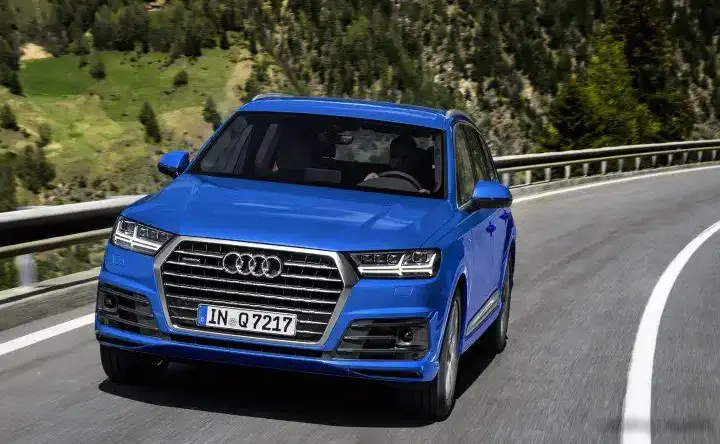
The Audi Q7 (Typ 4M) 3.0 ultra TDI V6 (218 hp) quattro tiptronic represents a significant iteration of Audi’s popular luxury SUV, produced from August 2015 to 2018. Positioned as a mid-range offering within the second-generation Q7 lineup (Typ 4M, succeeding the Typ 4L), this variant aimed to balance performance, fuel efficiency, and refinement for discerning buyers. It was a key model in the European market, where diesel engines remained highly favored for their economy and torque, and also saw moderate sales in other regions. The “ultra” designation signified Audi’s efforts to optimize efficiency through weight reduction and powertrain enhancements.
Technical Specifications
| Brand | Audi |
| Model | Q7 |
| Generation | Q7 (Typ 4M) |
| Type (Engine) | 3.0 ultra TDI V6 (218 Hp) quattro tiptronic |
| Start of production | August, 2015 |
| End of production | 2018 |
| Powertrain Architecture | Internal Combustion engine |
| Body type | SUV |
| Seats | 5 |
| Doors | 5 |
| Fuel consumption (urban) | 6.1 l/100 km (38.6 US mpg, 46.3 UK mpg, 16.4 km/l) |
| Fuel consumption (extra urban) | 5.1 l/100 km (46.1 US mpg, 55.4 UK mpg, 19.6 km/l) |
| Fuel consumption (combined) | 5.5 l/100 km (42.8 US mpg, 51.4 UK mpg, 18.2 km/l) |
| CO2 emissions | 144 g/km |
| Fuel Type | Diesel |
| Acceleration 0 – 100 km/h | 7.1 sec |
| Acceleration 0 – 62 mph | 7.1 sec |
| Acceleration 0 – 60 mph | 6.7 sec |
| Maximum speed | 216 km/h (134.22 mph) |
| Emission standard | Euro 6 |
| Weight-to-power ratio | 9.2 kg/Hp, 109.3 Hp/tonne |
| Weight-to-torque ratio | 4 kg/Nm, 250.6 Nm/tonne |
| Power | 218 Hp @ 3250-4750 rpm |
| Power per litre | 73.5 Hp/l |
| Torque | 500 Nm @ 1250-3000 rpm (368.78 lb.-ft. @ 1250-3000 rpm) |
| Engine layout | Front, Longitudinal |
| Engine Model/Code | CZZA, CZZB |
| Engine displacement | 2967 cm3 (181.06 cu. in.) |
| Number of cylinders | 6 |
| Engine configuration | V-engine |
| Cylinder Bore | 83 mm (3.27 in.) |
| Piston Stroke | 91.4 mm (3.6 in.) |
| Compression ratio | 16:1 |
| Number of valves per cylinder | 4 |
| Fuel injection system | Diesel Commonrail |
| Engine aspiration | Turbocharger, Intercooler |
| Engine oil capacity | 6.1 l (6.45 US qt | 5.37 UK qt) |
| Coolant | 13 l (13.74 US qt | 11.44 UK qt) |
| Kerb Weight | 1995 kg (4398.22 lbs.) |
| Max. weight | 2765 kg (6095.78 lbs.) |
| Max load | 770 kg (1697.56 lbs.) |
| Trunk (boot) space – minimum | 890 l (31.43 cu. ft.) |
| Trunk (boot) space – maximum | 2075 l (73.28 cu. ft.) |
| Fuel tank capacity | 75 l (19.81 US gal | 16.5 UK gal) |
| Max. roof load | 100 kg (220.46 lbs.) |
| Permitted trailer load with brakes (8%) | 2700 kg (5952.48 lbs.) |
| Permitted trailer load with brakes (12%) | 2700 kg (5952.48 lbs.) |
| Permitted trailer load without brakes | 750 kg (1653.47 lbs.) |
| Permitted towbar download | 115 kg (253.53 lbs.) |
| Length | 5052 mm (198.9 in.) |
| Width | 1968 mm (77.48 in.) |
| Width including mirrors | 2212 mm (87.09 in.) |
| Height | 1741 mm (68.54 in.) |
| Wheelbase | 2994 mm (117.87 in.) |
| Front track | 1679 mm (66.1 in.) |
| Rear (Back) track | 1691 mm (66.5 in.) |
| Front overhang | 978 mm (38.5 in.) |
| Rear overhang | 1080 mm (42.52 in.) |
| Minimum turning circle (turning diameter) | 12.4 m (40.68 ft.) |
| Drive wheel | All wheel drive (4×4) |
| Number of gears and type of gearbox | 8 gears, automatic transmission tiptronic |
| Front suspension | Independent multi-link suspension |
| Rear suspension | Independent multi-link suspension |
| Front brakes | Ventilated discs |
| Rear brakes | Ventilated discs |
| Assisting systems | ABS (Anti-lock braking system) |
| Steering type | Steering rack and pinion |
| Power steering | Electric Steering |
| Tires size | 235/65 R18 |
| Wheel rims size | 8.0J x 18 |
Powertrain & Engine Architecture
At the heart of the Q7 3.0 ultra TDI lies the 3.0-liter V6 diesel engine, specifically utilizing the CZZA or CZZB engine codes depending on the exact production date and market. This engine is a member of Audi’s modular longitudinal engine family. It features a common-rail direct injection system operating at extremely high pressures (typically around 2,000 bar) for optimized fuel atomization and combustion efficiency. The engine employs a single turbocharger with variable geometry turbine (VGT) technology and an intercooler to boost power and torque while minimizing turbo lag. The valvetrain utilizes four valves per cylinder, contributing to efficient gas exchange. Paired with this engine is Audi’s eight-speed tiptronic automatic transmission, known for its smooth shifts and wide gear ratio spread. This transmission allows for both fully automatic operation and manual gear selection via steering wheel-mounted paddles or the gear selector lever.
Driving Characteristics
The 218 hp and 368 lb-ft of torque delivered by the 3.0 TDI engine, combined with the quattro all-wheel-drive system and eight-speed automatic, provided the Q7 with respectable performance. While not as overtly sporty as higher-output Q7 variants (like the 3.0 TDI with 272 hp), the 218 hp version offered a comfortable and capable driving experience. Acceleration from 0-60 mph took approximately 6.7 seconds. The tiptronic transmission’s gear ratios were tuned for a balance of fuel economy and responsiveness. In typical driving situations, the transmission would upshift quickly to maximize efficiency, but would readily downshift when more power was needed for overtaking or climbing hills. Compared to the six-speed manual transmission available on some Q7 models, the tiptronic offered greater convenience and smoothness, but at the expense of some driver engagement. The quattro system ensured excellent traction in all weather conditions, making the Q7 a confident and stable vehicle to drive year-round.
Equipment & Trim Levels
The Q7 3.0 ultra TDI typically came well-equipped as standard. Interior features included leather upholstery, three-zone automatic climate control, power-adjustable front seats with memory function, and a multi-function steering wheel. The infotainment system featured a large central display screen with Audi’s MMI interface, providing access to navigation, audio, and vehicle settings. Standard safety features included ABS, electronic stability control, multiple airbags, and parking sensors. Optional extras included a panoramic sunroof, adaptive cruise control, a premium sound system (Bang & Olufsen), and various driver assistance packages. The “ultra” trim often included specific aesthetic touches, such as unique badging and interior trim elements.
Chassis & Braking
The Q7 (Typ 4M) featured a sophisticated chassis design. Both front and rear suspension utilized independent multi-link setups, providing a comfortable ride and precise handling. The suspension was tuned to prioritize comfort, but still offered good body control. Braking duties were handled by ventilated disc brakes on all four wheels. The braking system was augmented by ABS, electronic brake-force distribution, and brake assist. The Q7’s weight, around 4400 lbs, necessitated a robust braking system to ensure adequate stopping power. Stabilizer bars were fitted to both the front and rear axles to reduce body roll during cornering.
Market Reception & Comparison
The Audi Q7 3.0 ultra TDI was generally well-received by automotive critics. It was praised for its refined driving experience, spacious interior, and fuel efficiency. However, some reviewers noted that the 218 hp engine lacked the outright performance of higher-output Q7 variants. Compared to the 3.0 TDI with 272 hp, the “ultra” version offered better fuel economy but slower acceleration. Against competitors like the BMW X5 and Mercedes-Benz GLE, the Q7 3.0 ultra TDI held its own in terms of luxury, technology, and practicality. Its diesel engine provided a significant advantage in fuel economy compared to gasoline-powered rivals.
Legacy
The 3.0 TDI engine, in its various iterations, has proven to be a reliable and durable powertrain. However, like all modern diesel engines, it is susceptible to issues related to the diesel particulate filter (DPF) and emissions control systems, particularly if not properly maintained or subjected to frequent short trips. The eight-speed tiptronic transmission has also proven to be generally reliable, but requires regular fluid changes to ensure smooth operation. On the used car market, the Q7 3.0 ultra TDI represents a good value proposition for buyers seeking a spacious, comfortable, and fuel-efficient luxury SUV. Its reputation for build quality and refinement continues to make it a desirable choice.