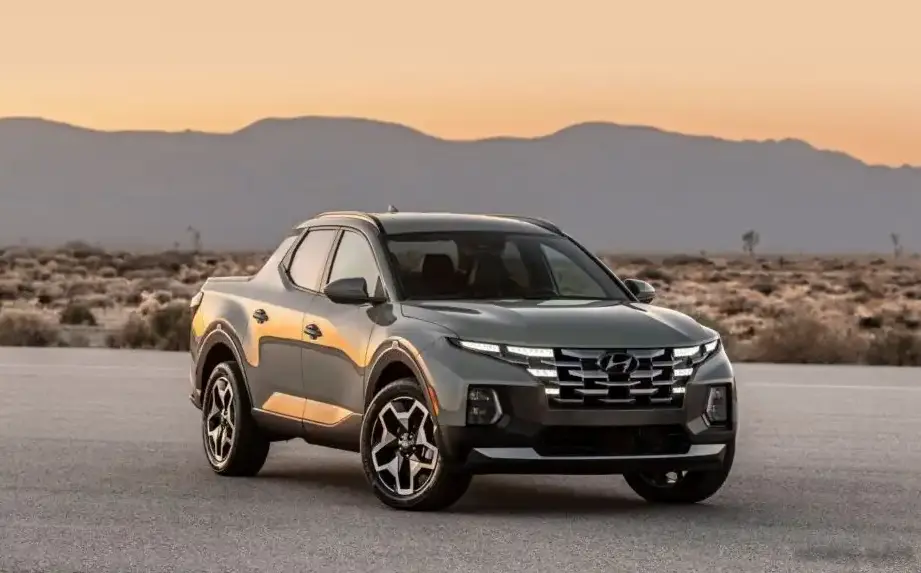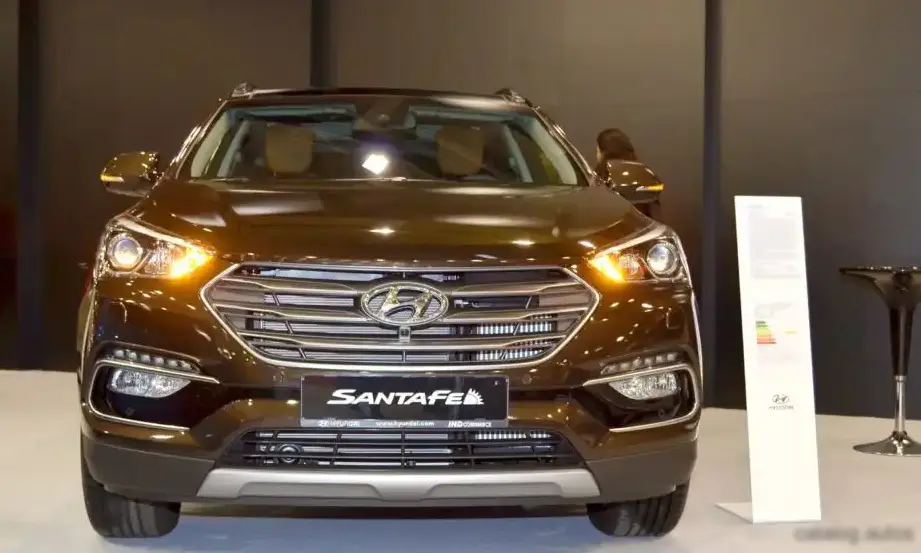
The Hyundai Santa Fe III (DM) facelift, specifically the 2.4 GDI 7-seat configuration, was produced from 2015 to 2018. This iteration of the Santa Fe represented a significant refresh of the popular mid-size SUV, aiming to enhance its appeal with updated styling, improved technology, and refined powertrain options. Positioned as a family-oriented vehicle, the 2.4 GDI 7-seat model offered a balance between affordability, space, and fuel efficiency within the Santa Fe lineup. It served as a step up from the base 2.0L engine, while remaining more accessible than the higher-end 3.3L V6 option.
Technical Specifications
| Brand | Hyundai |
| Model | Santa Fe |
| Generation | Santa Fe III (DM, facelift 2015) |
| Type (Engine) | 2.4 GDI (188 Hp) 7 Seat |
| Start of production | 2015 |
| End of production | 2018 |
| Powertrain Architecture | Internal Combustion engine |
| Body type | SUV |
| Seats | 7 |
| Doors | 5 |
| Fuel consumption (urban) | 12.9 l/100 km (18.2 US mpg, 21.9 UK mpg, 7.8 km/l) |
| Fuel consumption (extra urban) | 7.3 l/100 km (32.2 US mpg, 38.7 UK mpg, 13.7 km/l) |
| Fuel consumption (combined) | 9.4 l/100 km (25 US mpg, 30.1 UK mpg, 10.6 km/l) |
| CO2 emissions | 218 g/km |
| Fuel Type | Petrol (Gasoline) |
| Acceleration 0 – 100 km/h | 9.9 sec |
| Acceleration 0 – 62 mph | 9.9 sec |
| Acceleration 0 – 60 mph | 9.4 sec |
| Maximum speed | 202 km/h (125.52 mph) |
| Emission standard | Euro 6 |
| Power | 188 Hp @ 6000 rpm |
| Torque | 241 Nm @ 4000 rpm (177.75 lb.-ft. @ 4000 rpm) |
| Engine layout | Front, Transverse |
| Engine Model/Code | Theta II / G4KJ |
| Engine displacement | 2359 cm3 (143.96 cu. in.) |
| Number of cylinders | 4 |
| Engine configuration | Inline |
| Cylinder Bore | 88 mm (3.46 in.) |
| Piston Stroke | 97 mm (3.82 in.) |
| Compression ratio | 11.3:1 |
| Number of valves per cylinder | 4 |
| Fuel injection system | Direct injection |
| Engine aspiration | Naturally aspirated engine |
| Valvetrain | DOHC |
| Engine oil capacity | 4.8 l (5.07 US qt | 4.22 UK qt) |
| Coolant | 7.1 l (7.5 US qt | 6.25 UK qt) |
| Trunk (boot) space – minimum | 516 l (18.22 cu. ft.) |
| Trunk (boot) space – maximum | 1615 l (57.03 cu. ft.) |
| Fuel tank capacity | 64 l (16.91 US gal | 14.08 UK gal) |
| Length | 4690 mm (184.65 in.) |
| Width | 1880 mm (74.02 in.) |
| Height | 1680 mm (66.14 in.) |
| Wheelbase | 2700 mm (106.3 in.) |
| Front track | 1628-1633 mm (64.09 – 64.29 in.) |
| Rear (Back) track | 1639-1644 mm (64.53 – 64.72 in.) |
| Front overhang | 935 mm (36.81 in.) |
| Rear overhang | 1055 mm (41.54 in.) |
| Ride height (ground clearance) | 185 mm (7.28 in.) |
| Minimum turning circle (turning diameter) | 10.9 m (35.76 ft.) |
| Drivetrain Architecture | The Internal combustion engine (ICE) drives the front wheels of the vehicle. |
| Drive wheel | Front wheel drive |
| Number of gears and type of gearbox | 6 gears, manual transmission |
| Front suspension | Independent type McPherson |
| Rear suspension | Independent multi-link suspension |
| Front brakes | Ventilated discs |
| Rear brakes | Disc |
| Assisting systems | ABS (Anti-lock braking system) |
| Steering type | Steering rack and pinion |
| Power steering | Electric Steering |
| Tires size | 235/65 R17; 235/60 R18; 235/55 R19 |
| Wheel rims size | 7.0J x 17; 7.5J x 18; 7.5J x 19 |
INTRODUCTION
The Hyundai Santa Fe III, launched in 2012 and facelifted in 2015, quickly became a cornerstone of Hyundai’s success in the global SUV market. The 2.4 GDI 7-seat variant, introduced with the facelift, aimed to provide a practical and efficient option for families needing three-row seating. The “DM” designation refers to the internal platform code for this generation Santa Fe. This model year saw improvements in ride quality, interior materials, and safety features, solidifying the Santa Fe’s position as a competitive offering against established rivals like the Honda Pilot and Toyota Highlander, though generally positioned at a slightly lower price point.
Powertrain & Engine Architecture
At the heart of the 2.4 GDI 7-seat Santa Fe lies the Hyundai Theta II engine, specifically the G4KJ code. This 2.4-liter inline-four cylinder engine utilizes Gasoline Direct Injection (GDI) technology, which improves fuel efficiency and power output compared to traditional port fuel injection. The GDI system injects fuel directly into the combustion chamber, allowing for more precise fuel control and a higher compression ratio of 11.3:1. The engine features a dual overhead camshaft (DOHC) valvetrain with four valves per cylinder, optimizing airflow for enhanced performance. The 6-speed automatic transmission was the standard pairing for this engine, offering smooth shifts and reasonable responsiveness. While a manual transmission was available in some markets, it was less common in the US.
Driving Characteristics
The 188 horsepower and 177.75 lb-ft of torque produced by the 2.4 GDI engine provided adequate, though not exhilarating, performance for the Santa Fe. Acceleration from 0-60 mph took approximately 9.4 seconds. The automatic transmission was tuned for fuel efficiency, resulting in relatively conservative gear ratios. This meant that while the Santa Fe was comfortable for highway cruising and daily commuting, it lacked the punch of the optional V6 engine when fully loaded with passengers and cargo. The front-wheel-drive configuration contributed to decent fuel economy, but also limited traction in adverse weather conditions. Compared to the manual transmission equipped models, the automatic offered a more relaxed driving experience, but at the expense of some driver engagement.
Equipment & Trim Levels
The 2.4 GDI 7-seat Santa Fe typically came standard with features such as air conditioning, power windows and locks, a touchscreen infotainment system with Bluetooth connectivity, and a rearview camera. Higher trim levels added features like leather upholstery, heated front seats, a panoramic sunroof, and advanced safety technologies such as blind-spot monitoring and lane departure warning. Interior upholstery was typically cloth on the base trims, with leather options available on higher-spec models. Dashboard configurations were relatively straightforward, prioritizing functionality and ease of use. Optional extras included a navigation system, premium audio system, and automatic emergency braking.
Chassis & Braking
The Santa Fe utilized an independent McPherson strut suspension in the front and an independent multi-link suspension in the rear, providing a comfortable ride quality. Stabilizer bars were included both front and rear to reduce body roll during cornering. Braking duties were handled by ventilated discs in the front and solid discs in the rear, equipped with an Anti-lock Braking System (ABS). The braking system provided adequate stopping power for everyday driving, but wasn’t particularly sporty. The ride height of 185mm (7.28 inches) offered reasonable ground clearance for navigating uneven terrain.
Market Reception & Comparison
The 2.4 GDI 7-seat Santa Fe was generally well-received by critics as a practical and value-oriented SUV. It was praised for its spacious interior, comfortable ride, and long warranty. However, some reviewers noted that the engine lacked the power of its competitors, particularly when fully loaded. Fuel economy was considered competitive for its class, averaging around 25 mpg combined. Compared to the V6-equipped Santa Fe, the 2.4 GDI offered better fuel efficiency but less performance. Compared to the 2.0L turbo models, it offered a more linear power delivery, but less overall power.
Legacy
The Hyundai Santa Fe III (DM) 2.4 GDI 7-seat model has proven to be a relatively reliable vehicle in the used car market. The Theta II engine, while not without its issues (some early versions experienced oil consumption problems, which were addressed in later model years), generally holds up well with proper maintenance. The 6-speed automatic transmission is also known for its durability. Today, these Santa Fes represent a good value for buyers seeking a spacious, affordable, and reasonably fuel-efficient family SUV. Regular maintenance, including oil changes and timing belt replacements (if applicable), is crucial for ensuring long-term reliability.