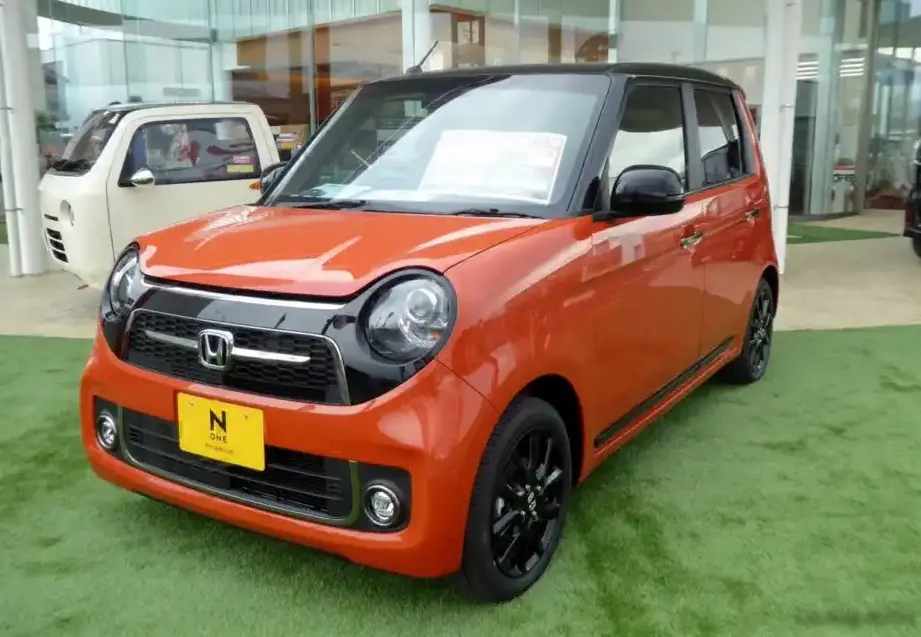
The Honda N-One I 0.7i (58 Hp) CVT, produced from November 2012 to March 2020, represents the entry point into the first generation of Honda’s “kei car” revival. The N-One, a five-door hatchback, was designed to evoke the spirit of the original N360 from the 1960s, offering a blend of retro styling and modern efficiency within the strict regulations governing Japan’s kei car class. This particular variant, powered by a small-displacement 658cc engine paired with a continuously variable transmission (CVT), was aimed at urban commuters prioritizing fuel economy and ease of driving. It played a significant role in re-establishing Honda’s presence in the kei car market, competing with established rivals like the Suzuki Alto and Daihatsu Mira.
Technical Specifications
| Brand | Honda |
| Model | N-One |
| Generation | N-One I |
| Type (Engine) | 0.7i (58 Hp) CVT |
| Start of production | November, 2012 |
| End of production | March, 2020 |
| Powertrain Architecture | Internal Combustion engine |
| Body type | Hatchback |
| Seats | 4 |
| Doors | 5 |
| Fuel consumption (combined) | 3.5 l/100 km (67.2 US mpg, 80.7 UK mpg, 28.6 km/l) |
| Fuel Type | Petrol (Gasoline) |
| Weight-to-power ratio | 14.3 kg/Hp, 69.9 Hp/tonne |
| Weight-to-torque ratio | 12.8 kg/Nm, 78.3 Nm/tonne |
| Power | 58 Hp @ 7300 rpm |
| Power per litre | 88.1 Hp/l |
| Torque | 65 Nm @ 4700 rpm (47.94 lb.-ft. @ 4700 rpm) |
| Engine layout | Front, Transverse |
| Engine displacement | 658 cm3 (40.15 cu. in.) |
| Number of cylinders | 3 |
| Engine configuration | Inline |
| Cylinder Bore | 64 mm (2.52 in.) |
| Piston Stroke | 68.2 mm (2.69 in.) |
| Compression ratio | 11.8:1 |
| Number of valves per cylinder | 4 |
| Fuel injection system | Multi-port manifold injection |
| Engine aspiration | Naturally aspirated engine |
| Valvetrain | DOHC |
| Engine oil capacity | 2.6 l (2.75 US qt | 2.29 UK qt) |
| Kerb Weight | 830-870 kg (1829.84 – 1918.02 lbs.) |
| Fuel tank capacity | 35 l (9.25 US gal | 7.7 UK gal) |
| Length | 3395 mm (133.66 in.) |
| Width | 1475 mm (58.07 in.) |
| Height | 1545-1610 mm (60.83 – 63.39 in.) |
| Wheelbase | 2520 mm (99.21 in.) |
| Front track | 1295-1305 mm (50.98 – 51.38 in.) |
| Rear track | 1295-1305 mm (50.98 – 51.38 in.) |
| Ride height (ground clearance) | 150 mm (5.91 in.) |
| Minimum turning circle | 9.0 m (29.53 ft.) |
| Drivetrain Architecture | Front wheel drive, Internal Combustion engine (ICE) |
| Number of gears and type of gearbox | automatic transmission CVT |
| Front suspension | Independent type McPherson |
| Rear suspension | Torsion |
| Front brakes | Disc |
| Rear brakes | Drum |
| Assisting systems | ABS (Anti-lock braking system) |
| Steering type | Steering rack and pinion |
| Power steering | Electric Steering |
| Tires size | 155/65 R14; 165/55 R15 |
| Wheel rims size | 14; 15 |
Powertrain & Engine Architecture
The heart of the N-One 0.7i is the S07A engine, a 658cc inline-three cylinder unit. This engine utilizes a multi-point fuel injection system and a double overhead camshaft (DOHC) valvetrain, contributing to its relatively high power output for its size. The engine’s design prioritized efficiency and low emissions, crucial for meeting kei car regulations. The CVT, a Honda-developed unit, was chosen for its smooth operation and contribution to fuel economy. Unlike traditional automatic transmissions with fixed gear ratios, the CVT continuously adjusts the gear ratio to keep the engine operating at its most efficient point. This results in a smoother, albeit sometimes less engaging, driving experience. The engine code is often associated with the Japanese market, and specific variations may exist depending on the production date.
Driving Characteristics
The 58 horsepower and 65 Nm (47.94 lb-ft) of torque produced by the 0.7i engine, when coupled with the CVT, resulted in modest but adequate performance for city driving. Acceleration was not brisk, and overtaking required careful planning. The CVT’s programming prioritized fuel efficiency over responsiveness, leading to a noticeable “rubber band” effect where engine RPMs would rise before translating into proportional acceleration. Compared to the more powerful N-One variants (like those with the 660cc turbocharged engine), the 0.7i felt significantly slower. However, the CVT’s smooth operation made it ideal for navigating congested urban environments. The gear ratios were optimized for low-speed drivability, making it easy to maneuver in tight spaces.
Equipment & Trim Levels
The 0.7i CVT trim typically served as the base model for the N-One. Standard equipment included air conditioning, power windows, and a basic audio system. Safety features such as ABS were also standard. Interior upholstery was typically cloth, and the dashboard featured a simple, functional design. Optional extras included alloy wheels, a navigation system, and upgraded audio options. Higher trim levels, such as the Premium and RS, added features like leather upholstery, sportier styling cues, and enhanced audio systems. The base 0.7i model focused on providing essential transportation at an affordable price point.
Chassis & Braking
The N-One I utilized a front-engine, front-wheel-drive layout. The front suspension employed an independent McPherson strut setup, while the rear suspension utilized a torsion beam. This configuration provided a reasonable balance between ride comfort and handling. The braking system featured disc brakes on the front wheels and drum brakes on the rear, a common configuration for kei cars in this price range. The relatively light weight of the vehicle (830-870 kg) helped to compensate for the less powerful braking system. Stabilizer bars were included to reduce body roll during cornering, enhancing stability.
Market Reception & Comparison
The N-One 0.7i CVT was generally well-received for its fuel efficiency and affordability. Critics praised its retro styling and practical interior. However, the engine’s lack of power was a common criticism, particularly when compared to turbocharged alternatives. In terms of fuel economy, the 0.7i consistently outperformed larger vehicles, achieving around 3.5 liters per 100 kilometers (67.2 US mpg). Compared to other kei car models, the N-One offered a more refined driving experience and a more stylish interior. The CVT, while efficient, was often criticized for its lack of engagement compared to manual transmissions.
Legacy
The Honda N-One I 0.7i CVT remains a popular choice in the used car market, particularly among those seeking an affordable and fuel-efficient city car. The S07A engine is known for its reliability, although regular maintenance is essential. The CVT, while generally durable, may require servicing at higher mileages. The N-One’s retro styling has also contributed to its enduring appeal. As a key model in Honda’s kei car lineup, the N-One 0.7i helped to revitalize the brand’s presence in this important segment of the Japanese automotive market, and continues to be a practical and charming option for budget-conscious buyers.