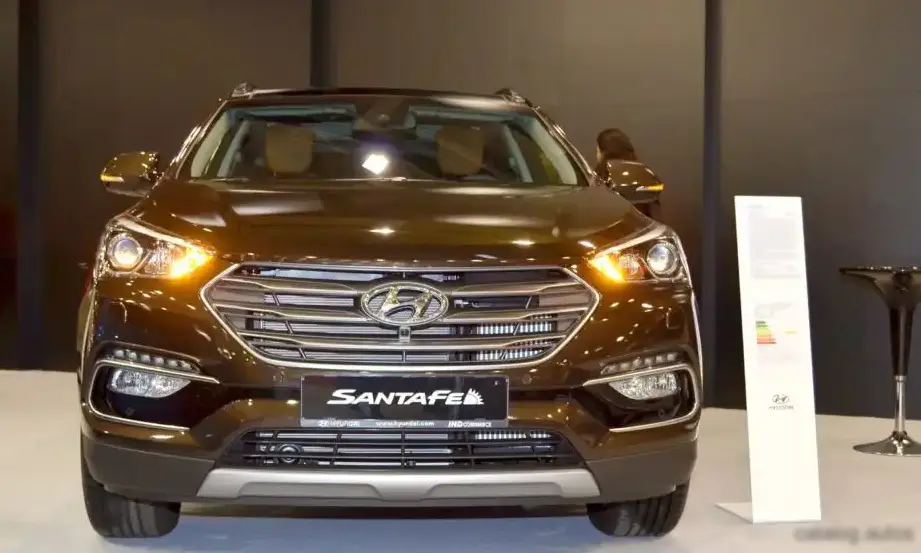
The Hyundai Santa Fe III (DM, facelift 2015) 2.4 MPI 4WD Automatic represents a significant iteration of Hyundai’s popular mid-size SUV, produced from 2017 to 2018. This variant occupied a key position within the Santa Fe lineup, offering a balance between affordability, practicality, and all-weather capability. Positioned as a step up from the base models, the 2.4L engine and automatic transmission combination aimed to appeal to families and individuals seeking a comfortable and versatile vehicle without the higher price tag of the more powerful trims. It was primarily sold in North America, and other markets where a comfortable, well-equipped, and affordable SUV was in demand.
Technical Specifications
| Brand | Hyundai |
| Model | Santa Fe |
| Generation | Santa Fe III (DM, facelift 2015) |
| Type (Engine) | 2.4 MPI (172 Hp) 4WD Automatic |
| Start of production | 2017 year |
| End of production | 2018 year |
| Powertrain Architecture | Internal Combustion engine |
| Body type | SUV |
| Seats | 5-7 |
| Doors | 5 |
| Fuel consumption (economy) – urban (NEDC) | 14.1 l/100 km (16.7 US mpg, 20 UK mpg, 7.1 km/l) |
| Fuel consumption (economy) – extra urban (NEDC) | 7.5 l/100 km (31.4 US mpg, 37.7 UK mpg, 13.3 km/l) |
| Fuel consumption (economy) – combined (NEDC) | 9.9 l/100 km (23.8 US mpg, 28.5 UK mpg, 10.1 km/l) |
| CO2 emissions (NEDC) | 230 g/km |
| Fuel Type | Petrol (Gasoline) |
| Acceleration 0 – 100 km/h | 11.5 sec |
| Acceleration 0 – 62 mph | 11.5 sec |
| Acceleration 0 – 60 mph | 10.9 sec |
| Maximum speed | 190 km/h (118.06 mph) |
| Weight-to-power ratio | 9.9 kg/Hp, 101.1 Hp/tonne |
| Weight-to-torque ratio | 7.6 kg/Nm, 132.2 Nm/tonne |
| Power | 172 Hp @ 6000 rpm |
| Power per litre | 72.9 Hp/l |
| Torque | 225 Nm @ 4000 rpm (165.95 lb.-ft. @ 4000 rpm) |
| Engine layout | Front, Transverse |
| Engine Model/Code | Theta II / G4KE |
| Engine displacement | 2359 cm3 (143.96 cu. in.) |
| Number of cylinders | 4 |
| Engine configuration | Inline |
| Cylinder Bore | 88 mm (3.46 in.) |
| Piston Stroke | 97 mm (3.82 in.) |
| Number of valves per cylinder | 4 |
| Fuel injection system | Multi-port manifold injection |
| Engine aspiration | Naturally aspirated engine |
| Valvetrain | DOHC |
| Engine oil capacity | 4.8 l (5.07 US qt | 4.22 UK qt) |
| Coolant | 7.1 l (7.5 US qt | 6.25 UK qt) |
| Kerb Weight | 1702 kg (3752.27 lbs.) |
| Max. weight | 2510 kg (5533.6 lbs.) |
| Max load | 808 kg (1781.34 lbs.) |
| Trunk (boot) space – maximum | 1680 l (59.33 cu. ft.) |
| Fuel tank capacity | 64 l (16.91 US gal | 14.08 UK gal) |
| Length | 4700 mm (185.04 in.) |
| Width | 1880 mm (74.02 in.) |
| Width including mirrors | 2179 mm (85.79 in.) |
| Height | 1690 mm (66.54 in.) |
| Wheelbase | 2700 mm (106.3 in.) |
| Front track | 1628-1633 mm (64.09 – 64.29 in.) |
| Rear (Back) track | 1639-1644 mm (64.53 – 64.72 in.) |
| Front overhang | 940 mm (37.01 in.) |
| Rear overhang | 1060 mm (41.73 in.) |
| Drivetrain Architecture | The Internal combustion engine (ICE) drives the front wheels permanently, and the rear wheels are driven through an electrically or mechanically operated clutch if necessary. |
| Drive wheel | All wheel drive (4×4) |
| Number of gears and type of gearbox | 6 gears, automatic transmission |
| Front suspension | Independent type McPherson |
| Rear suspension | Independent multi-link suspension |
| Front brakes | Ventilated discs |
| Rear brakes | Disc |
| Assisting systems | ABS (Anti-lock braking system) |
| Steering type | Steering rack and pinion |
| Power steering | Electric Steering |
| Tires size | 235/65 R17; 235/60 R18; 235/55 R19 |
| Wheel rims size | 7.0J x 17; 7.5J x 18; 7.5J x 19 |
INTRODUCTION
The Hyundai Santa Fe III, launched in 2012 and receiving a significant facelift in 2015, represented a major step forward for the Korean automaker in the competitive mid-size SUV segment. The 2.4 MPI 4WD Automatic variant, produced from 2017-2018, was a key component of this success. Built on the Hyundai-Kia Y6 (or internally DM) platform, this generation Santa Fe offered increased space, improved refinement, and a more sophisticated design compared to its predecessors. The facelift brought updated styling, enhanced safety features, and improvements to the interior. This particular configuration aimed to provide a comfortable and capable all-wheel-drive experience for families and individuals prioritizing practicality and value.
Powertrain & Engine Architecture
At the heart of the Santa Fe 2.4 MPI 4WD Automatic lies the Hyundai Theta II G4KE 2.4-liter inline-four cylinder engine. This engine utilizes multi-point fuel injection and a double overhead camshaft (DOHC) valvetrain. The G4KE engine is known for its relatively simple design and robust construction. It produces 172 horsepower at 6000 rpm and 225 Nm (165.95 lb-ft) of torque at 4000 rpm. The engine’s architecture is designed for smooth operation and reasonable fuel efficiency, though it doesn’t offer the performance of the optional turbocharged engines available in the Santa Fe lineup. The engine is paired with a six-speed automatic transmission, which was a standard feature for this trim level. This transmission is known for its smooth shifts and reliable operation, though it isn’t particularly sporty in its tuning. The all-wheel-drive system is an on-demand system, primarily driving the front wheels but engaging the rear wheels when traction is lost.
Driving Characteristics
The 2.4L engine and six-speed automatic combination delivers adequate, but not exhilarating, performance. Acceleration from 0-60 mph takes approximately 10.9 seconds, and the vehicle has a top speed of 118 mph. The automatic transmission is tuned for comfort and fuel economy, resulting in relatively relaxed gear changes. Compared to the more powerful 2.0T or 3.3L V6 models, the 2.4L feels noticeably less responsive, particularly when accelerating for highway merging or overtaking. However, the all-wheel-drive system provides enhanced stability and traction in inclement weather conditions. The gear ratios are optimized for cruising, making it a comfortable vehicle for long road trips. The steering is light and easy, contributing to a relaxed driving experience.
Equipment & Trim Levels
The 2.4 MPI 4WD Automatic Santa Fe typically came standard with a respectable array of features. These included air conditioning, power windows and locks, a touchscreen infotainment system with Bluetooth connectivity, a rearview camera, and keyless entry. Higher trim levels offered upgrades such as leather upholstery, a panoramic sunroof, heated front seats, and a premium audio system. Safety features such as ABS, electronic stability control, and multiple airbags were standard across the range. The interior design was generally considered modern and well-appointed for its price point, with a focus on practicality and comfort.
Chassis & Braking
The Santa Fe III utilizes an independent McPherson strut suspension in the front and an independent multi-link suspension in the rear. This setup provides a comfortable ride quality, absorbing bumps and irregularities in the road surface effectively. The chassis is designed to balance ride comfort with handling stability. Braking duties are handled by ventilated discs in the front and solid discs in the rear. ABS (Anti-lock Braking System) is standard, providing enhanced braking performance in emergency situations. The Santa Fe’s weight distribution contributes to predictable handling characteristics.
Market Reception & Comparison
The Hyundai Santa Fe III, including the 2.4 MPI 4WD Automatic variant, was generally well-received by automotive critics. It was praised for its spacious interior, comfortable ride, and value for money. However, some reviewers noted that the 2.4L engine felt underpowered compared to its competitors and the more powerful engine options within the Santa Fe lineup. Fuel economy was considered average for the class. Compared to rivals like the Honda CR-V and Toyota RAV4, the Santa Fe offered a more generous warranty and a lower starting price, but lacked the same level of brand recognition and resale value. The 1.8L and 2.0T trims offered different trade-offs, with the 1.8L being more fuel-efficient but even slower, and the 2.0T providing significantly more performance at a higher cost.
Legacy
The Hyundai Santa Fe III 2.4 MPI 4WD Automatic has proven to be a relatively reliable vehicle in the used car market. The Theta II engine, while not without its potential issues (such as occasional oil consumption), is generally considered durable when properly maintained. The six-speed automatic transmission is also known for its longevity. Today, these Santa Fes represent a good value for buyers seeking a spacious, comfortable, and capable SUV at an affordable price. Regular maintenance, including oil changes and fluid checks, is crucial to ensuring the long-term reliability of this powertrain. The availability of affordable parts and a growing network of independent Hyundai specialists contribute to its continued appeal in the used car market.