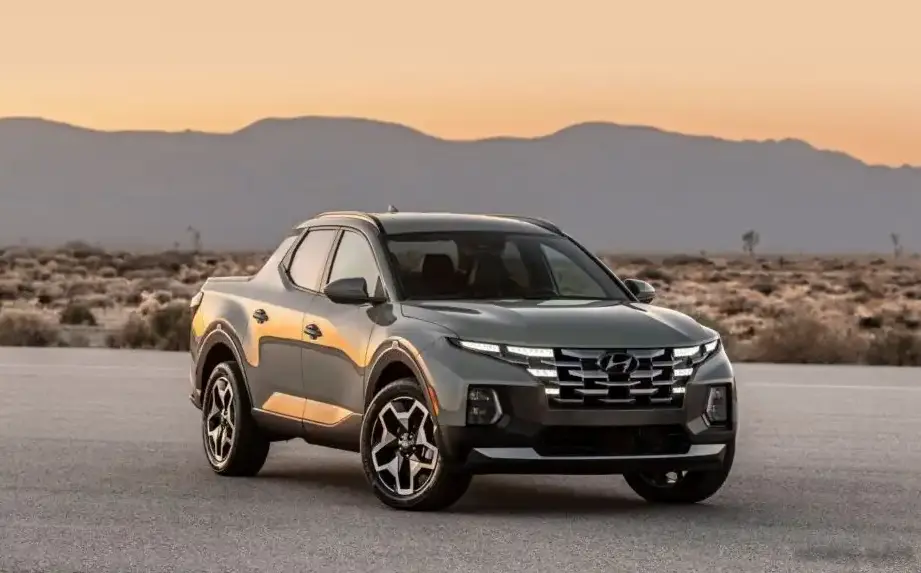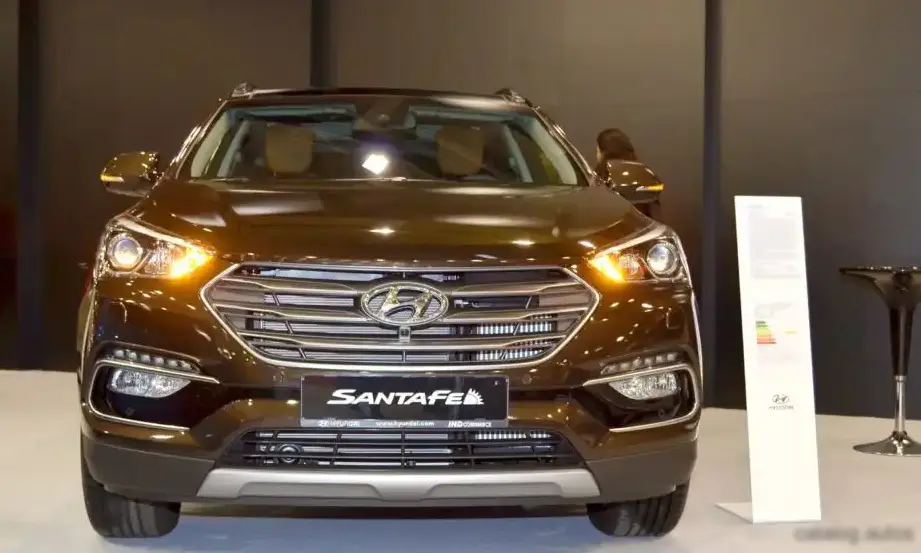
The Hyundai Santa Fe III (DM) facelift, specifically the 3.3 MPi (270 Hp) AWD Automatic variant, was produced for a limited time from 2017 to 2018. This model represented the top-tier engine option for the facelifted third generation Santa Fe, positioned as the premium offering within the lineup. It built upon the foundation of the DM platform, introduced in 2012, offering a larger, more refined SUV experience for the North American market and beyond. The facelift brought updated styling, improved interior materials, and enhanced technology features, solidifying the Santa Fe’s position as a competitive mid-size crossover.
Technical Specifications
| Brand | Hyundai |
| Model | Santa Fe |
| Generation | Santa Fe III (DM, facelift 2015) |
| Type (Engine) | 3.3 MPi (270 Hp) AWD Automatic |
| Start of production | 2017 |
| End of production | 2018 |
| Powertrain Architecture | Internal Combustion engine |
| Body type | SUV |
| Seats | 5-7 |
| Doors | 5 |
| Fuel consumption (economy) – urban | 14.4 l/100 km (16.3 US mpg, 19.6 UK mpg, 6.9 km/l) |
| Fuel consumption (economy) – extra urban | 8.3 l/100 km (28.3 US mpg, 34 UK mpg, 12 km/l) |
| Fuel consumption (economy) – combined | 10.5 l/100 km (22.4 US mpg, 26.9 UK mpg, 9.5 km/l) |
| CO2 emissions | 245 g/km |
| Fuel Type | Petrol (Gasoline) |
| Acceleration 0 – 100 km/h | 8.5 sec |
| Acceleration 0 – 62 mph | 8.5 sec |
| Acceleration 0 – 60 mph | 8.1 sec |
| Maximum speed | 210 km/h (130.49 mph) |
| Weight-to-power ratio | 6.5 kg/Hp, 153.6 Hp/tonne |
| Weight-to-torque ratio | 5.5 kg/Nm, 180.9 Nm/tonne |
| Power | 270 Hp @ 6400 rpm |
| Power per litre | 80.8 Hp/l |
| Torque | 318 Nm @ 5300 rpm (234.54 lb.-ft. @ 5300 rpm) |
| Engine layout | Front, Transverse |
| Engine Model/Code | Lambda II / G6DF |
| Engine displacement | 3342 cm3 (203.94 cu. in.) |
| Number of cylinders | 6 |
| Engine configuration | Inline |
| Number of valves per cylinder | 4 |
| Fuel injection system | Multi-port manifold injection |
| Engine aspiration | Naturally aspirated engine |
| Engine oil capacity | 5.7 l (6.02 US qt | 5.02 UK qt) |
| Coolant | 9.1 l (9.62 US qt | 8.01 UK qt) |
| Kerb Weight | 1758 kg (3875.73 lbs.) |
| Max. weight | 2510 kg (5533.6 lbs.) |
| Max load | 752 kg (1657.88 lbs.) |
| Trunk (boot) space – minimum | 1680 l (59.33 cu. ft.) |
| Length | 4700 mm (185.04 in.) |
| Width | 1880 mm (74.02 in.) |
| Width including mirrors | 2179 mm (85.79 in.) |
| Height | 1680 mm (66.14 in.) |
| Wheelbase | 2700 mm (106.3 in.) |
| Front track | 1628-1633 mm (64.09 – 64.29 in.) |
| Rear (Back) track | 1639-1644 mm (64.53 – 64.72 in.) |
| Front overhang | 940 mm (37.01 in.) |
| Rear overhang | 1060 mm (41.73 in.) |
| Drivetrain Architecture | All wheel drive (4×4). ICE drives all four wheels. |
| Number of gears and type of gearbox | 6 gears, automatic transmission |
| Front brakes | Ventilated discs |
| Rear brakes | Disc |
| Assisting systems | ABS (Anti-lock braking system) |
| Steering type | Steering rack and pinion |
| Power steering | Electric Steering |
| Tires size | 235/65 R17; 235/60 R18; 235/55 R19 |
| Wheel rims size | 7.0J x 17; 7.5J x 18; 7.5J x 19 |
INTRODUCTION
The 2017-2018 Hyundai Santa Fe 3.3 MPi AWD Automatic represented the pinnacle of performance for the DM facelift generation. It was designed to appeal to buyers seeking a spacious, well-equipped SUV with robust power and all-weather capability. The Santa Fe, in general, was a crucial model for Hyundai’s expansion in the North American market, offering a compelling alternative to established Japanese and American competitors. The facelifted DM model aimed to elevate the Santa Fe’s perceived quality and sophistication, and the 3.3L V6 engine was a key component of that strategy.
Powertrain & Engine Architecture
At the heart of this Santa Fe variant lies the Hyundai Lambda II 3.3-liter V6 engine, designated as the G6DF. This naturally aspirated engine utilizes multi-port fuel injection (MPI) to deliver 270 horsepower at 6,400 rpm and 318 Nm (234.54 lb-ft) of torque at 5,300 rpm. The engine features a double overhead camshaft (DOHC) valvetrain with four valves per cylinder, contributing to its relatively high specific output. The engine is transversely mounted in the front of the vehicle. Paired with this engine is a six-speed automatic transmission, providing smooth and responsive shifts. This transmission was chosen for its balance of efficiency and drivability, although it lacks the advanced gear counts found in some competitor vehicles. The all-wheel-drive (AWD) system is a full-time system, distributing power between the front and rear axles for enhanced traction in various driving conditions.
Driving Characteristics
The 3.3L V6 and six-speed automatic combination provided a noticeable performance upgrade compared to the base 2.4L four-cylinder engine. Acceleration to 60 mph was achieved in approximately 8.1 seconds, making it a reasonably quick SUV for its class. The automatic transmission offered a comfortable driving experience, with well-spaced gear ratios that prioritized smooth cruising. While not a sports-oriented vehicle, the Santa Fe 3.3 MPi offered ample power for highway merging, overtaking, and carrying a full load of passengers and cargo. Compared to the more fuel-efficient but less powerful four-cylinder models, the V6 provided a more relaxed and confident driving experience, particularly when fully loaded or towing. The AWD system enhanced stability and control in inclement weather, making it a practical choice for regions with snow or rain.
Equipment & Trim Levels
The 3.3 MPi AWD Automatic trim typically came well-equipped, often representing the highest trim level available. Standard features generally included leather upholstery, heated front seats, a touchscreen infotainment system with navigation, a rearview camera, and a premium sound system. Optional extras could include a panoramic sunroof, ventilated front seats, and advanced safety features such as blind-spot monitoring and lane departure warning. Interior materials were upgraded compared to lower trims, with soft-touch surfaces and refined trim accents. The dashboard layout was functional and user-friendly, with logically placed controls.
Chassis & Braking
The Santa Fe DM utilized a front MacPherson strut suspension and a rear multi-link suspension, providing a comfortable and controlled ride. The suspension was tuned to prioritize ride quality over sporty handling. Braking duties were handled by ventilated discs at the front and solid discs at the rear, providing adequate stopping power for the vehicle’s weight. Anti-lock brakes (ABS) were standard, along with electronic stability control. The steering was electrically assisted, offering light and precise steering feel.
Market Reception & Comparison
Critics generally praised the Santa Fe 3.3 MPi for its spacious interior, comfortable ride, and strong engine performance. However, some reviewers noted that the fuel economy was relatively poor compared to competitors offering turbocharged engines or hybrid powertrains. Compared to the base 2.4L models, the 3.3L offered a significant performance boost but came at a higher price point and with increased fuel consumption. Against rivals like the Toyota Highlander and Honda Pilot, the Santa Fe offered a competitive value proposition, particularly considering its standard features and warranty coverage.
Legacy
The Hyundai Santa Fe 3.3 MPi AWD Automatic, while only produced for two model years in this configuration, has proven to be a relatively reliable powertrain. The Lambda II V6 engine is known for its durability, and the six-speed automatic transmission has a good track record. In the used car market, these models are often sought after by buyers who prioritize power and all-wheel-drive capability. Maintenance costs are generally reasonable, although routine servicing is essential to ensure long-term reliability. The Santa Fe DM facelift, including the 3.3 MPi variant, helped solidify Hyundai’s reputation as a maker of well-equipped, reliable, and value-oriented SUVs.