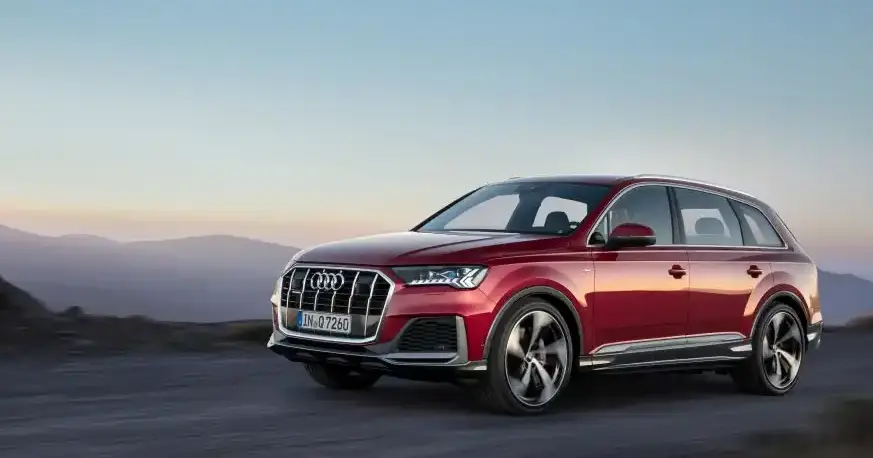
The Audi Q7 (Typ 4M, facelift 2019) 45 TFSI represents a significant iteration of Audi’s popular luxury SUV, produced from 2022 to 2024. This variant, equipped with a 2.0-liter turbocharged four-cylinder engine paired with a mild-hybrid system and an eight-speed tiptronic automatic transmission, occupies a key position in the Q7 lineup, offering a balance of performance, efficiency, and practicality for families. The facelifted Typ 4M Q7, introduced in 2019, brought updated styling, enhanced technology, and refined powertrains, solidifying the Q7’s position as a competitive contender in the mid-size luxury SUV segment. The 45 TFSI trim, with its seven-seat configuration, was aimed at buyers seeking a versatile and comfortable vehicle for both daily commuting and longer journeys.
Technical Specifications
| Brand | Audi |
| Model | Q7 |
| Generation | Q7 (Typ 4M, facelift 2019) |
| Type (Engine) | 45 TFSI (261 Hp) Mild Hybrid quattro tiptronic 7 seats |
| Start of production | 2022 |
| End of production | 2024 |
| Powertrain Architecture | MHEV (Mild Hybrid Electric Vehicle) |
| Body type | SUV |
| Seats | 7 |
| Doors | 5 |
| Fuel consumption (urban) | 12.4 l/100 km (19 US mpg) |
| Fuel consumption (extra urban) | 9.4 l/100 km (25 US mpg) |
| Fuel consumption (combined) | 11.2 l/100 km (21 US mpg) |
| Fuel Type | Petrol (Gasoline) |
| Acceleration 0 – 60 mph | 6.7 sec |
| Maximum speed | 210 km/h (130.49 mph) |
| Weight-to-power ratio | 8.3 kg/Hp |
| Weight-to-torque ratio | 5.9 kg/Nm |
| Battery voltage | 12 V |
| Power | 261 Hp |
| Torque | 370 Nm (272.9 lb.-ft.) |
| Engine layout | Front, Longitudinal |
| Engine Model/Code | EA888 / DUVA |
| Engine displacement | 1984 cm3 (121.07 cu. in.) |
| Number of cylinders | 4 |
| Engine configuration | Inline |
| Cylinder Bore | 82.5 mm (3.25 in.) |
| Piston Stroke | 92.8 mm (3.65 in.) |
| Number of valves per cylinder | 4 |
| Fuel injection system | Direct injection |
| Engine aspiration | Turbocharger, Intercooler |
| Valvetrain | DOHC |
| Engine oil capacity | 5.2 l (5.49 US qt) |
| Coolant capacity | 10 l (10.57 US qt) |
| Kerb Weight | 2175 kg (4795.05 lbs.) |
| Trunk (boot) space (min) | 402 l (14.2 cu. ft.) |
| Trunk (boot) space (max) | 1971 l (69.61 cu. ft.) |
| Fuel tank capacity | 85 l (22.45 US gal) |
| Length | 5063 mm (199.33 in.) |
| Width | 1970 mm (77.56 in.) |
| Height | 1737 mm (68.39 in.) |
| Drag coefficient (Cd) | 0.36 |
| Minimum turning circle | 12.5 m (41.01 ft.) |
| Drive wheel | All wheel drive (4×4) |
| Number of gears | 8 |
| Gearbox type | Automatic transmission tiptronic |
| Front suspension | Independent multi-link suspension, Transverse stabilizer |
| Rear suspension | Independent multi-link suspension, Transverse stabilizer |
| Front brakes | Ventilated discs, 376 mm |
| Rear brakes | Ventilated discs, 350 mm |
| Tire size | 255/55 R19; 285/45 R20; 285/40 R21 |
Powertrain & Engine Architecture
The heart of the Q7 45 TFSI is the EA888 2.0-liter turbocharged inline-four engine, specifically the DUVA variant. This engine is a member of the widely-used EA888 family, known for its robust construction and tuning potential. The DUVA code indicates a specific calibration for the Q7, prioritizing fuel efficiency and smooth power delivery. It utilizes direct fuel injection, delivering fuel directly into the combustion chamber for improved efficiency and reduced emissions. The engine also features an integrated exhaust manifold for faster warm-up times and reduced turbo lag. The turbocharger itself is a twin-scroll unit, further enhancing responsiveness. The mild-hybrid system, a 48-volt system, incorporates a belt starter generator (BSG) that provides a power boost during acceleration and allows for extended coasting with the engine off, improving fuel economy. The eight-speed tiptronic automatic transmission is a torque-converter type, offering smooth and quick shifts. It’s programmed to prioritize comfort and efficiency, but also allows for manual gear selection via steering wheel-mounted paddles.
Driving Characteristics
The 261 horsepower and 272.9 lb.-ft. of torque produced by the 45 TFSI powertrain provide adequate performance for the Q7’s size and weight. Acceleration from 0 to 60 mph takes a respectable 6.7 seconds. While not as exhilarating as the higher-output Q7 variants (like the 55 TFSI with its V6 engine), the 45 TFSI offers a comfortable and refined driving experience. The eight-speed transmission is well-matched to the engine’s characteristics, providing smooth upshifts and downshifts. The quattro all-wheel-drive system ensures excellent traction in all weather conditions. The mild-hybrid system is largely transparent to the driver, providing a subtle boost during acceleration and contributing to improved fuel economy. Compared to the manual transmission options available on some Q7 models in other markets, the tiptronic offers greater convenience and ease of use, particularly in city driving.
Equipment & Trim Levels
The Q7 45 TFSI typically came well-equipped as standard. Key features included leather upholstery, three-zone automatic climate control, a panoramic sunroof, and Audi’s MMI touch response infotainment system with a 10.1-inch touchscreen display. Standard safety features included Audi pre sense basic, lane departure warning, and rear parking sensors. Optional extras included adaptive cruise control, a premium sound system, and upgraded leather packages. The seven-seat configuration was standard on this trim, making it a practical choice for families. Interior trim options varied, allowing buyers to personalize the cabin to their preferences.
Chassis & Braking
The Q7 45 TFSI utilizes an independent multi-link suspension at both the front and rear axles, providing a comfortable and controlled ride. A transverse stabilizer bar is fitted to both axles to reduce body roll during cornering. The braking system consists of ventilated discs at all four corners, with larger discs at the front (376mm) compared to the rear (350mm). Anti-lock braking system (ABS) and electronic stability control (ESC) are standard features. The steering is an electric power steering system, providing precise and responsive steering feel.
Market Reception & Comparison
The Q7 45 TFSI was generally well-received by automotive critics. It was praised for its comfortable ride, spacious interior, and user-friendly technology. Fuel economy was considered competitive for its class, although not exceptional. Compared to the Q7 55 TFSI, the 45 TFSI offered a more affordable entry point into the Q7 range, but at the expense of some performance. The 45 TFSI also offered a more economical alternative to the diesel-powered Q7 variants available in Europe. Reliability reports have been generally positive, with the EA888 engine proving to be a durable and dependable unit.
Legacy
The Audi Q7 (Typ 4M) 45 TFSI has established itself as a solid and reliable luxury SUV in the used car market. The EA888 engine, when properly maintained, is known for its longevity. The mild-hybrid system has also proven to be relatively trouble-free. The Q7’s spacious interior and comfortable ride continue to appeal to buyers seeking a practical and refined family vehicle. As with any used vehicle, a thorough inspection and maintenance history are essential before purchasing a Q7 45 TFSI.