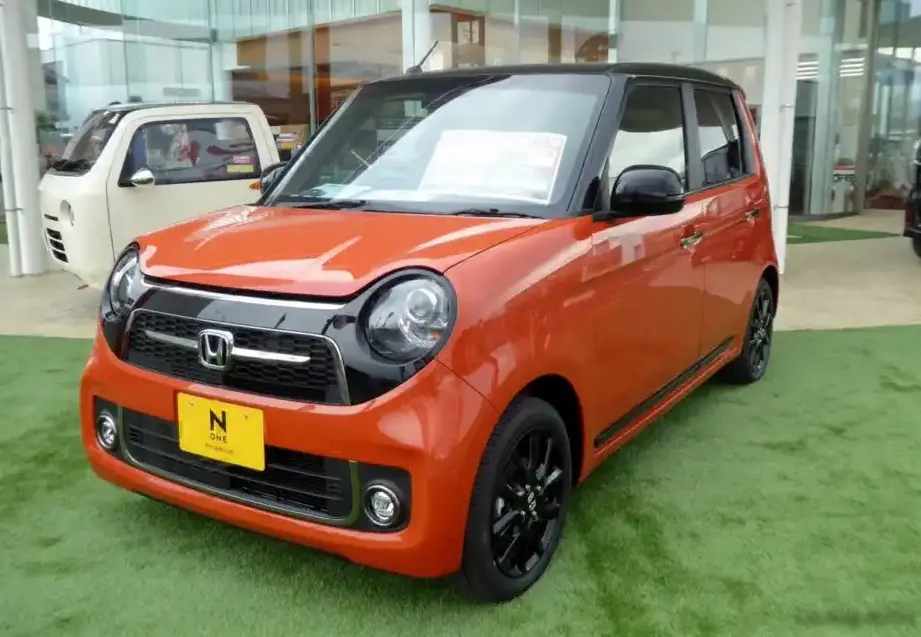
The Honda N-One II 0.7 (58 hp) 4WD CVT is a kei car produced by Honda, representing the second generation of the N-One model. Introduced in 2020, this variant caters to the Japanese domestic market (JDM) with its compact dimensions, fuel efficiency, and practical features. It builds upon the success of the first-generation N-One, offering updated styling, improved safety technology, and a continued focus on maximizing interior space within the strict regulations governing kei cars. This specific configuration – the 0.7-liter engine paired with a continuously variable transmission (CVT) and all-wheel drive – positions itself as a versatile option for urban commuting and occasional rural driving.
Technical Specifications
| Brand | Honda |
| Model | N-One |
| Generation | N-One II |
| Type (Engine) | 0.7 (58 Hp) 4WD CVT |
| Start of production | 2020 |
| Powertrain Architecture | Internal Combustion engine |
| Body type | Hatchback |
| Seats | 4 |
| Doors | 5 |
| Fuel consumption (urban) | 5.4 l/100 km (43.6 US mpg, 52.3 UK mpg, 18.5 km/l) |
| Fuel consumption (extra urban) | 4.4 l/100 km (53.5 US mpg, 64.2 UK mpg, 22.7 km/l) |
| Fuel Type | Petrol (Gasoline) |
| Weight-to-power ratio | 15.5 kg/Hp, 64.4 Hp/tonne |
| Weight-to-torque ratio | 13.8 kg/Nm, 72.2 Nm/tonne |
| Power | 58 Hp @ 7300 rpm |
| Power per litre | 88.1 Hp/l |
| Torque | 65 Nm @ 4800 rpm (47.94 lb.-ft. @ 4800 rpm) |
| Engine layout | Front, Transverse |
| Engine Model/Code | S07B |
| Engine displacement | 658 cm3 (40.15 cu. in.) |
| Number of cylinders | 3 |
| Engine configuration | Inline |
| Cylinder Bore | 60 mm (2.36 in.) |
| Piston Stroke | 77.6 mm (3.06 in.) |
| Compression ratio | 12:1 |
| Number of valves per cylinder | 4 |
| Fuel injection system | Multi-port manifold injection |
| Engine aspiration | Naturally aspirated engine |
| Valvetrain | DOHC |
| Kerb Weight | 900 kg (1984.16 lbs.) |
| Fuel tank capacity | 25 l (6.6 US gal | 5.5 UK gal) |
| Length | 3395 mm (133.66 in.) |
| Width | 1475 mm (58.07 in.) |
| Height | 1570 mm (61.81 in.) |
| Wheelbase | 2520 mm (99.21 in.) |
| Front track | 1300 mm (51.18 in.) |
| Rear track | 1305 mm (51.38 in.) |
| Ride height (ground clearance) | 145 mm (5.71 in.) |
| Minimum turning circle | 9.4 m (30.84 ft.) |
| Drivetrain Architecture | All wheel drive (4×4). ICE drives front wheels, rear wheels driven via clutch. |
| Drive wheel | All wheel drive (4×4) |
| Number of gears and type of gearbox | automatic transmission CVT |
| Front suspension | Independent type McPherson |
| Rear suspension | Torsion |
| Front brakes | Disc |
| Rear brakes | Drum |
| Assisting systems | ABS (Anti-lock braking system) |
| Steering type | Steering rack and pinion |
| Power steering | Electric Steering |
| Tires size | 155/65 R14 |
Powertrain & Engine Architecture
The N-One II 0.7 4WD CVT is powered by Honda’s S07B engine, a 658cc inline-three cylinder unit. This engine utilizes a multi-point fuel injection system and a double overhead camshaft (DOHC) valvetrain, contributing to its relatively high power output for its displacement. The engine is naturally aspirated, meaning it doesn’t employ a turbocharger or supercharger. The S07B engine is designed to meet Japan’s stringent kei car regulations, which limit engine displacement and overall vehicle dimensions. The engine is transversely mounted at the front of the vehicle. The CVT (Continuously Variable Transmission) is a key component of this variant, prioritizing fuel efficiency and smooth acceleration over outright performance. The 4WD system employs an electronically controlled clutch to engage the rear wheels when traction is needed, enhancing stability in slippery conditions.
Driving Characteristics
The 58 hp output and CVT pairing result in modest, but adequate, performance for city driving. Acceleration is linear and predictable, though not particularly brisk. The CVT effectively keeps the engine within its optimal power band, providing smooth and efficient power delivery. Compared to the manual transmission versions of the N-One, the CVT sacrifices some driver engagement for ease of use. The all-wheel drive system provides enhanced grip and stability, particularly on wet or snowy roads, making it a practical choice for regions with inclement weather. The relatively light weight of the vehicle (900 kg) helps to mitigate the effects of the low horsepower, making it feel more responsive than the numbers might suggest. The gear ratios are optimized for fuel economy, meaning highway passing maneuvers require careful planning.
Equipment & Trim Levels
The N-One II 0.7 4WD CVT typically comes equipped with standard features such as air conditioning, power windows, power steering, and an audio system. Safety features include ABS (Anti-lock Braking System) and airbags. Higher trim levels offer additional features like a touchscreen infotainment system, navigation, and advanced driver-assistance systems (ADAS) such as collision mitigation braking and lane departure warning. Interior upholstery is typically cloth, with options for upgraded materials on higher trims. The dashboard layout is functional and driver-focused, with a clear instrument cluster. Optional extras could include alloy wheels, body-colored door handles, and a variety of interior customization options.
Chassis & Braking
The N-One II utilizes a McPherson strut suspension setup at the front and a torsion beam suspension at the rear. This configuration provides a balance between ride comfort and handling. The front brakes are disc brakes, while the rear brakes are drum brakes – a cost-saving measure common in kei cars. The electric power steering provides light and easy steering, making it ideal for maneuvering in tight urban spaces. The relatively narrow tires (155/65 R14) contribute to fuel efficiency but limit grip in more demanding driving situations. The chassis is designed to be lightweight and rigid, enhancing handling and safety.
Market Reception & Comparison
The Honda N-One II 0.7 4WD CVT was generally well-received in the Japanese market for its practicality, fuel efficiency, and unique retro-inspired styling. Critics praised its spacious interior for a kei car and its comfortable ride. Compared to other kei car variants, such as those with larger engines or turbocharging, the 0.7-liter CVT version prioritized fuel economy and ease of use over outright performance. It offered a compelling alternative to other small cars, particularly for buyers seeking a versatile and affordable vehicle for urban commuting. Fuel economy figures of around 5.4 l/100km (43.6 US mpg) were considered excellent for its class. Reliability was generally high, consistent with Honda’s reputation.
Legacy
The Honda N-One II 0.7 4WD CVT has established itself as a popular choice in the used car market in Japan. The S07B engine and CVT transmission are known for their reliability, provided they are properly maintained. The compact size and fuel efficiency continue to make it an attractive option for urban dwellers. While not a performance-oriented vehicle, its practicality and affordability have ensured its enduring appeal. The N-One, in general, represents a successful attempt by Honda to revitalize the kei car segment with a stylish and well-engineered product.